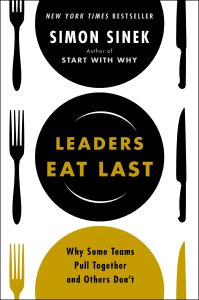
 Leaders eat last: Why some teams pull together and others don’t by Simon Sinek is a thoughtful analysis of many of the problems created and experienced by leaders and organisations in today’s world. It contains case studies, research, and biological and anthropological explanations for why successful organisations are those that create strong and safe communities. While this book is longer than it needs to be, and possibly over reaches in its biological and evolutionary claims, there is much to learn and relearn in this analysis of human interaction. Leaders of all types, whether in families, business, churches, government or other organisations, will do well to review their leadership in the light of Leaders eat last. I’ve personally found many points for reflection as I’ve be pushed to evaluate my leadership and the organisation (church) that I lead.
While the title is a metaphor for selflessness, it resonates literally with me. In 2002, as I became the team chaplain for the Brumbies Super 12 Rugby Team, I met the assistant team manager, Garry Quinlivan. ‘Quinzo’ is a retired customs officer who devotes his time to serving the Brumbies players and staff. He works without pay, spending long hours preparing, cleaning, checking up on, and sacrificially caring for everyone. Many things stand out about Quinzo, but one thing has struck me over the entire time I have watched him at work—he always eats last! Whether it’s a social BBQ, a drinks break, team lunch, or celebrating after a win—Quinzo always eats last. He gives everything for the team. And, in turn, people love Quinzo—they would do anything for this man.
Leaders eat last has constructive advice to leaders who preside over toxic work places. Watch how you lead—you may be the problem! Though of course, many selfish leaders would never consider themselves at fault. They don’t pause to reflect on the climate they are creating. The push for profits, the obsession with numbers, and the focus on short-term results mask the damage many leaders are doing to people. And then they wonder why their outcomes and results are so poor.
Sinek makes much of the importance of creating a circle of safety in the organisation. This idea is taken from Aesop’s Fable:
A lion used to prowl about a field in which four oxen used to dwell. Many a time he tried to attack them; but whenever he came near they turned their tails to one another, so that whichever way he approached them he was met by the horns of one of them. At last, however, they fell a-quarrelling among themselves, and each went off to pasture alone in a separate corner of the field. Then the Lion attacked them one by one and soon made an end of all four. (p20)
When we are part of a strong circle of safety, we naturally share ideas, burdens, successes, and we build a culture of collaboration, trust, and innovation. Good relationships are key to people surviving, let alone flourishing. A healthy organisation will be built on good relationships between colleagues. People grow in their trust for one another and become willing to do more for each other and the organisation. By contrast, organisations characterised by suspicion, fear, and distrusting micromanagement, are destined for decline and failure.
Sinek suggests a number of strategies that leaders can adopt to build a healthy, positive, relational culture in their organisations:
Rule 1: Keep it real—bring people together. Efficiency doesn’t always equal effectiveness. Emails, intranets, and on-line people management systems won’t necessarily build deep, trusting relationships. Trust is not formed through a screen, it is formed across the table. It takes a handshake to bind humans … and no technology yet can replace that. There is no such thing as virtual trust. (p111)
Rule 2: Keep it manageable—obey Dunbar’s Number. Anthropologist Robin Dunbar has found that people are not able to maintain close relationships with more than 150 people at a time. Traditional societies around the world tend to be organized in groups of 100 to 150. Larger groups require clear lines of organisation and specialist care to encourage cooperation and healthy relationships to develop. I suspect it is no accident that many churches seem to get stuck, never growing much beyond 150 people.
Rule 3: Meet the people you help. Fund-raising workers who have personal contact with the people they help have far more success. We work harder and better when we can see our potential impact. If we are focused purely on names and numbers, then morale drops and the organisation suffers.
Rule 4: Give them time, not just money. Research has shown that we place a higher value on time than money. Giving time, attention, and energy builds relationship, fosters community, creates trust, and encourages loyalty.
Rule 5: Be patient—obey the rule of seven days and seven years. Building relationships of trust takes time. Gauging someone’s fit in an organisation or in a relationship takes longer than the time that we typically give it: ‘more than seven days, but less than seven years’.
Sinek teaches that becoming a leader involves the key ingredients of love and trust. Leaders must model and grow organisations shaped and characterised by care and strong relationships. They should work to provide safe environments for their workers to enjoy being productive.
It’s not hard to see the relevance of this book to many workplaces and community organisations. Many of us have experienced difficult work environments where the CEO or the boss is a large part of the problem. The drive for profits often leaves a wake of departures and problems for the organisation.
As a pastor, I see a number of lessons for myself and my colleagues. If churches focus on growing numbers, budgets, buildings and the like, then we can forget that we should be primarily about the love of God and a love for people. I’m called to put others before myself—to be a leader who eats last. Jesus is the great example of the one who did not come to be served, but to serve, and to give his life as a ransom for many (Mark 10:45). In a sense, I don’t need the wisdom of Sinek—I need the vision and example of Jesus. However, it doesn’t hurt to be reminded by whatever means. If God can teach people through an ass, then he can certainly challenge me through a popular leadership book!
The sad reality is that there are too many people who’ve been hurt by their churches. I regularly meet people who feel they have been neglected, rejected, abused, or betrayed by their church or their leaders. This many be a one-sided analysis (it’s much easier to see how we’ve been hurt, than how we might have hurt others) but it’s a reminder to stay in touch with what the church is intended to be—the body of Christ, shaped by his love.
Leaders eat last has encouraged me to do some self-reflection. Is my leadership offering care and protection to those entrusted to me? Are we building a church community where it is safe to be weak and vulnerable? Are people more important than processes? Is maturity more valued than money? Where are my blind spots as a leader? What do I need to change or work at?

 From time to time I plan to link to some helpful articles and ideas that I’ve been reading, This is my first instalment…
 macarisms