
Dear Dad,
I’m writing to ask you to send me money so I can come home. I’m sorry for leaving and all the other stuff.
There’s a lot I’ve wanted to say for a long time. You don’t know how many nights I’ve cried myself to sleep. Though much of the time I have not gotten much sleep because I’ve been forced to live in a barn. And a pig bit me. Talk about painful.
I’ve made a mess, but not everything has been my fault. You know me. I’ve always been too trusting of people. I tried to help some guys out, but they weren’t who I thought they were … then I was mugged. I nearly died. It was the worst pain ever. I woke up in the gutter. I didn’t call because I didn’t want you to worry. By sheer determination, I was able to crawl to a nearby farm which was the start of the whole pig business …
Like I said, there is so much we need to talk about. My elder brother is a narcissist, in case you didn’t know. He checks all the boxes. Whenever you were not around, he said the most cruel and horrible things to me and constantly gaslighted me. I will never tell you what he said about you and Mom. Even writing this triggers me.
Besides, I know when Mom sees my ear (that’s where the pig bit me), she will feel terrible. So I tried to stick it out. I wasn’t going to be a quitter.
My therapist, who is a Christian, helped me to realise that I was self-medicating. She told me that I should say this to you. Here it goes. I’ve never felt like I was good enough. Don’t get me wrong. I know that you had to discipline me. But no one is harder on me than me. I’m struggling to forgive myself, and I talked to my therapist and now realise that the way you and especially those hypocrites at church went about confronting me was wrong. I know you didn’t mean to be abusive. I just wish it could have been handled in a Christian way. But I’ve forgiven you.
Anyway, when I asked you for my inheritance, I wanted you to tell me no, but you gave it to me. So I didn’t really have any choice but to leave.
I’m not going to tell you everything that happened at church, but I hope that guy is no longer a pastor. I talked to another pastor who said that what that pastor did was no way to shepherd people. My therapist has made me promise that I will not return home unless there are boundaries in place with my brother and, obviously, I will be looking for a different church situation once I have healed.
I feel so bad for what you and mom have gone through. I’ve cried until I didn’t have any tears left. But I know that as a Christian, you will forgive me and receive me back. I am willing to work to pay you back and that includes managing the guys in the field. I’ve never gotten over how much direction they need.
Anyway, could you send me the money soon? I have a few things to take care of and then I’ll come home. Love to Mom. I’ve never stopped missing and loving her and would do anything for my family. I can’t wait for roast beef.
You’re sorry son.
(Chris Brauns, The Way of Repentance, pages 148-150)
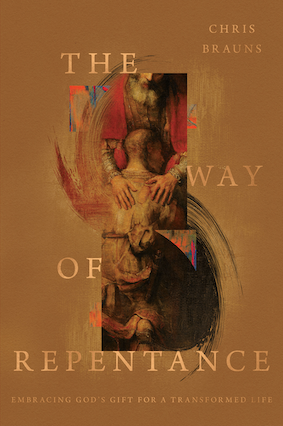
I must admit that I’ve never read the Parable of the Prodigal Son quite that way before. But I wonder if this is the likely reality for today. We’ve all heard fake apologies, like “I’m sorry if you feel hurt”. It seems that our politicians have made this an art form. But blame-shifting isn’t a modern phenomenon. It’s been around since the garden of Eden. It’s the modus operandi of the ancient serpent, the deceiver, the original arch-enemy of God.
The Way of Repentance by Chris Brauns is the first book I have read on the topic of repentance. And I am so thankful that I have. Brauns shines a light on the Scriptures and helps us see what things look like in practice. He highlights the fundamental differences between doing penance and being repentant. The former is a work that we wrongly believe will earn God’s favour. Repentance, on the other hand, is a gift from God in response to his favour.
One issue that Brauns helpfully explores is how to tell when repentance is genuine, and not just the shame of being caught out. It’s easy to say we are sorry, but another thing to resolve to change how we relate to another. The Apostle Paul described a godly sorrow that leads to repentance, salvation and life with God. He contrasts this with a merely worldly sorrow that involves no change of heart and leads only to death. (2 Cor. 7:10)
This book begins with a basic definition of what repentance is.
Repentance means turning from unbelief to belief in Jesus …an about-face of mind, heart, and will from sin to Jesus that results in bearing fruit.
(Chris Brauns, p9)
Brauns places repentance at the heart of the Christian life. As one of my mentors, Chappo, taught me, every part of the Bible calls me to the same two responses–faith and repentance. Each time I read God’s Word, study it, remember it, or hear it preached, it’s another opportunity to trust God and change the way I live. To turn from my way to his way. Both faith and repentance are gifts from God. This doesn’t mean we don’t exercise real faith or real repentance. It just means that if we are going to exhibit deep and genuine and lasting change, then God must be at work in us .
I’m so glad that I’ve read this book. The cover makes it look like it might be a difficult, detailed, and even technical book. It’s not light and bright. But don’t judge this book by its cover. I’m glad that, after so many years as a Christian, I’ve finally read this book (even if it did only get released in March 2026). Perhaps, you should read it too.


Thanks for this review Dave. Really helpful topic.