The Friend who Forgives

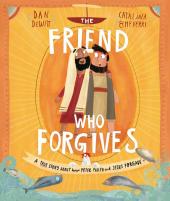
forgiveNow that I’m a grandpa, I’m on the look out for great kids’ books. We’ve still got a few at home that our kids haven’t taken with them, but we’re keen for some new ones for when the grandkids come to visit. So I was pleased when the The Good Book Company sent me a new children’s book to review. It’s The Friend who Forgives: A True Story about how Peter Failed and Jesus Forgave, written by Dan DeWitt and illustrated by Catalina Echeverri.

Firstly, this is a beautiful book. The pictures are captivating—not just for kids, but adults too. They are lively, funny, colourful, and expressive. And the words, too. They’re written in a clear, simple, conversational style, that works for adults and children. The listener is drawn in with the occasional question. And most importantly, it’s beautifully theological. It introduces the readers and listeners to the wonder of Jesus’ forgiveness.

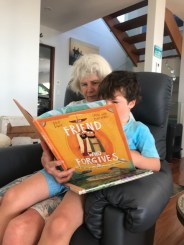
IMG_1171We tested the book yesterday with our nearly five year old grandson. He’s not reading yet so Nona read it to him. He listened intently, answering appropriately, and told me he enjoyed it at the end. We’ll read it to him again, next time he comes over.

But this is a review and not the ramblings of a grandpa. I need to mention the inside back cover. It helpfully reminds the readers that this is a ‘tale that tells the truth’. DeWitt explains that this story is taken from the New Testament Gospels. This is God’s revealed will. It’s anchored in history and it has significance for us. I think it would be worth reading the account from an easy-to-read Bible with the children from time to time, so they make the connection with the Scriptures.

I do have one concern about this book. It uses the words ‘forgive’, ‘forgave’, ‘forgiven’, ‘forgiveness’ without giving an explanation of what the word means. Not all words need explanation, but I think this one does. It’s central to the book and our grandson couldn’t tell us what it meant. When we thought about it, we realised that it is a difficult word to define simply. I recommend that you work out a simple explanation of forgiveness to share with the children who read this or have it read to them. Perhaps, you can think of an example or two they will quickly understand or identify with. Maybe, the author could add another page at the start or back, with a ‘For the reader’ section, defining and describing forgiveness.

For now, why don’t you make a comment or suggestion on this post. How would you explain forgiveness to a five year old?

Caring for One Another

caringWho of us wouldn’t want our churches to be genuine communities of meaningful, caring relationships? Perhaps this is your experience already. People invest in each other, they look out for one another, they show genuine interest, they seek help, they ask what they can pray and then they pray. They do more than offer support to others, they show deep empathy, compassion, and practical care. Maybe this is a bit of overreach, but you see glimpses of it and you want it more and more. Right?

If you’re a pastor or church leader, there is a danger of burning out due to the endless expectations that people place on you. Are you tired and weary from being expected to be the ‘minister’ to everyone? Do you wish that some other people would step up a bit, or that other leaders would share the load? Do you long for a community where everyone is looking out for one another?

Or are you getting disappointed that ministry has become more and more like social work? Are you worried that people’s health and finances and relationships are what seem to matter most? Do you lament the lack of spiritual engagement between people throughout the week, and worry that Sunday conversations rarely get beyond small talk?

Let me offer a suggestion for taking things deeper.

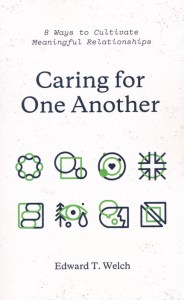
Ed Welch has released a new book called Caring for One Another: 8 Ways to Cultivate Meaningful Relationships. Get yourself a copy, read it, and start getting those around you to buy in. Following on from one of his previous books, Side by Side, he provides a simple and practical resource for equipping Christians for real interpersonal ministry. It’s a brief book—8 short chapters that get us thinking about how to encourage each other to live in the light of the gospel of Jesus. There are great ideas, Biblical foundations, practical recommendations, and each chapter finishes with questions for discussion and application.

This book is intended to be read with others. I can see it providing a good tool for one-to-one meetings with key leaders, or in small group leader training, or with a pastoral care team. It’s not specifically a book for leaders—it’s intended to mobilise everyone in the church to be encouraging and building each other—but I’d start by working these things through with leaders and then mobilise them to equip others.

Welch’s book is less of a ‘how to manual’ and more of a ‘keys to the heart’ guide—but practical and hands on nonetheless. He shows deep understanding of God’s part and our part in God’s work of changing people. Humility, prayer, understanding our weaknesses and sin, reflecting carefully on suffering, and knowing the power of God and the gospel are all critical. Caring for One Another moves well past the theoretical. It aims to grow intentionality and to activate us in relationship with each other. It’s grounded in a deep understanding of how people tick and it’s littered with great ideas and suggestions for making things happen.

I’ve read through this book quickly, but I plan to go over it again, and probably again, and again, by reading it with others. I recommend you do too.

Welch writes in his closing:

Caring for One Another has identified ordinary features of person-to-person engagement. There is nothing new here. The purpose has been to remember and live out applications of the gospel of Jesus Christ. But in that, the very power of God is further on display, and the church is strengthened and drawn together. (p67)

Fellowship or denomination

helena-lopes-459331-unsplashSome of us have been on a date, a third date to be precise. It’s been a date of ‘fellowships’, or should that be ‘denominations’. The Fellowship of Independent Evangelical Churches has gone out with the Fellowship of Evangelical Churches of Australia. We had three leaders of each group meeting, listening, talking, exploring, wondering what it might be like to be in ministry together. Two of their leaders attended our national conference, then two of our leaders shared in their conference. We’ve begun to explore matters of unity in the gospel and what matters are non-negotiable when it comes to getting hitched. There has been much to thank God for and there is much more yet to be considered.

There have been lots of questions in the mix, but I’d like to focus on one in particular. It’s an issue that has concerned both groups at different times and, in some cases, has led to a separation and parting of ways between churches. It has to do with whether our groups are ‘fellowships’ or ‘denominations’ and how that might be expressed in financial terms. The mindset of some appears to be that ‘fellowship’ is good, but ‘denomination’ is bad. Perhaps there have been fears of centralism, external controls, wasted resources, inertia, growing bureaucracy and the like. If so, then these are legitimate concerns and need to be taken seriously.

To put a sharp edge on it, if a fellowship gathered fees from its members, would that make it a denomination? Is giving money to the centre so as to resource the ministry of the fellowship a step too far? Does it boil down to taxation, socialism, control, establishment, or some other negative idea?

It strikes me that we need to renew our understanding from the scriptures. But we wont get very far searching for ‘denomination’ in the Bible. We’re better off looking in a good dictionary. ‘Denomination’ is literally concerned with naming things or designating something. It can be used of different categories. For example, when we speak of denominations of bank notes, we are describing notes with the same value and appearance. Likewise, a denomination of churches could be simply a collection of churches that share a name and the same values. Our government recognises formal denominations in this way, and affords certain privileges and sets obligations and expectations accordingly. The reality is that both the FIEC and the FECA are denominations.

What about fellowship? I grew up with a weak understanding of what ‘fellowship’ meant. Sometimes it meant having a coffee and biscuit after church. Other times it seemed to be a name given to a group that was more fun than work—a fellowship group rather than a Bible study. But the Bible offers us much greater clarity when it comes to understanding ‘fellowship’. The word for ‘fellowship’ in the Greek New Testament is koinonia. It appears in English versions translated variously as ‘fellowship’, ‘sharing’, ‘participation’ and ‘contribution’.

The book of Philippians is a good case study for the use of ‘fellowship’ because the word appears on six occasions. Each highlighted word below is a translation of koinonia in the New International Version:

In all my prayers for all of you, I always pray with joy because of your partnership in the gospel from the first day until now (1:4-5)

It is right for me to feel this way about all of you, since I have you in my heart and, whether I am in chains or defending and confirming the gospel, all of you share in God’s grace with me. (1:7)

Therefore if you have any encouragement from being united with Christ, if any comfort from his love, if any common sharing in the Spirit, if any tenderness and compassion,  then make my joy complete by being like-minded, having the same love, being one in spirit and of one mind. (2:1-2)

I want to know Christ – yes, to know the power of his resurrection and participation in his sufferings, becoming like him in his death, and so, somehow, attaining to the resurrection from the dead. (3:10-11)

I know what it is to be in need, and I know what it is to have plenty. I have learned the secret of being content in any and every situation, whether well fed or hungry, whether living in plenty or in want.  I can do all this through him who gives me strength. Yet it was good of you to share in my troubles. (4:12-14)

Moreover, as you Philippians know, in the early days of your acquaintance with the gospel, when I set out from Macedonia, not one church shared with me in the matter of giving and receiving, except you only; for even when I was in Thessalonica, you sent me aid more than once when I was in need. (4:15-16)

We discover some profound and powerful things about ‘fellowship’ in Paul’s letter. Fellowship is a unity in the Holy Spirit. It’s a reality of being Christian that we are united to brothers and sisters in the gospel. God’s work in us means that we arein fellowship together. All Christians are joined together in having received God’s grace. We are brought into partnership with others from day one of our new life in Christ. So fellowship is first and foremost not something that we create, but a gift from God in the gospel.

However, expression of this fellowship can be sought, developed, offered and maintained. It is to be given observable and practical expression. Paul seeks to share in Christ’s sufferings and he is united with fellow believers who are similarly focused. He was in physical need, not discontented, but definitely in need. And the Philippians showed him fellowship. Their fellowship with the Apostle cost them as a church. It meant giving gifts and aid to their brother. In other words, sharing resources was what fellowship looked like. It’s a fundamentally Christian attitude and behaviour.

It seems bizarre, therefore, to oppose churches giving money to each other, or committing together to provide common resources for gospel work, or ‘giving to the centre’ to help the gospel work grow and develop in health and numbers, or setting fees to share the costs of working well together, or taking up a collection to assist other churches. Yes, we are to be careful and prudent with our funds. No, we don’t want to throw money away or waste it on bad ideas. But sharing money doesn’t tip us into becoming a ‘denomination’—it’s simply what Christians and churches and fellowships do.

Resilience – A Spiritual Project

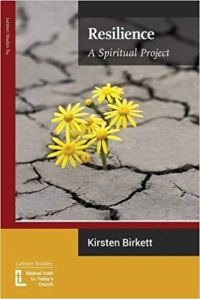
resilienceResilience and burnout are big issues in work and ministry at present. In the field of Christian ministry the statistics of burnout seem alarmingly high and the focus on building resilience is both urgent and important. Kirsten Burkett has provided a great service by sharing her research into these areas in her latest book Resilience: A Spiritual Project. This isn’t a popular level book. For a start it’s published by The Latimer Trust, as the 84th of their brief academic studies. While only being 46 pages in length, it includes another 9 pages of bibliography, comprising mainly of academic journal articles. But don’t let these things put you off. Resilience: A Spiritual Project is compact, yet thorough, and I found it engaging and easy to read. While much of her book is surveying and summarising findings in the literature, Dr Birkett draws us to practical conclusions with profound pastoral implications.

Dr Birkett writes as an experienced researcher, academic, author, and teacher. However, she does this in sync with her experience of grappling with burnout herself, and with an eye to equipping men and women in pastoral ministry. She understands the particular dangers and threats for those engaged in a profession where resilience is needed to fuel perseverance and endurance. Most profoundly, Dr Birkett draws on the wisdom of the research to argue that resilience ‘can be learned’ and ‘people can be trained against future stress’ (p17). She is also careful to emphasise that resilience is not a cure all. Sometimes people are simply tired and need to slow down, rest, or take time out. Other times people are overwhelmed by sadness, grief, or trauma, and just need time to weep and mourn. However, she writes:

If we keep resilience in perspective, as ways of helping healthy people stay healthy and of helping ill people recover, it seems to be an extremely useful construct. Human beings are resilient — we could hardly have survived this long otherwise. (p25)

Dr Birkett demonstrates in her book that there are significant overlaps between resilience research and Christian spirituality. Many features identified in the literature as important in building resilience, find expression in biblical expressions of Christian faith in action. She examines the following areas:

  • Adversity leads to strength
  • Sense of meaning and purpose
  • Transcendence
  • Hope and optimism and positive emotions
  • Altruism
  • Self-efficacy: God efficacy
  • Forgiveness
  • Social network

If you have a good understanding of the life of a Christian then you will hear the resonance already.

We believe that God works to strengthen and transform his people through adversity. Suffering is not to be sought after, but it is to be expected. ‘What people need, it seems, is not a stress-free life, but the framework to treat stress well; to use it as a stimulus for growth, rather than buckling under it’ (p33).

We believe that we have been created for a purpose, essentially for Jesus Christ (Colossians 1:16). We are not the product of chance and time. There is meaning, purpose, significance, and eternity. We may not always understand our suffering but God, in his wisdom, uses it to produce good (Romans 8:18,28).

We believe, not in some external transcendent force, but in a God who is accessible and invites us to come to him in our times of need. God has come to us in the incarnation of Jesus. God dwells in and among his people by his Spirit. We have access to God through the death and resurrection of his Son, and so we are invited to come before him in prayer, and present our requests to him rather than staying isolated in our anxiety.

We believe there is good reason for hope. Our faith is built on hope in the promises of God. God has shown he is faithful in Christ Jesus and because of this we can have joy even in the midst of suffering (1 Peter 1:3-7).

We have deep reason to love others. We did nothing to deserve it, but God has loved us, at enormous cost, through the atoning death of Jesus. This leads to a purposeful altruism, motivated by God’s work in and through us. At the heart of this is power and willingness to forgive those who have wronged us. We can shed our anger and avoid bitterness.

We believe, not in self-efficacy, but in the efficacy of God. There is honesty in Christian understanding that we are not equal to all tasks. We don’t need to be demoralised by our continual sub-par performances. We’re not required to grow super powers. Our sovereign God knows our needs and will accomplish his purposes for our good. This is stress-relieving.

We believe that God has given us a community. We are adopted into his family and called to love our brothers and sisters. Hospitality and care are part of the fabric of our relationships.

You see, in other words, God is in the business of building resilience in his people. How then should we train Christian ministers for resilience? Dr Birkett nails it with her insight:

It would seem we do so by training them to be Christian. (p38)

Read that again! Building resilience comes from Christian discipleship.

Building resilience in Christian leaders isn’t simply the domain of Christian psychologists, as important and as helpful as they can be. It should be the fruit of putting a deepening understanding of God and his ways into practice. It should come as we soak ourselves in the Scriptures and turn to God in prayer. Resilience should be the outworking of good doctrine and faith working itself out in love. There are no silver bullets, no secret elixirs, when it comes to avoiding burnout. But, as God’s children, we have a Father in heaven who knows us, loves us, guides us, equips us, heals us, and sustains us. Let’s turn to him in our hour of need.

Resilience: A Spiritual Project is a word in season.

Serendipity or God works in mysterious ways

God works in mysterious ways.

q400A fortnight ago I boarded a plane for Sydney in order to speak at the Managers Conference for Koorong Books. They wanted me to speak devotionally and to share about Hope Beyond Cure. My plans had been to shut my eyes and add a little sleep after what had been a very busy fortnight in New Zealand. But it wasn’t to be.
The woman in the seat beside me asked what I would be doing in Sydney. I replied that I was planning to speak at a conference about ‘How to find hope in the face of a terminal diagnosis’. At this she choked up, and began to share with me that her husband had died only weeks before. Her grief was palpable as she described the heartache and devastation on her family.

She asked my how I came to be speaking on this topic and I shared that I’d received a terminal lung cancer diagnosis a few years back. We talked for a while and shared a connection through the heaviness of our conversation. I wanted to be able to offer her a copy of my book, but I didn’t have one with me. Why would I? I was off to Koorong Books!

As the flight continued, we talked through many shared experiences. I told her of my struggle with cancer and also the challenges to my faith in God. As I described the context of my circumstances, something clicked for her, and she asked me whether I had written a book.

“Yes”, I said.

“Is it just a small book?”

“With a black cover?”

“With a picture of someone in a tunnel?”

“Yep, that’s it”, I said.

When hearing of her husband’s diagnosis, her aunt had sent her a copy of Hope Beyond Cure, which she then read to her husband each day in hospital. They both found it encouraging and hope-filling. She said that she wasn’t religious, but something deep struck a chord with them.

She wept at the serendipity of sitting beside me in the plane. Who’d have thought? What were the chances? She asked if we could get a photo together to show her aunt. She lives in Victoria, but her aunt lives close to us and works in the local Op Shop. I’ve since popped into the Op Shop, met her aunt, and thanked her for sending the book.

I continue to thank God that this book is helping people. And I thank him for connecting the two of us on the plane.

Black Box Thinking

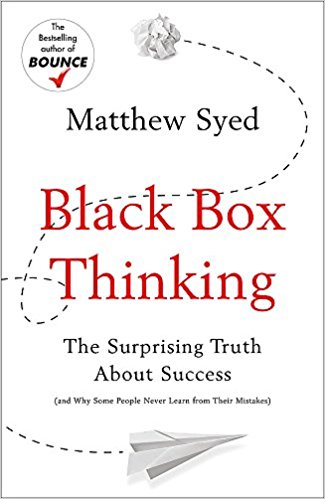
blackboxYes, I’m trying to get my writing mojo back. People say the way to start writing is to start writing. People are profound sometimes! So back to reviewing a few of the books I’ve been reading. This book was recommended to me by a friend who suggested it might be helpful to leaders in our network around the country.
Black Box Thinking: The surprising truth about success and why some people never learn from their mistakes by Matthew Syed identifies some important blind spots. People are always telling us that we should learn from our mistakes, fail forward, and change the way we go about things so that we keep on improving. The problem is that we so often repeat our mistakes, get stuck in ruts, and fear making changes.

This book takes its title from the little black boxes fitted to aeroplanes. I understand that planes are fitted with devices to record the electronics of the aircraft and to record the interactions of the pilots. These devices are stored in ‘indestructible’ black boxes that can be retrieved in the case of accidents. Apparently these black boxes are now orange, not because orange is the new black, but because orange boxes are easier to locate when rubble is scattered far and wide. What a great example of black box thinking!

Going back to 1912, plane crashes were considered normal and inevitable. Half of US army pilots died in air crashes, even during peacetime. Fast-forward to today and plane travel is one of the safest means of transport. There are very few deaths and the accident rate is about 1 in 2.5 million flights. There are many reasons for this tremendous improvement, but at its core there is a mindset in the aviation world that says, “We must learn from our mistakes.” The black box is a tangible expression of this attitude. When something goes badly wrong, it must then be examined with a fine tooth comb to make sure such mistakes don’t happen again. This is a life and death imperative.

This mindset is not seen everywhere else. People are reluctant to own up to their mistakes. We’d prefer to rationalise things, pass the blame, gloss over what has happened, and avoid scrutiny or accusation. Human pride gets in the way. Syed contrasts the slowness of the health profession to learn from mistakes with the progress of the aviation industry. When doctors make mistakes they get hammered by litigation, public shaming, deregistration, increased insurance costs, and the like. So who wants to admit fault? In both arenas, people’s lives depend on learning from mistakes and making changes to avoid things being repeated.

I depend greatly on the proficiency and safety of both the medical and aviation sectors. Both these areas matter to me. But there are other lessons I am interested in. As one who now leads are network of churches, or denomination, I am concerned about the systemic failure of churches to learn from their mistakes. The recent Royal Commission into institutional child abuse, has reveal some appalling accounts of denials, cover ups, and codes of silence. Black box thinking requires the truth to be revealed, serious questions to be asked, and future problems avoided.

We need to learn from our mistakes. Even more so, we need to repent of our blatant sin. The problem with sin is that it leads to shame and so we cover ourselves. We’ve been doing it since the beginning. God calls us to confess our sins, to be honest with one another, to take heed of our failures, and to spur each other on to love and good works.

But it’s not simply in the areas of heinous sin that we need to develop black box thinking—it’s in the day to day of our ministry. It seems that many churches are trapped in patterns of mindless repetition. Q. “Why do we do what we do?” A. “Because that’s what we’ve always done.”  And we wonder why people have stopped coming!

Whether it’s church, school, business, club, or whatever, we need to keep thinking about what’s not working, why it’s not working, what needs to change, and how we can change it. Review should me commonplace and regular. Action—reflection—reaction should be our normal pattern. Failures should be seen as opportunities to make changes for the better. Mistakes should be valued as triggers for improvement. You’ve probably heard the Michael Jordan stories of countless missed shots, errors of judgment, lost games—all viewed as opportunities to learn, grow, succeed, and become arguably the greatest basketball player in history.

Syed challenges the popular view that success is primarily based upon innate qualities such as talent and intelligence. He describes this as a Fixed Mindset. He argues that we need to develop a Growth Mindset, where success can be achieved though dedication and hard work. People are capable of achieving more if they are willing to learn and make changes and if they are willing to practice until perfect.

In my world of Christian ministry I want to make a plea for black box thinking. Let’s learn from our mistakes and failures. Let’s ask the difficult questions. Let’s normalise reviews and feedback. And this will require humility from everyone, and especially from pastors and leaders.

Allow me to illustrate with 7 suggestions for black box thinking for pastors:

  1. Pastors would benefit from professional supervision. Taking timeout to reflect and learn from our practice will improve our ministries. Find someone who can speak into your circumstances and help you to develop black box thinking.
  2. Pastors should seek feedback on their sermons from people they trust. I’ve heard depressing tales of ministers unwilling to provide support and feedback to their trainees because they won’t accept critique themselves.
  3. Pastors can build a culture of learning from mistakes by reviewing what they and the church do on a regular basis. Go with the natural rhythms. Monday is a good time to review the services on the weekend—what worked, what didn’t, what could be done better next time? Once a quarter would be a good time to make adjustments to our regular programs. Why not introduce a major annual review, such that every year things change and grow for the better?
  4. Pastors could organise to get together with peers from time to time to share successes and failures. Being open with one another builds a culture of humility. Iron sharpens iron. You can learn from one another’s mistakes and avoid falling in the same traps. Go to a conference or two where you can learn from others.
  5. Maintain the discipline of reading books that will keep building your competencies. Begin regularly with the Bible and ask God to deepen your love and understanding of him. Read a commentary to enrich your understanding of the Scriptures, something on leadership to challenge your practice, a book on culture to evaluate how well you understand your world, and so on. Ask others you trust what they have found useful.
  6. Become more thoughtful. Think about your thinking. Keep some notes and look back over them. Journal lessons you have learned. Set goals for change.
  7. Pray. Ask God to shine a light into your thinking, feelings, emotions, relationships, decisions, plans. Look into the ‘black box’ of God’s word and make the necessary changes.

Do not merely listen to the word, and so deceive yourselves. Do what it says. Anyone who listens to the word but does not do what it says is like someone who looks at his face in a mirror and, after looking at himself, goes away and immediately forgets what he looks like. But whoever looks intently into the perfect law that gives freedom and continues in it – not forgetting what they have heard but doing it – they will be blessed in what they do. (James 1:22-25)

Thinking, Fast and Slow

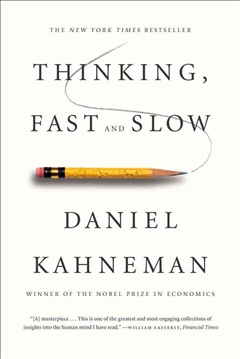
thinkingI could never have imagined myself reading a book by a Nobel Prize-winning economist, but I have, and to my profit. Daniel Kahneman’s Thinking, Fast and Slow has helped me understand more about how I think, make decisions, communicate, and respond to the words and actions of others.
His basic idea is that we have two different modes of thinking and processing information. The first mode is automatic and impulsive. It’s our knee-jerk response that enables us to take short cuts and move on with ease. The second mode is more deliberate, focused, logical, and it’s necessary for making truly wise choices. Some of us tend to react instinctively, go with our guts, and sometimes miss things that are critical. As an ENFP (Myers-Briggs Type), I’m one of them. People need to spend most of their time in the first mode because we haven’t got the time or the stamina to carefully examine every decision we make. Some things just need to be automatic. However, we can become lazy thinkers, and take short cuts when we shouldn’t, and not slow down when we really should.

We are all prone to making snap choices—weighing up people and situations in an instant. We oversimplify, latching on to something we like and assuming that we will like everything. This can lead to major errors in judgment. Let’s say I’m considering someone for a job. I learn that they love fishing, camping and four-wheel driving. This leads me to gravitate towards them. We spend time chatting about our common interests, places we’ve been, experiences we’ve had. I like them. Hence, there is now a bias toward preferring this person regardless of what experience they might have had in the job, how competent or incompetent they are, whether they are a team player or prima donna, or any other critical criteria. This has been called the halo effect. We assume they will be good even though we know very little about them.

Similarly, I might know some details about a person, such as where they trained or who they’ve worked with previously. I associate what I know about them with an ideal that I’ve created. If I’ve had positive experiences with the people they know or with the training organisation they come from, then confirmation bias may lead me to make assumptions about them and not do due diligence to get more relevant information specifically about them. I wonder how many people employed on the ‘it’s not what you know, it’s who you know’ principle, have turned out so differently to what was expected. Taking short cuts might save time in the short term, but may lead to drawn out disasters in the longer term.

Kahneman discusses how we perceive statistics, memories, risks, choices, and more. He shows how our perspective shapes how we respond to things. For example, if a shopkeeper is told that there is a 1% chance that someone entering her shop will be a shoplifter, then she might not worry too much. But, if she was told that of the 1000 people who will come through her shop this week, 10 of them will be shoplifters, you can imagine she will be on high alert for who they might be. The statistics are identical but each statement offers a different perspective.

Context is also important for weighing decisions. If two people are both promised that by the end of the year they will each have a net worth of $100 million, then you’d expect them to be equally happy, wouldn’t you? If one of them was me, I’d be ecstatic. Who wouldn’t be happy with $100 million? If I told you that the other person was Mark Zuckerberg, whose current net worth sits at $75 billion, you can see how context changes everything!

These insights will help us to be more effective communicators. Pausing to consider how people might ‘see’ what we are saying, will move us to take the extra step to get our message across more clearly. So often we think if something has been said then it’s been heard. But is their perception the same as our intention? It pays to be clear and it pays to enquire as to whether we’ve been understood.

Thinking, Fast and Slow is a book to get us thinking about our thinking. While much of what we do needs to be quick and automatic, there are some areas where we need to disengage cruise control and put our minds into manual. In my work as a church pastor over many years I can see times when I took the lazy option and endured the consequences of not thinking hard or long enough. Now, I watch others fall into similar errors of judgment. While we know there is always more than meets the eye and we shouldn’t judge a book by its cover, we get lazy, we’re attracted by the short cuts. I hope that I will grow in wisdom, be a better judge of people, make smarter decisions, and communicate for effectively, as I seek to think both fast and slow.


My Donkey Body

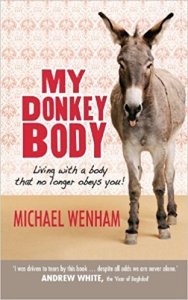
It’s a small world, sometimes. Last weekend Fiona and I were camped in the shearers quarters at Lake Menindee, together with the members of Saltbush Church from Broken Hill. We hadn’t been there before and it’s quite a while since we were anywhere so remote. Over breakfast I met John Wenham, and I jokingly said that I had a few books written by him at home. Turns out that I had read books by his grandfather of the same name, also a few by his dad, and a couple by one of his uncles. I’ve since read a book by another of his uncles, Michael Wenham, called My Donkey Body: Living with a body that no longer obeys you. Wow, so many books in one family!

donkeyMy Donkey Body recounts Michael Wenham’s journey with a rare form of Motor Neurone Disease (MND). If you’re unfamiliar with this disease, think Stephen Hawking. The motor neurones that transmit instructions from the brain to the muscles deteriorate and cannot replace themselves. The brain keeps working but it becomes unable to get messages to the muscles to do their work. The person becomes more and more debilitated and eventually the muscles that keep you alive stop working. MND is a terminal illness and there is currently no known cure.

Michael Wenham is a Christian, who tells his story of discovering and living with this disease from the perspective of faith. My Donkey Body is a sad, gripping, and often humorous account of one man, together with his wife and family, coming to grips with weakness, disability, frustration, pain, and ultimately mortality. As a preacher, whose voice was his tool of trade, he recounts what it’s like to lose control over your vocal muscles. He shares about the humiliation of being picked up out of the gutter by strangers and relying on his wife to wipe his backside. There’s nothing romantic about MND.

I checked with Google and discovered that Wenham continues to blog, write articles, and he has done some very moving video interviews. Wenham has now been living with this disease for many years. While his physical abilities have declined, his mind has remained sharp. He engages with real issues of relationships, health, religion, dependence, living and dying. Wenham has engaged with Stephen Hawking and provided informed and sympathetic rebuttals to Hawking’s dismissive critiques of any afterlife. He has written against legalising assisted suicide for the terminally ill like himself.  He opposes the creation of human stem cells for the purpose of experimentation, even if it should provide the cure for MND. His arguments aren’t a bigoted bias toward regressive religion over against progressive science. Rather, they arise from one who knows suffering and mortality, but who deeply respects that all persons are made in God’s image. He demonstrates powerfully that people are not valuable according to their utility and value to society (however that might be measured), but because God has made them human. Every person matters.

Wenham argues for the importance of knowing God and having faith in God’s power and goodness. He’s prepared to ask the hard questions and admits to not having all the answers. Being a Christian doesn’t take away the pain or the suffering. He argues with CS Lewis:

Talk to me about the truth of religion and I’ll listen gladly. Talk to me about the duty of religion and I’ll listen submissively. But don’t come talking to me about the consolations of religion or I shall suspect you don’t understand.
(quoting CS Lewis A Grief Observed p23) in My Donkey Body p128

I am grateful that Michael Wenham took the time and made the effort to share his thoughts. Much of this book resonates with my experience of receiving a terminal diagnosis, coping with physical and mental pain, losing things that have shaped my identity, and asking questions of faith and doubt. Yet my circumstances have taken a turn for the better. Many of my disabilities have been replaced by renewed abilities. And that brings it’s own dangers and threats—especially the risk of forgetting how much I need God.

There is something about weakness that drives us back to our Father in heaven. I need to be reminded that this life is a gift from God. Every day is a day for rejoicing. Nothing should be taken for granted. The less I remember my dependence on God, the bigger an ass I become.

IMG_8818


Expositional Preaching

helmCoaching and playing don’t always require the same skill set. Not every player will make a good coach and not every successful coach will have been an elite player. Look at some of the men coaching gymnastics. It’s hard to believe they could have ever mastered the pommel horse or uneven bars for themselves, but they can be brilliant at training others.  The successful coaches are somehow able to deconstruct each aspect of each move, and train their athletes to weave their brilliance in seamless performances.

Every now and then we see a player with a deep awareness of the game. And not just their contribution to the game, but the game itself, and how every part works together. Steve Larkham, the Australian rugby great, was a player like this. He’d weave his magic and he’d create the opportunities for others to weave their’s. Larkham not only did, but he knew what he did, and he could pass this on to others. He coached as he played and it was no surprise to see him coaching after he stopped playing.

So what does this have to do with expositional preaching? Nothing. I just love gratuitous sporting illustrations!

Seriously though, many great preachers function at a very high level of unconscious competence. They communicate with clarity and depth. They shine a light on the riches of God’s word and they impress it on the hearts and minds of their listeners. We come away from their preaching with ‘our hearts burning within us’. But don’t ask them to train other preachers. They can’t even tell you what it is they do. They’re at a loss when it comes to coaching.

Recently, I attended a preaching coaching workshop at Moore College. I’m so glad I did. For me it was Preaching Coaching 101. Keep it simple. Break things down. Clarity. Simplicity. Specificity. Depth. Grace. Gospel. Theological. Heart. Mind. Affections. Motivations. Exegesis. Contextualisation. And more.

I love preaching, but I also love listening to great preaching. We need more and more passionate, humble, empowered, clear, focused communicators of the Word of God’s Spirit. We need people who will dig deeply into the text and fire it deep into the psyches of the listeners. We need preachers who handle the Scriptures with care and expect God to transform their listeners. This means both getting the message right and getting the message across.

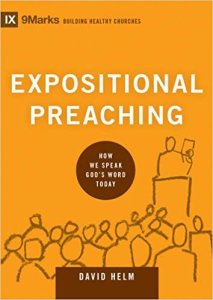
Enter David Helm and his sharp little book, Expositional Preaching: How we speak God’s Word today. Our coaching workshop leant heavily on Helm’s approach to expositional preaching. Helm has learned much from the likes of great preachers like Dick Lucas and Kent Hughes, and it shows. Like a master coach he has broken down the art of preaching so as to pass it on to others. Helm is persuaded that we need to do two things well: Get it right and get it across (p36).

I’ve listened to the audio book of Expositional Preaching and now I’m digging into it more thoroughly with my paper copy, and a pen and a highlighter in hand.

Helm addresses the dangers of merely coming to the Bible to find something that fits with what we want to say. He asks the question “Who will be king? Me? Or the biblical text?” Helm is persuaded that we must let God speak and not get in his way with our hobby horses or attempts to be ‘relevant’. This must involve careful exegesis and theological reflection, but it will also require an investment in careful communication. Helm covers both sides of this equation in his book.

Expositional Preaching provides an introduction to the necessary building blocks for preparing messages that will communicate God’s message to contemporary listeners. If I can shift my metaphors, Helm’s book offers us a recipe for preaching that is nutritious, well presented, and full of taste.

It’s probably aimed at new preachers—ministry trainees, students in theological colleges, people starting out on a lifetime of teaching the Scriptures. For me, it’s an excellent coaching manual for those of us who feel we can do, but who have trouble in identifying what we do and why we do it and how we do it. If we seriously want to equip people who are passionate and skilled in biblical preaching, then I recommend we recruit David Helm as our coach—or at least work seriously through his coaching manual.

Returning to the scene

IMG_8551It’s been an anxious week as I’ve anticipated returning to the exact place and the same event where I first noticed the symptoms of my cancer. It was the Geneva Push church planting conference and I was speaking on leadership, church planting, and the vision to reach Australia with the good news of Jesus. It was the end of November in 2011 that I climbed the three flights of stairs at Scots Church in Melbourne, stopping on each landing, completely breathless, not knowing that within a few days I’d be in hospital fighting for my life.
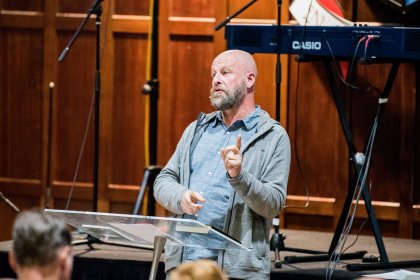
Fast forward six and a half years and here I am at Scots Church, speaking on ministry, team work, and persevering as a Christian, and listening to others teach about the urgency of sharing the message of Jesus with those around us. I walked the same stairs to get to lunch today, pausing on each landing and reflecting on the amazing kindness of God. Wow! Who’d have thought I’d be remission? But more than this, I mean the wonder that God cares so much as to reach out to us, send his Son to die for us, welcome us into his family, gather us together in unity, transform his children into the likeness of Jesus, and equip us to work together to build something that will last for eternity—the church of God. Not human institutions, but the gathering together of people belonging to him.

We’ve been reminded once again that God’s vision for this world is to restore broken relationships. Primarily our broken relationships as sinners to a holy God, but also our relationships with one another. In days where the church seems out of touch and past its use by date, we are encouraged to understand our world, to listen to others, to show kindness, love, and patience, as we seek every opportunity to share the amazing news of Jesus Christ. No, not religion—Jesus!

davemaccaIt’s a joy and honour to be able to gather with men and women, young and old, to spur each other on to reach Australia with the life transforming, eternally consequential message of Jesus. People are getting jaded by the endless cycle of meaninglessness promoted by our society. People are searching for meaning. Surely there has to be more that work, sleep, eat, over and over again. Or are we just caught up in an endless Groundhog Day?
Our scientific materialism has ripped us off. It can’t deliver answers to the questions that matter most. It doesn’t offer meaning or purpose. It leaves us rudderless, lost, and unsatisfied. No, the truth is there is much more to life. The transcendent, living, almighty God has entered our world in Jesus Christ. Jesus has shown us what it really means to be human. He’s taught us what life is all about. More than this, by giving his life for us, and through rising from the dead, he has placed God within reach. He’s made peace with God possible. He’s gathering people to himself. He’s planting, growing, and building churches—gatherings of weak, ordinary, forgiven people. People who deserve nothing but are given everything. That is such good news.

Thank you God for bringing me back—not simply to Scots Church and another church planting conference—but to you, to Jesus, to your family, to a certain hope for all eternity.

Do you need an echocardiogram?

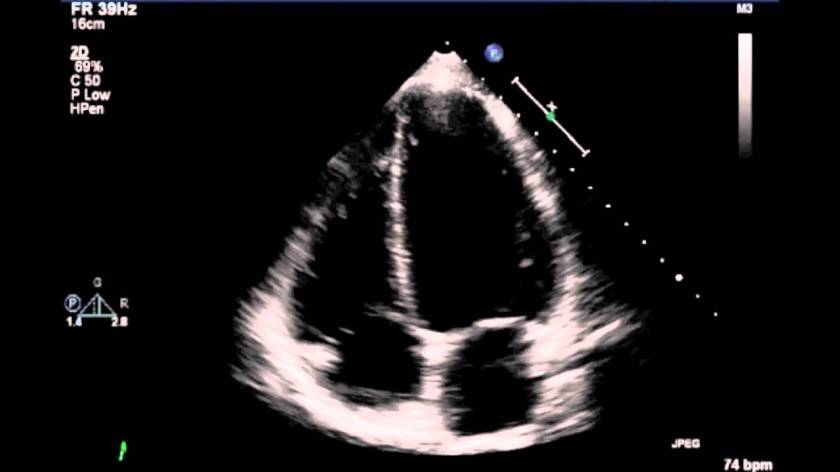
echoThis morning I had an echocardiogram. Don’t know what that is? Neither did I until this morning. It’s basically an ultrasound of the heart. This is one of a number of health checks I’ve had in recent months. Since it’s six years since I was diagnosed with cancer, and two years since I’ve had chemo, and since we’re planning on moving cities, we thought it wise to book in for a major service or two. So far, I’ve had the cameras in both ends and seen some of the damage chemo has left behind. I’ve managed to take on another ‘C’ disease—well developed coeliac. So we’ve had a pantry purge and I’ve started to become one of those difficult people who is always asking what’s in the food I’ve been given. I’ve had lung function tests and discovered that despite the beating my lungs have taken I’m sitting on the low end of average for a bloke my age. My bone density has been checked and I’m osteopaenic. Don’t know that word either? Well, it’s much better than osteoporosis and osteopathetic. I’ve even spoken to my first specialist, a lung physician, who was willing to explore another ‘C’ word—cure. I liked the sound of that one, but we can’t ever know for sure.
Back to the echocardiogram. They were checking the health of my heart. Occasional atrial fibrillation or arrhythmia. I’ve had it a few times over the years and I’ve usually been able to explain it away. But then the heart is one organ to take seriously. It was behaving itself today, but there was something a little remarkable. The echo showed that my heart has become somewhat hardened. The muscle has thickened. Probable causes are high blood pressure and insufficient exercise. Yes, I know what to do. More exercise, get the heart working a bit more. And slow down, relax, rest, recreate, de-stress. In other words, I mustn’t harden my heart any more than it is.

As I walked away from the cardiologist this morning, I remembered having heard something like this before:

12 See to it, brothers and sisters, that none of you has a sinful, unbelieving heart that turns away from the living God. 13 But encourage one another daily, as long as it is called ‘Today’, so that none of you may be hardened by sin’s deceitfulness. 14 We have come to share in Christ, if indeed we hold our original conviction firmly to the very end. 15 As has just been said:

‘Today, if you hear his voice,
    do not harden your hearts
    as you did in the rebellion.’

Hebrews 3:12-15 NIV

I need to pay attention to my heart. This muscle is indispensable to my continued welfare and existence. I can’t do without it.

But, more importantly, I must also pay attention to my spiritual ‘heart’—the centre of my being, my values, my conscience, my choices, my priorities. God is calling me to listen to his voice. Not some mystical connection found in solitary introspection, but his message of good news focusing on Jesus. The good news is that Jesus is the only one to live for, the one who deserves everything, including my complete allegiance. He has given his life for me, to rescue me from the futility and judgment that comes from living for myself.

When God reminds me of this fact, I mustn’t harden my heart against him. When my will aches for independence, when I simply want to do my own thing, when I’m tempted to despair, when I’m feeling that God is remote or irrelevant, then I mustn’t harden my heart. When the world around me is shouting that there is no God, and when consumerism keeps luring me to live myself, then I must listen to the true word of God. The voice that reminds me that my heart will never be satisfied until it finds its rest in God.

And I urge you too to listen to God. Take a look at your spiritual echocardiogram, get your spiritual heart checked, while you still can. Good heart health is smart and spiritual heart health matters even more.

6 AD

You know I’m a Christian, right? So BC and AD to me reflect the most significant events in human history: BC—before Christ and AD—anno domini (in the year of the Lord). It makes perfect sense to me to divide our calendars at this point.

So it is with humble respect that I claim another BC and AD hinge point in my own life. BC—before cancer and AD—after diagnosis. And today I reach 6AD. Today is my six year survival mark. It’s exactly six years since my friends ushered me from the coffee shop to the cancer journey. On 2nd December 2011 I was admitted to hospital and today I begin my seventh year of life AD.

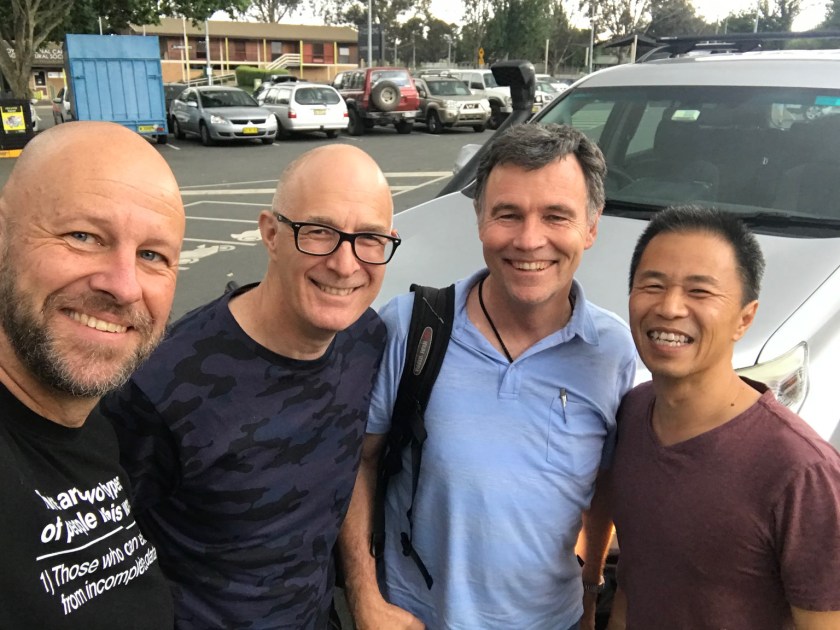
IMG_7390Yesterday I had the privilege of catching up with the same blokes who cared for me on that first day. As we have done every year, we drank coffee (or chai lattes and hot chocolates—we’re getting older), we shared stories, and we prayed for each other. Much has happened in this time. So much has changed. But the goodness of God remains. As I drove home, I found myself singing (yes, truly—and I believe I was even in tune!)
Through many dangers, toils and snares
I have already come
’tis has brought me safe thus far
and grace will lead me home

There have been so many dangers, toils and snares, and I am so conscious of God’s grace in all of them. God’s abundant kindness and mercy astound me. All of my bucket list prayers have been answered. I’m not supposed to be here—the doctors said so. And yet God has given me more days in this life to sing his praise.

But, you know, it’s not about me. The original BC-AD divide leaves my personal experience deep in its wake. The coming of Jesus Christ offers us forgiveness, life, and reconciliation. The sting of death has been removed. Hopelessness and despair have been replaced by joy and assurance. I can look forward in confident anticipation to an eternity with my saviour, not because of anything on my part. No, it’s all of grace, amazing grace. The same grace that transformed John Newtown, and William Wilberforce, and millions of others throughout the centuries. And you too can know this grace.

Heaven, how I got here

heavenI miss Chappo! Yesterday I saw someone reading one of his books and I felt a pang of grief. He was so good to talk with, to chat to about real stuff. He’d always keep pointing me to Jesus. He loved Jesus and wanted nothing more than for others to love him too. Chappo might not be here—that’s because he is now with the risen Jesus—but I still have his books. My favourite is A Fresh Start. It’s clear, fun, engaging, serious, Biblical, and helpful, all rolled into one. It’s a great explanation of what a Christian is and how you can become one.

It got me thinking that we could do with some more books like A Fresh Start. It’s a while since I’ve read a simple and engaging book that explains the significance of Jesus and calls people to respond.

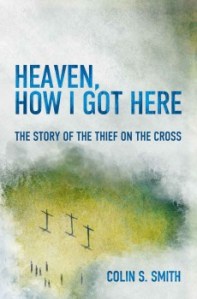
Last night, Good Friday, I sat down with my Kindle and thumbed through the books that I’d bought cheaply, but hadn’t got around to reading. Colin S. Smith’s book, Heaven, how I got here caught my eye. I decided to take a look, hoping it wasn’t another of those ‘heaven tourism’ books. My Kindle told me that it would take about an hour to complete. Just what I needed before I went to bed.

Heaven, how I got here tells the story of the thief on the cross from the thief’s perspective. Of course, we only have a brief glimpse of this man in the Scriptures and only a few of his words are recorded, so there is much that has to be ‘imagined’ in this account. However, I would describe Smith’s narrative as a ‘Biblically informed imagination’. The author draws all his important insights from the Scriptures themselves. Profoundly important theological insights are ascribed to the dying thief as he reflects on the significance of the innocent Jesus, dying at his side.

Why has he be condemned if he is innocent? How can God allow him to hang on the cross if he is the promised Christ? Smith highlights one reality that I’d only ever glossed over—that Jesus died before this man. He watched as Jesus died. He had time (albeit agonisingly brief) to reflect on what Jesus had said and done. The thief heard the taunts and attacks thrown at Jesus. He saw close up the injustice and horror. He witnessed the devastating words of Jesus, “My God, My God, Why have you forsaken me?” and his final cry “It is finished.” He experienced the total darkness in the middle of the day, the shudder of the earthquake, and the acclamation of the centurion, “Surely this man was the son of God.”

This book is tonic to those for whom the cross has become mundane. It brings us in, close and personal. We can almost hear and touch and see and smell the events as they unfold. But the real strength of this book lies not in reminding us of the horrors of crucifixion. It lies in the awesome significance of what Jesus achieved, not only for the thief, but for you and for me. Heaven, how I got here is good news to all who think they have no hope of forgiveness and a challenge to any who think that it’s what they do that will get them there.

Please persuade me

Version 2I’m a preacher. Something of a frustrated one currently. Most Easter Sundays see me preaching. And if you only ever hear me on this day, you might think I’m a one trick pony. The topic is always the same. Resurrection. Jesus coming back from the dead. The empty tomb. Appearances to the women. Dealing with doubting Thomas. The hope of eternal life. Why death is not all there is. Being prepared for your future beyond your future.
If you get along to church on an Easter Sunday morning, there’s a pretty good chance you know what you are going to get. And if you are the preacher at that church, there’s a pretty good chance you know what you should give. It will be about Jesus. The one who died is no longer dead. There is real hope for humanity. We can know our creator. We can receive his forgiveness. We can be adopted into his family. We can trust him in life and in death. Life can be better—not freedom from suffering, but genuine hope in our suffering. Life can have meaning—not simply protons, neutrons, electrons—life with God, shaped and transformed by God.

Easter is familiar. Like birthdays and Christmas are familiar. It comes around every year. We know what to expect, and we know what to give. It’s comfortable.

So, let me plead with you, preacher. Don’t just preach another sermon tomorrow. Don’t give me extraneous facts. Don’t show me how well you know your Bible. Don’t parrot out the same message you wrote for another gathering a decade ago. Don’t read your manuscript like any other lecture. Don’t make it about you—make it about Jesus. And make it about me, and how much you want me to know Jesus. Persuade me. Implore me. Urge me. Don’t give me reason to ignore you, to tune out, to scan my Facebook. Call on me to take this with deathly seriousness. Prove to me how much this matters to you. Show me how much you care—about me and your message.

Don’t you dare simply go through the motions. Preacher, if you’re not persuaded, then pull out now. Tomorrow you will have people turn up to listen to you. Please don’t let them down. Persuade them. Show some passion.

Stop now and pray. Ask God to speak through you. Pray that you will be captivated by the love of Christ. Call on God to fill you with the power of the Spirit who raised Jesus from the dead. Humble yourself and seek God’s help for your privileged task of declaring that Jesus is alive today.

When I turn up to church to hear what you have to say, please persuade me. Make me so glad I came.

Be like the Apostle Paul…

As was his custom, Paul went into the synagogue, and on three Sabbath days he reasoned with them from the Scriptures, explaining and proving that the Messiah had to suffer and rise from the dead. ‘This Jesus I am proclaiming to you is the Messiah,’ he said. Some of the Jews were persuaded and joined Paul and Silas, as did a large number of God-fearing Greeks and quite a few prominent women.
(Acts 17:2-4)

Another author in the family

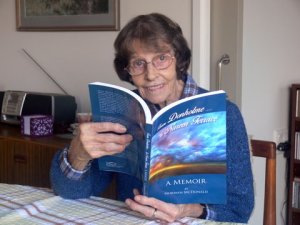
P1070341Over the past couple of years my father has been working on his memoirs. He’s been reflecting on more than eight decades of seeing God at work in and through his family, in many different locations. In the last few days these words have been delivered—printed and bound—to his home. Dad has called his book From Donholme to Nareen Terrace, and he has shaped the book around each of the places he has lived. I’m glad the book has a title, because otherwise I might be tempted to call it The Book of Norman! (That’s got that joke out of the way. It was bound to emerge at some point.)
I am eagerly waiting to get my hands on a copy—not least to reflect on my own life through the lens of my father. But more so, to read and learn from the experiences of my dad. It is a joy to see this book come out. Roughly six years ago, my father was diagnosed with cancer and we all wondered how long he would be with us. Then my diagnosis made it seem highly unlikely that we would have much of a future together. Tomorrow marks my father’s birthday, and how great it is to be able to look back and celebrate the goodness of God over 82 years.

Maybe you know my father. Perhaps you’ve shared a part of your life with him. If so, there’s a chance you might even get a mention!

Let me know if you’d like to buy a copy. Perhaps I can get a job as a promoter.

Then again, I should probably read what he has to say about me first!

Blindspots

FIEC-conference-2017-small
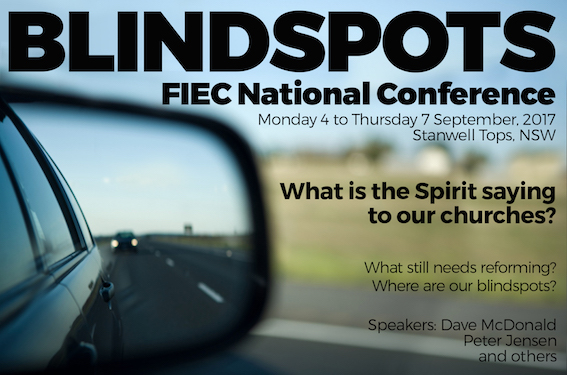
Planning is now well underway for the FIEC 2017 National Conference. It will take place at Stanwell Tops in NSW, from Monday 4 to Thursday 7 September.
This is the one time of the year when we get together with our brothers and sisters serving in FIEC churches across our country. It’s a time to catch up with old friends, make new ones, and encourage one another to keep serving our saviour, the Lord Jesus. 2017 marks 500 years since the birth of the Reformation, when Martin Luther nailed his 95 theses to the door in Wittenberg. We thank God for calling his people back to the truth of his word, and we are calling on God to keep us reforming.
This year’s conference is based on the theme of BLINDSPOTS. Where do we need to be changing? What are the threats to the spread of the gospel? Why might we need shaking from our complacency? How will we persevere in bearing testimony to Jesus in an increasingly hostile world? These are some of the challenges we all face. And there are many more we probably don’t even see.
We will be asking what God’s Spirit is saying to our churches. I will be opening God’s Word from the book of Revelation, asking God to shine a light on our blindspots. Peter Jensen will speak in the evenings, and many of our pastoral staff will lead us in sessions designed to get us reviewing our ministries, planning for the future, and prayerfully advancing in the strength God provides. There will be seminars, workshops, and opportunities to connect with others doing similar stuff to you.
Whether you come from a small church or a bigger one, whether from the country or the city, whether you’re encouraged or struggling—this conference will be designed to spur you on in your service of God.
Please plan now to come. Set aside the dates. Budget for the opportunity. Consider who to invite.
Full costs, details, and registration will be available on our website soon.

Fellowship of Independent?

It’s been fun trying to explain to explain my new role in our organisation to people.

“I used to work for an IEC”, I say.
“But now I’m employed by an F.”

Each letter of our acronym and each word in our title is significant. I wouldn’t say that they each bear equal significance, but together they paint a picture of who we are and what we are on about.

Let’s start with independent. This doesn’t, or at least it shouldn’t, mean that we are a bunch of lone rangers. We’re not to be a motley bunch of mavericks who despise denominations, resent others having input to our decisions, or simply can’t get along with anyone else. ‘Independent’ mustn’t describe an unwillingness to fellowship with other believers or an isolationist mindset—this is profoundly unChristian. It simply affirms the fact that each church is self-governed, with its own constitution, leaders, and ways of doing things. I’d like to think that we are little ‘i’ independents!

So how do we function as a fellowship? While upholding the independent governance of each church, we share a vision for reaching Australia with the gospel of Jesus through planting and building healthy evangelical churches. We understand that together we can teach and learn, and give and gain, to and from each other. We can pool resources, encourage one another in our shared vision, share our joys, and carry one another’s burdens. We can seek to build one another through teaching from God’s word at conferences and courses, and commit to regular prayer for our members. Together, we can share ideas, learn from others’ experiences, cooperate in ventures, and provide help to those who need guidance and support.

Ours is a fellowship that is shaped by firm beliefs. We are unashamedly evangelical. We are persuaded that true Christianity is evangelical in its very essence. That is, people are reconciled into relationship with God, and churches are created and grow, through the work of God’s ‘evangel’—the good news that Jesus Christ was crucified for the forgiveness of sins and was raised physically from the dead to rule over God’s world. We learn this good news from the Bible—not people’s best ideas about God, but God’s specific revelation of himself.

Finally, we are a fellowship of churches—evangelically persuaded and independently governed churches. We don’t view FiEC as ‘our church’, ‘the church’, or even ‘a church’. Rather, we are a network or ‘denomination’ comprised of many churches who voluntarily take steps to fellowship with one another in various ways. It is impractical for all of our churches to meet together—we are scattered across this vast country. However, we seek to gather members of each of our churches together at different events during the year so as to encourage personal and practical fellowship. The official representatives of each church—usually the senior pastors—meet together at formal meetings of the FiEC to review, plan, and pray for our fellowship.

Gospel DNA

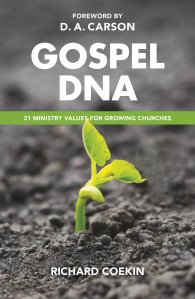
gospeldnaDNA is who we are. It’s you and I boiled down to our most basic fundamental parts. It’s our point of difference, our unique identifier. It’s the building block of our health and biological integrity. DNA gets passed from generation to generation during reproduction. Zillions of pieces of code are transmitted intact so that new things grow. Occasionally there are mistakes in the code. Sometimes things go wrong—like in me! I have a genetic mutation. My second chromosome has flipped around, fused with the fifth chromosome, and created a genetic short circuit, thus producing cancer of the lungs.

What about other bodies? What about the body of Christ we call the church? How is it reproduced? What keeps it healthy? The answer is Gospel DNA. The gospel gives spiritual life to churches. People respond to the gospel in repentance and faith, are thereby incorporated in Christ’s body, and knit together by his Spirit. Healthy churches reproduce this gospel DNA without allowing mutations to develop.

Richard Coekin’s new book Gospel DNA is a spiritual health manual for evangelical churches. He focuses on what he calls an ‘electrifying training seminar’ for church leaders. You and I might know it as the Apostle Paul’s words to the Ephesian elders recorded in Acts 20:17-38. In a handful of verses, Paul condenses the essence of what it takes to grow and reproduce healthy gospel-shaped churches. He identifies the matters that matter to God, responsibilities of leaders, the convictions that must shape all we do, and the threats to healthy church growth and reproduction. Richard Coekin spends 22 chapters exploring 22 verses of the Bible that are nothing less than a masterclass for gospel ministers.

I’ve long turned to Acts 20 for encouragement and inspiration for the work of gospel ministry. Simply being reminded that the church belongs to God and has been purchased by his blood, is enough to call me back into line. Paul’s words refocus my lens when I’m pulled here and there by the pressures and challenges of leading a church. They retune me to the matters of first importance to God. They remind me what the church is, why it matters so much to God, what will see it grow bigger and stronger, and warn me to stay alert to attacks.

This book isn’t so much a commentary on Acts 20:17-38 as it is a reflection on the Apostle Paul’s ‘ministry values’. No doubt Paul had more to say to the Ephesian elders, but the message that Luke records takes us deep into his core values of gospel ministry. Richard Coekin works off Paul’s script to explore these values in greater detail, by taking us to other parts of the Bible that expound each value. He explains their significance for promoting faithful and fruitful gospel ministry, often illustrating from his own experience with the Co-Mission network of churches in the UK.

I’m keen to get multiple copies of this book so that I can start reading it with others. In fact, I recommend the churches and leaders in our FiEC network make use of this book as a training manual. It’s a book to read slowly, chapter by chapter, pausing to review, discussing how we can apply its lessons, and making plans to change for the better. Gospel DNA is an excellent resource to use in personal ministry, training our leaders, enriching our elders, inspiring our potential missionaries, and preparing our future church planters.

(Richard Coekin, Gospel DNA: 21 Ministry Values for Growing Churches, The Good Book Company, 2017)

New job

Many of you will know that I’ve recently taken on a new job. I’m now over 3 weeks into working as the National Director for the Fellowship of Independent Evangelical Churches in Australia. This is a ‘start up’ role and I’m currently working out where I need to get to, checking my bearings, and mapping out the routes I will need to take.

A big part of this role will focus on communication. Sharing the vision for who we are and who we are seeking to become. It will be my job to be the CRO of the organisation—what Patrick Lencioni describes as the ‘Chief Reinforcement Officer’. It’s easy for us to grow forgetful, get distracted, experience mission drift, live off the past, or get tired and merely go through the motions. God’s word calls us not to grow weary or stop caring.

Our vision under God is to grow healthy gospel-shaped churches throughout this land (and beyond). We need to keep one other on target, on mission, and focused on what matters most. I pray that God will use me in a small way to keep reinforcing his message.


Gratias – Dr James Howard Bradbury (AM)

howardIt was my honour and privilege to speak at the thanksgiving service for Howard Bradbury at the Australian National University last Saturday. I first met Dr Bradbury (as I knew him then) early in 1975 when we moved to Canberra. I last met Howard (as I’ve known him for some time) at the ICU at National Capital Private Hospital only days before he died. Our lives have connected in so many ways over so many years, and I truly thank God for our friendship and his lasting influence upon me.
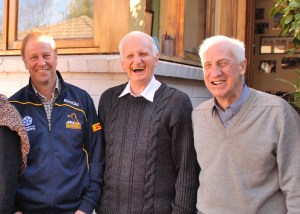
Dr Bradbury completed a PhD in polymer chemistry at Birmingham University in record time. After a postdoctoral fellowship at Harvard University, and working at CSIRO Wool Research Laboratories, he joined the Chemistry Department at the ANU in 1961. He has pursued sabbatical research at Cornell and Oxford Universities. He has been award a DSc from both Melbourne University and ANU. He received the David Syme Research Prize from Melbourne University and the Rennie Memorial Medal and H G Smith Memorial Medal from the Royal Australian Chemical Institute. In 2007 he was appointed a Member of the Order of Australia for his contributions.

The Director of the ANU Research School of Chemistry, Professor John Carver, was Professor Bradbury’s PhD student and friend. He spoke highly at the thanksgiving service about Dr Bradbury’s lasting impact in the lives of so many people—both academically and personally. Dr Bradbury was a scientists’ scientist. And yet, I knew next to nothing of this influence prior to his passing.
I’ve been aware for some time of Dr Bradbury’s extraordinary commitment to using his science for humanitarian good. He retired from his salaried position at the ANU at the early age of 61 so that he could devote himself more fully to exploring the chemistry of food and providing solutions to the plight of the poorest people in the world. He continued this brilliant work, unpaid for another 28 years, inventing and producing simple and affordable techniques to remove cyanide from cassava. Thousands and thousands have been rescued from the debilitating paralysis of konzo. It was deeply moving at the thanksgiving service to be reminded of the generous humanitarian impact of his work.

Yet my experience of the impact of Howard Bradbury, together with Ruth—his wife of 64
years—began with their hospitality. As a young teenager I was welcomed into the world of university student ministry at Reid Methodist (Uniting from 1977) Church. Howard and Ruth would reach out to students in the colleges, invite them into their home, provide transport, cook meals, offer support, encourage fun, and generously pour out Christian love. Howard and Ruth loved students and, even more, they loved students to enter into a real relationship with God through Jesus Christ. And this has left its legacy on me.

When I left home for university it made sense to seek out a church that understood university students and that had a passion to see their lives transformed. This I found at the University of NSW with the ministry of Phillip Jensen and St Matthias. Howard’s passion to impact students with the message of Jesus became my passion. I pursued this with vigour and eventually moved back to the place where I had seen it first—the ANU—where I started the ministry of FOCUS and later Crossroads Christian Church.
Howard and Ruth supported Fiona and me as we began this new work in Canberra. They would ask us how we were going and pray for us. Howard joined the committee to support the university ministry and, together with Ken Mackay, opened up many doors for ministry on the campus.

Version 2Over the last decade or more of Howard’s life our friendship has been enriched in new ways. Being unimpressed with the compromise of the Uniting Church on some matters of biblical importance, Howard led the planting of a new church called the Canberra Christian Fellowship (in the Methodist Tradition). I would visit this congregation often, regularly providing preaching support, and always dropping the average age significantly! While small in numbers, this body of believers has always been big in heart, no doubt encouraged by the wisdom, grace and love of Howard and Ruth. Each time I would join with this fellowship I would come away encouraged to keep on going myself.

Howard Bradbury was a man of science, esteemed across the globe. He was a man of the people, loved by his wife, children, grandchildren, and 20 great grandchildren. His love for people shaped his application of his science to the needs of others. But deeper still, Howard was a man of faith in God through Jesus Christ. His knowledge of God laid a solid foundation for his scientific passion. The mercy and kindness of his Saviour pushed him to love, respect, and invest in people.

At a time when it is normal to view Science in opposition to Christianity and reason as the antithesis of faith, Howard causes us to pause and reconsider. Here was a man whose faith was founded on good reasons. Jesus Christ, who died and was buried, was raised and appeared to eye-witnesses, who testified to what they saw. These events in history transformed Emeritus Professor James Howard Bradbury AM, PhD (Birmingham), DSc (Melbourne), DSc (ANU), to apply his immense scientific brain to consider the claims and promises of God.

Will you do the same?