Growth group leaders bibliography

swiss_army_knifeEvery tradie needs their tools. Good tools make it so much easier to do a job well. Imagine trying to cut wood with a blunt saw that’s been left out in the rain, or snipping electrical wires with a pair of kitchen scissors, or trying to mix concrete in your bathtub. Growth group leaders need good tools too. Our trade is dealing with the Word of God and people, so here’s a few useful tools.

1. A Bible

bible_picYou can’t do without this one. We’re on about knowing God through his word so, unless you’ve got your own special divine broadband network, you’ll need a Bible! It usually helps if most people are reading from the same translation, so you might want to get a feel for what others in your group are reading. There are many good up-to-date English versions available. Try the New International Version, the English Standard Version, or the Holman Christian Standard Bible.

2. A Study Bible or Reference Bible

ESVThese are useful tools for helping you prepare studies. Reference Bibles contain cross-references which assist you in chasing themes around the Bible and discovering Old Testament background to New Testament ideas. Study Bibles go a step further and include commentary on verses and background articles on books of the Bible and selected topics. The ESV Study Bible is probably the most comprehensive around.

BUT, I don’t recommend you use a Study Bible when you lead studies because you don’t want people to think you’ve got the Leaders Version with Complete Cheat Notes. The idea is to learn together from the Bible, not someone’s commentary on the Bible.

3. New Bible Dictionary

NBDA good quality Bible dictionary is an excellent tool for getting background and details on the Scriptures. The New Bible Dictionary contains articles on every book of the Bible, names, places, themes and ideas. If you need to research further, these articles are a good starting point, and refer you to other works.

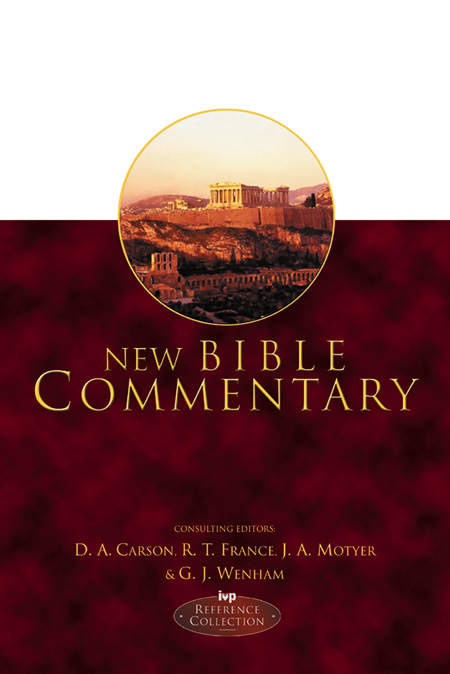
4. New Bible Commentary

NBCThe New Bible Commentary is the companion volume to the dictionary. This is a one volume commentary on every chapter in the Bible. Written by authors who respect the authority of the Bible, it can help you to get a handle on the big picture, or grapple with difficult ideas.

There are a number of good books available that will help you as you develop as a leader. A few are summarised and reviewed on this site. Check out some of these:

5. Spice it up

spiceitupThis is a great book for all growth group leaders. Its strength is in getting people into the Bible in creative ways that help them to deeply engage with God’s word for their lives. The book is strictly a course manual, but there is enough in it to pick up the gist if you can’t access a training course.

6. Growth Groups

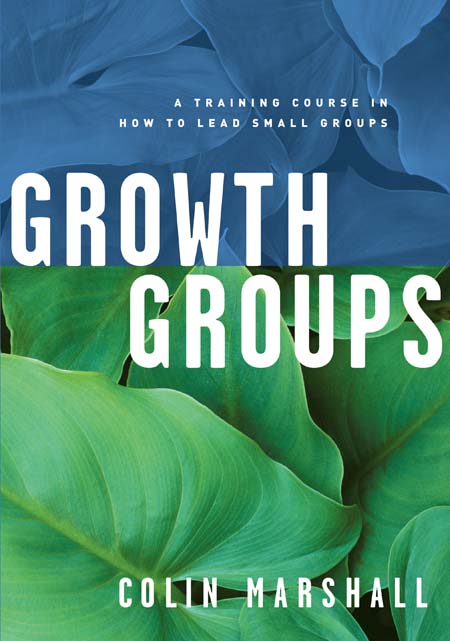
The name says it. This is the basic text book for growth group ministry. It breaks down the different aspects of group life and address topics such as Bible study, prayer, developing leaders, outreach, group dynamics and more. Great for all leaders and very helpful for mentors.

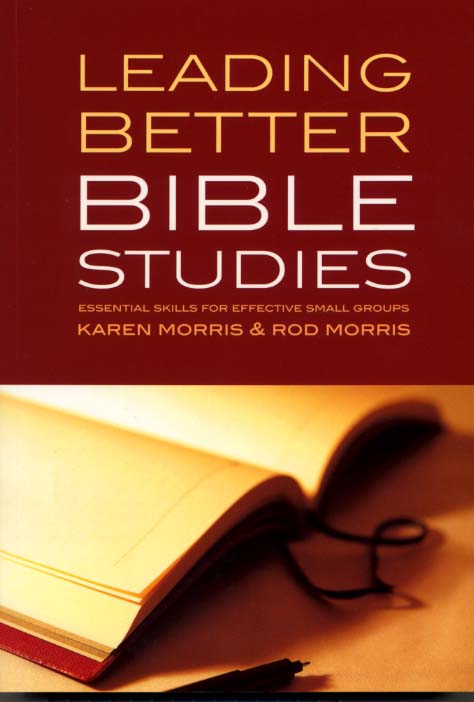
7. Leading Better Bible Studies

Leading Better Bible StudiesThis book in grounded in the Bible, while being very practical. It draws from theological study and adult education theory, to help leaders to creatively approach Bible study and build good group interaction. Coaches and mentors will also find this an excellent resource.

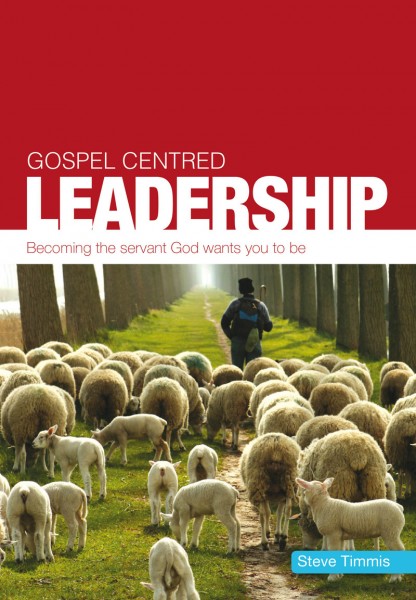
8. Gospel centered leadership

gcleadershipGrowth group leadership is part of a bigger picture of Christian leadership. You can read this book personally, but it may have greater benefit if you discuss it with others, such as your mentor, peer leaders or an apprentice leader in your group.

9. The Trellis and the Vine

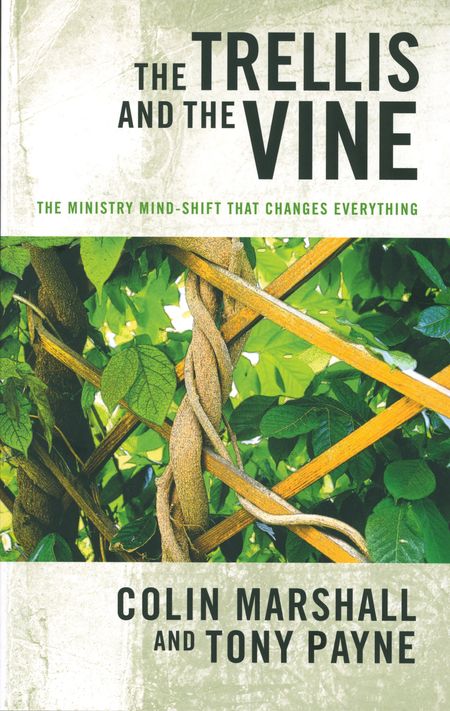
Trellis and the VineIt’s too easy become caught up with organisation and structures – even organising growth groups – so that we lose sight of the purpose of meeting. This excellent resource reminds us to keep focused on the ministry of the word, training one another in godliness, and growing in relationship with God.

10. Sticky Church

sticky_church_coverAn inspiring book, containing many encouraging suggestions for organising groups, training leaders and keeping groups at the heart of church life. Sermon-based Bible studies are advocated, with the main purpose of encouraging participation and application in groups.

11. Creating Community

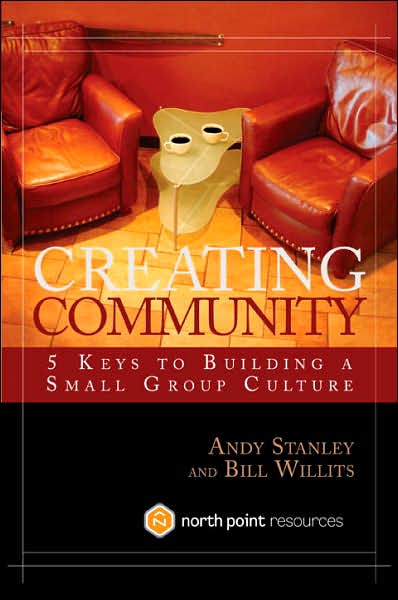
creatingcommunityThe emphasis of this material is on relationships and creating community and it provides a helpful complement to the Bible input from some of the books above. This is a useful book for pastors or directors of growth group ministries to consider as they evaluate and review the ministry.

Mentoring growth group leaders

swiss_army_knifeEveryone needs encouragement. It’s pretty tough doing a job on your own without the support of others spurring you along. Growth group leaders are no different. They require training and resources, but they also depend on encouragement. In a church with many leaders, no one person can be relied upon to provide all the encouragement. We trust it will come from a number of sources. God’s Word is our primary source of inspiration. We look to the members of each group to not only support one another, but also their leaders. Co-leaders can meet and pray and share together about their group. Fellow leaders can catch up and support each other in their roles as leaders. A pastor can catch up with leaders here and there to enquire about how they’re travelling and suggest ways ahead. All this can happen quite naturally without any planning or any specific structures being put into place. However, the truth is it usually doesn’t!

Our plan is for every growth group leader to be able to meet up with a mentor (or coach) to encourage them in their ministry. We will arrange a meeting once a term where all the leaders get together, but we are also depending on purposeful mentoring relationships being established. Mentors should aim to connect with the other leaders at least once a term, ideally face-to-face, to share together in different areas.

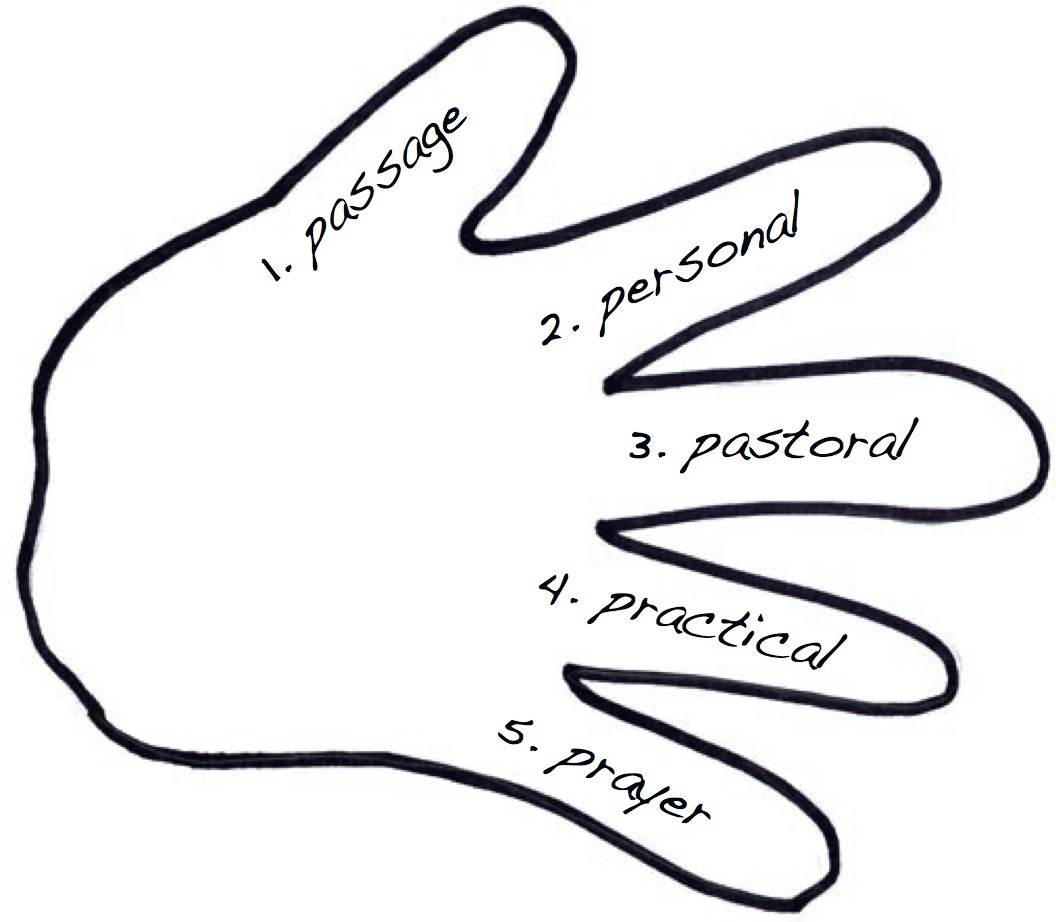
HandSometimes we can get stuck in wondering what to talk about when we meet with others. How’re you doing? Good. How’s the group? Oh, it’s okay. What’ve you been studying? The same as everyone else! Need any help? Nah, I’ll be all right. Well, I’ll see you next time. Okay!

We can do a lot better! I suggest five areas to give you focus each time you meet together. To keep it memorable, you might want to think about each area as one finger!

1. Passage

For the word of God is alive and active. Sharper than any double-edged sword, it penetrates even to dividing soul and spirit, joints and marrow; it judges the thoughts and attitudes of the heart.  (Hebrews 4:12)

At the heart of all ministry is the Word of God. God speaks and gives life. He cuts deeply within us to transform us into the likeness of his Son, Jesus. Our growth groups are focused upon the Scriptures because we desire to see change in people’ lives. For the same reason, we want to shape our mentoring times by opening God’s word together. This isn’t the place for a detailed Bible study together, but we do want to hear from God each time we meet.

There are many different approaches we could take to looking at the Bible in our mentoring meetings. Here are a few suggestions:

  • Choose a few verses that have stood out in your recent Bible studies and share what they have meant to you.
  • Choose one of the pastoral letters (1 & 2 Timothy and Titus), take a few verses at a time, and reflect together on what you learn about Christian leadership.
  • Read through one stanza of Psalm 119 each time you meet and share any new insights into God’s word.
  • Take a short New Testament book, such as Philippians or James, read a few verses each time to encourage each other.

2. Personal

12 Don’t let anyone look down on you because you are young, but set an example for the believers in speech, in conduct, in love, in faith and in purity. 

15 Be diligent in these matters; give yourself wholly to them, so that everyone may see your progress. 16 Watch your life and doctrine closely. Persevere in them, because if you do, you will save both yourself and your hearers.  (1 Timothy 4:12; 15-16)

Leadership involves teaching in word and example. We’re called to walk the talk or stumble the mumble, as I heard recently! Mentors should take an interest in the lives and teaching of their leaders, but we can’t expect people to do what we’re not prepared to do. This means that mentors also need to be open about themselves. Each mentor meeting should allow time to share together about ourselves. This might be a little awkward at first, but will become easier as our relationships grow.

It’s helpful not to be prescriptive about what you discuss together. Some weeks there might be a big issue that takes most of the time. Other weeks there may be very little to discuss. Here are a few suggestions to get you going:

  • Get to know a little about each other’s lives – family, work, interests, etc.
  • Share together about how you became Christians.
  • Is there something you’ve been really encouraged with recently?
  • Is there something you’re finding hard?
  • How are you finding being a leader in the group?

3. Pastoral

Growth groups are about more than Bible study. They’re about the lives of the members of the group. It’s important that we recognise that everyone is different and that God is in the business of working in each person differently. This means we need to think specifically about individuals. Mentors can encourage their leaders to show an active interest in each member of the group. One way to do this is simply asking what they have observed.

Our greatest desire is for every member of our groups to know and love God, to place their trust firmly in Jesus, and to look forward to the hope of heaven. We want to spur the members of our groups on to love and good works, that God has prepared for them to do. This means a leader is rather like a Christian ‘coach’ urging the members of the team forward.

Mentors can help this to happen. We can discuss and pray about the people in our groups. As we do this, it’s important to be motivated by love. There is absolutely no excuse for gossip. We need to respect confidentiality. Many times we can talk productively without even needing to mention specific names or details.

Sometimes there will be people in our groups with very great needs. They could be very ill, going through a marriage break up, struggling with depression, out of work, having a crisis of faith, or struggling with other serious matters. This may be beyond the capacity of the group or its leaders to deal with on their own. The mentor may be able to assist by linking the leaders with the wider support of the church, or other resources.

Two books that will assist you to think pastorally about the members of the group are Mission Minded by Peter Bolt, and The Trellis and the Vine by Tony Payne and Colin Marshall.

4. Practical

It takes skill and practice to lead a group well. While we don’t expect mentors to necessarily be trainers, we do want them to encourage their leaders to keep getting better at their ministry. There could even be times when a mentor and leader will undertake a training course or refresher together.

A browse through the contents pages of Leading Better Bible Studies by Rod and Kaen Morris, or Growth Groups by Col Marshall, will highlight a number of aspects to group life worth exploring together. And reading the chapters will give you plenty to discuss! Further, we are aiming to produce a range of papers on this site to assist you with improving your small group leadership. Matthias Media has also started a monthly Home Group Leaders Digest which should offer some helpful ideas.

We’re looking to mentors to take the initiative in encouraging leaders to develop as leaders. Ask questions, be specific. For example:

  • What aspects of preparing or leading a Bible study do you find most difficult?
  • Why do some studies work better than others?
  • What do you think is stopping the group from opening up in prayer times?
  • How do you think social activities could help the group to click together?
  • What plans do you have for the term ahead?
  • Have you considered any ways that the group could serve the church together? What?

One area of practical consideration and long term importance is equipping new leaders. We are keen to be apprenticing leaders within our groups by giving them opportunities to lead and work through issues of leadership. If we don’t do this, then we won’t grow. Mentors can take a role in encouraging the leaders in their task of developing new leaders:

  • Have they identified people who could be potential leaders? Who?
  • What are the leaders doing with their apprentices? (e.g. preparing studies together, praying for members of the group, reflecting and planning together, following up members of the group one-to-one)
  • Have they encouraged their apprentice to participate in a training course, read some helpful books, come to a leaders meeting?

5. Prayer

What, after all, is Apollos? And what is Paul? Only servants, through whom you came to believe—as the Lord has assigned to each his task. I planted the seed, Apollos watered it, but God has been making it grow. So neither the one who plants nor the one who waters is anything, but only God, who makes things grow. The one who plants and the one who waters have one purpose, and they will each be rewarded according to their own labor. For we are co-workers in God’s service; you are God’s field, God’s building.  (1 Corinthians 3:5-9)

Without God we can do nothing. We can’t make a person trust in the death and resurrection of Jesus for their salvation. We can’t fill a person with love for others. We can’t save a person from the judgment of God. We can’t guarantee their future for all eternity. BUT God can… and more! So we are to rely on him, call out to him, ask him to be actively working in our lives and the members of our groups.

As mentors meet with their leaders, so we want them to pray. Together, humbly, asking God to be graciously at work. Allow the time to speak together with God, not as an afterthought, but as the most practical use of your time together. God loves to hear our prayers and he is more willing to bless us with answers than we are to ask him our questions.

Leading better Bible studies

Leading Better Bible StudiesLeading Better Bible Studies: Essential skills for effective small groups by Rod and Karen Morris is a compendium of valuable information on small groups ministry. The authors draw together a wealth of material acquired through theological training, adult education study, and years of practical experience leading Bible study groups. There’s much more to Leading Better Bible Studies than teaching us how to lead better Bible studies, but the Bible is clearly central to the whole agenda. This book is intended to assist leaders to ensure their groups are about helping people (i) grow in their relationships with God, (ii) become more like Jesus, and (iii) experience the joy of doing this in relationship with others.

Scan 2A strength of this book is its balance. Good small group leadership requires people to build biblically-shaped competence in a range of areas. Leading Better Bible Studies outlines seven areas important areas for leadership development. While the book follows a logical sequence, any chapter can be dipped into at any stage.

1. Being a Christian leader

The assumption is that leaders are men and women seeking to know God and serve him in their role as leaders. They must be Christians who trust in the saving work of the Lord Jesus. Leaders are not called primarily to impart their own wisdom, but to help the members of the group grow in their knowledge and love of God through studying the Bible. This will require leaders to focus on Christ, depend on the power of God’s Spirit, delve deeply into the Scriptures, pray humbly, teach in word and example, and call people to change in the light of God’s word.

2. Helping people learn

The main task of the leader is seen to be helping people learn from the Bible. This will, in turn, shape all the other ministry in the group. This takes diligence in understanding the Scriptures and it also requires the leader to understand how people people learn and how we can assist people to learn.

The content of our teaching is so important that we must use the best possible methods to enable people to learn.  (p2)

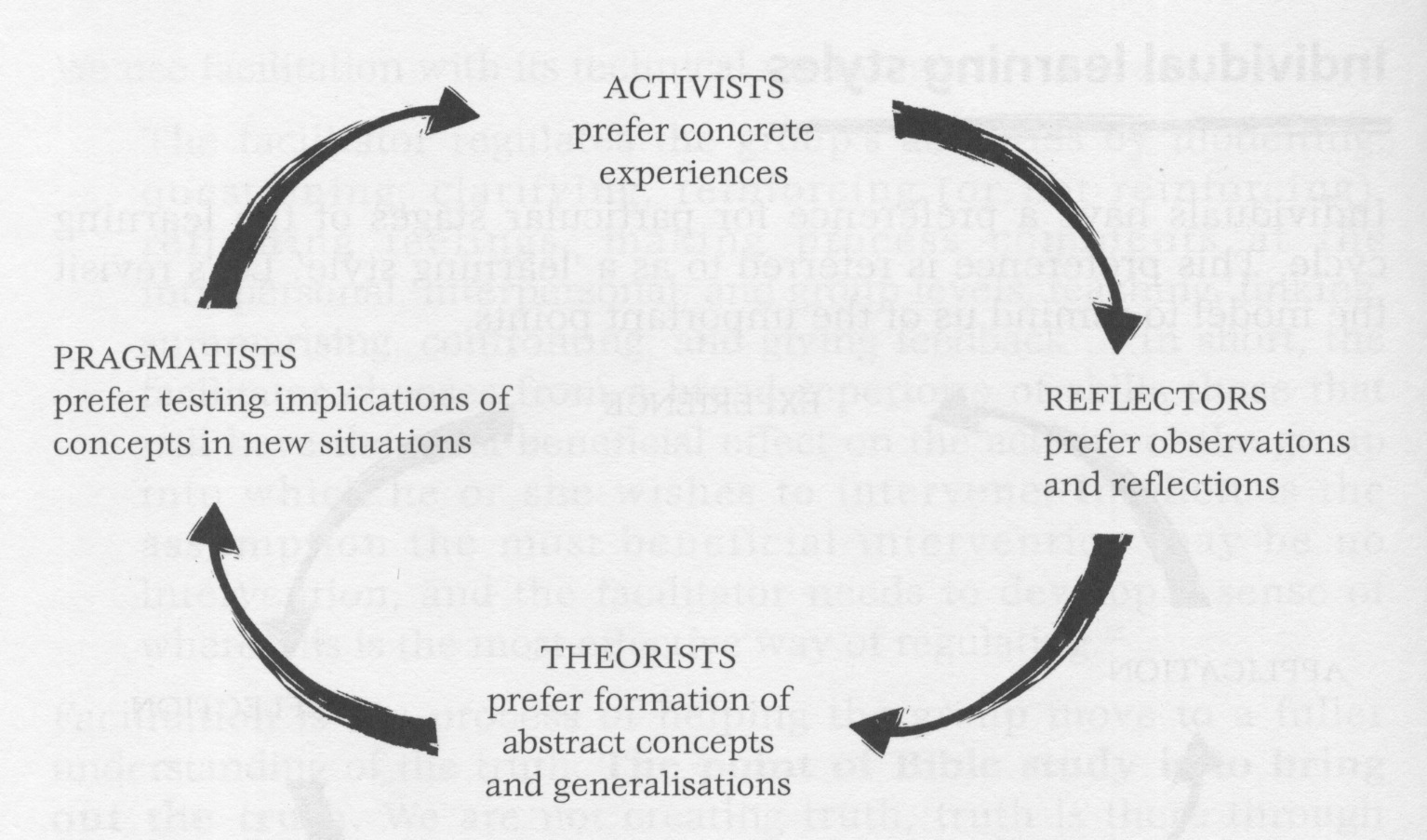
Scan 3Rod and Karen apply their understanding of adult learning principles and the adult learning cycle to enable leaders to suitably connect with the variety of people in their groups. They show how people learn through stages, but also how individuals have a preference for particular stages of the cycle. Activists tend to focus on the challenge of something new and fresh. They love the ‘doing’ part of learning. Reflectors take more time to reflect and consider how things relate. They look for patterns, connections and explore things from different perspectives. These people tend to take more time to come to their conclusions. Theorists are more into formulating explanations and developing principles. They’re keen to draw everything together into coherent unity. Pragmatists are keen to get to the point where the ‘rubber hits the road’. Recognising the different stages and preferences for learning can assist the leader to engage all members of the group better and, hopefully, help the pragmatists not to get so frustrated with the theorists!

3. Learning from the Bible in groups

This is the longest chapter in the book and focuses upon the leader’s central task. It looks to develop skills in handling the Bible, both personally and in the group. The foundations of understanding Scripture in its context are well presented here. We’re encouraged to look at the detail in each passage, within the overall theology of the whole Bible. Three aspects are developed in studying the Bible:

(i) observation – what does the text actually say?
(ii) interpretation – what does the text mean?
(iii) application – how do we respond to what the text means?

This chapter is a treasure chest of strategies for doing Bible study in our groups. It helps us to get beyond the boring Q and A approach of so many studies, and explore creative means of learning together from the Bible. They are designed to help people learn from the Bible and not simply discover what’s in the head of the leader! There are 21 different approaches to Bible study outlined here, each with an example study to share.

4. Developing group life

Many of us will have had superb experiences of small groups, along with others we’re still trying to forget. This chapter focuses on the ‘people’ side of our groups and how to develop groups that really work. It’s highly practical, dealing with issues such as group size, when and where you meet, developing mutual expectations of the group, building trust, sharing responsibilities, good communication, celebrating milestones, and more. Groups go through life cycles and good preparation enables the group to navigate these well. They require attention to task and maintenance functions. Finishing groups well can be as important as starting them well. If you’re looking for a range of activities to help people in your group get to know each other, this chapter offers you another 24 great ideas!

5. Helping people pray

Prayer is often emphasised in theory in Bible study groups, yet neglected in practice. We know of groups which run out of time and have only a perfunctory prayer to open and close the meeting; of others which never move beyond the mundane and superficial; and of still others where only one or two people pray, while everyone else remains silent.  (p151)

I suspect many of us have been involved in groups that struggle to pray. The strength of this chapter is that it offers practical steps to model, teach and encourage people in our groups to pray. And it needs to begin with the leader.

6. Sustaining group members

A good Bible study leader will seek to look after the members of their group. They will care for each person with regard to their relationship with God, and what’s going on in their lives. They will seek to equip the group to build one another through God’s word and loving service. This requires more than simply preparing a study and opening our homes each week. It requires perseverance and hard work, understanding of people, good communication skills, capacity to work through and resolve conflicts, and more. But it also requires a healthy grasp of the limits of our responsibility. Ultimately, the people in the group are God’s responsibility, not yours. Therefore there are limits to your accountability. (p188) A healthy reminder!

7. Continuing as a leader

How do we keep leaders fresh and willingly serving God in this ministry for the long haul? The book finishes with some more practical wisdom. Refreshment is key to doing anything long term. People need change, variety and breaks. While they may no longer need basic training, they may benefit greatly from ongoing encouragement and support. Supervision, peer mentoring, personal reflections and self-appraisal are all useful tools for developing leaders.

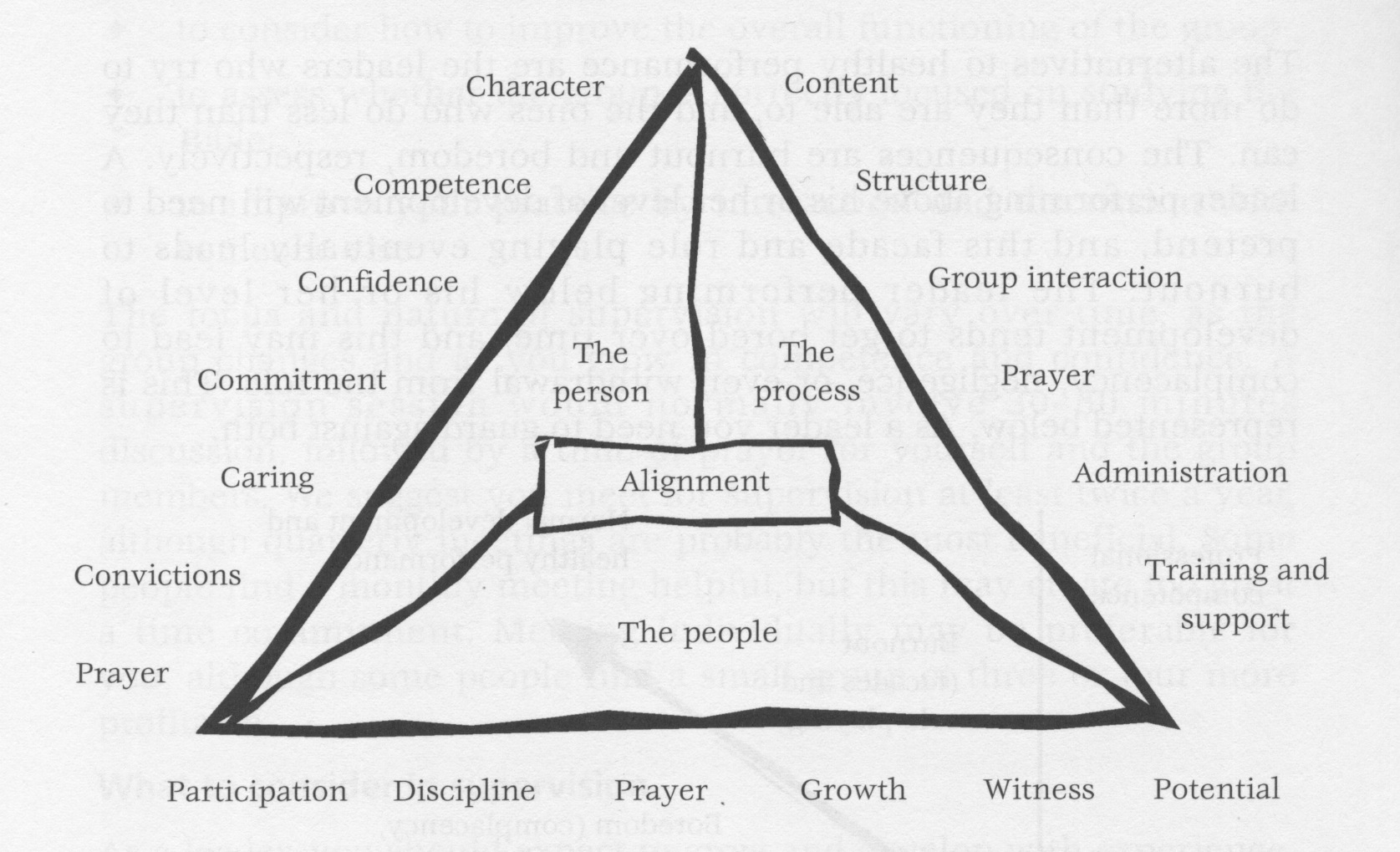
Scan 4Rod and Karen suggest focusing on the person, the people, and the process. These three areas are all important for healthy leaders and healthy groups. They include a few pages of questions and ideas that could be used either personally, or by a supervisor who is encouraging another leader (p195-8).

Leading Better Bible Studies finishes with a list of resources on a range of topics related to each of the chapters. These are good resources, but it would be useful to update them to include materials written since the first printing of the book in 1997.

I’ve worked through this book on a number of occasions previously. It’s been my ‘textbook’ for teaching courses on leading Bible studies. Along with other books, such as Growth Groups, it’s been a ‘reference guide’ for equipping myself and others to lead. Our church is implementing a strategy of coaching and mentoring for our growth group leaders. My hope is for every coach to be familiar with this book, so they are better equipped to support the leaders under their care.

Sober celebrations

20130316-140139.jpgGrace has organized a team of 24 for the Relay for Life again this year. There are hundreds of people walking, running, hanging around. The theme is:

Celebrate. Remember. Fight Back.

There’s not much to celebrate about cancer. Only last night my very good friend lost his mum after a relatively short battle with lung cancer. It’s a cruel killer. It takes life and twists and distorts it. It ruins other lives and the sadness spreads. It reminds us that life isn’t how it should be. It’s a sign that our world has been subjected to disease, decay, and death and we groan for things to be set right once more.

Last year I walked the survivors lap and felt rather like a fraud. This year I celebrate a year of survival, another year of life. With God’s help, the support of family and friends, and powerful chemo, I’ve been fighting back.

I remember some who are no longer with us. Like my friend’s mum, my wife’s boss, my cousin, a number of friends, and countless friends’ friends.

More importantly I remember that God has fought back so that we can celebrate life forever through Jesus. We might beat cancer in this life but only God can enable us to beat death for eternity. Please turn to him while you have breath!

With love,
Macca

Do you feel called by God?

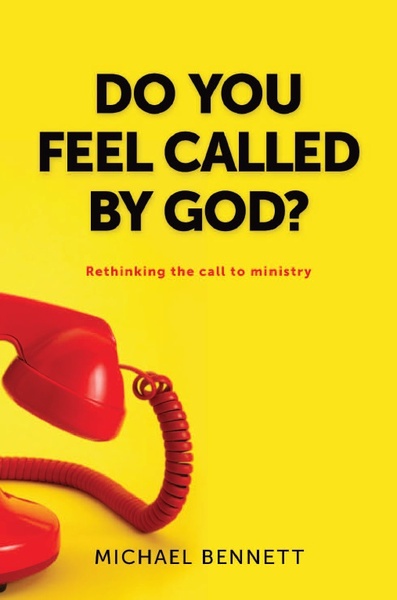
calledI think I need to take more plane trips. They’re a great way to set aside time for reading. Bit expensive though! This book was started on the trip back from Sydney and finished during chemo this morning. The chemo makes it even more expensive! Having now read Michael Bennett’s Do you feel called by God? Rethinking the call to ministry, I’m eager to share what I’ve discovered. This is a book that mirrors so much of my own experience, addresses so many of the same questions I’ve asked, and comes to the same conclusions. It’s easy to review a book that backs up your own opinions, but I can honestly say that it has also been a long and careful journey for me to be persuaded of these matters and I’ve never once had a conversation about them with Michael Bennett.

We’re told from the outset why Michael wrote this book and what conclusions he makes throughout. The book is spent substantiating these conclusions:

  1. The often-ward and almost universally accepted expression “I feel God is calling me” is totally foreign to the revealed content of both the Old and New Testaments of the Bible. The continued use of this unscriptural pietistic language may be having negative consequences for churches, missionary societies and other Christian organisations in the choosing and training of leaders.
  2. Without denying in any way God’s ability to call people by overt and supernatural signs, it is argued here that this is not usually God’s method today. The motivation to serve the Lord, particularly in what is called full-time ministry, is a human desire to do so, and not a felt call. However, this human desire, which must spring from one’s love for Jesus and the gospel and genuine compassion for people, is not sufficient or valid in itself: it must be rightly motivated and rightly tested. (p6-7)

I suspect by revealing his conclusions at the outset, Michael will lose some readers. “That’s not right. It can’t be right. It’s not what happened to me… or others I know.” And they’ll put the book down. Or because they’ve read this far in my review, they wont even bother buying it! Oops, sorry! Let me say this would be a huge mistake. Please judge these conclusions on the strength of the arguments, not on whether they confirm or run contrary to your current thinking.

This book is very autobiographical and anecdotal. We get to know Michael Bennett, the rugby player, Christian, Bible college student, and author. We journey with him as his questions and struggles are explored and answered. However, this is not a this happened to me and therefore I am the paradigm for everyone else book. Michael seriously engages with the Scriptures to find the answers. We are able to weigh up his arguments on the lines of whether they faithfully expound the teaching of the Bible.

‘Call’ and ‘calling’ are explored in the Old and New Testaments. Michael examines the key people called by God to particular tasks and roles, and how this is specifically described. The observation is made that the word of God comes directly and personally to some people for particular purposes, but that this never resembles a concept of ‘feeling called’ that is commonly described today.

Close attention is given to examining every reference to ‘call’ and its cognates in the Greek New Testament. Only after the serious word studies completed and the contexts explored, are conclusions drawn. Seven different uses of the words are identified in the New Testament and the conclusion is reached, after looking at over 300 verses, that God calls all people in two specific ways:

  • First, we are called to be Christians – to be disciples of Jesus.
  • Second, we are called to be holy – to grow in Christ-likeness. (p60)

Some of the references that speak of a call to holiness are another way of describing the call to be Christian. Christians are the ‘called out’, ‘set apart’, or ‘sanctified ones’. They’re the saints – not those who gain post humous titles for miracles and deeds done – but those who, because of Christ’s work now, belong to God. In 1991, I completed exactly the same comprehensive word studies and came to the same conclusions that this is how the Bible speaks to Christians about the nature of being called by God.

Michael Bennett addressed the potential criticism of simply playing semantics by showing that the implications of using Biblical words and phrases in non-Biblical ways can be dangerous and debilitating. If candidate committees, ministers, theological colleges, and mission organizations are all asking for evidence of a ‘calling’, when the Bible doesn’t make this necessary, then where do people turn? Perhaps they end up deifying their desires to justify their position.

This book contains a very helpful and bold chapter of Hudson Taylor. It’s a pertinent case-study exploring what’s going on for this towering missionary as he speaks of his ‘call’. Taylor is quoted as saying:

I felt that I was entering into a covenant with the Almighty. I felt as though I wished to withdraw my promise but could not. Something seemed to say: “Your prayer is answered”. And from that time on the conviction has never left me that I was called to China. (quoted on p70)

The language of Hudson Taylor is important to observe. He uses expression such as, “I felt”, “Something seemed to say”, and “the conviction”. He doesn’t speak categorically of God’s specific or clear personal command. Michael respectfully seeks to diagnose what’s going on in Taylor’s experiences and the way he describes them. He argues that Taylor uses the normal language of pietism in his day (and for many in the church today) to tie together a number of influences and motivations for mission work. These areas include his family and background, his conversion to Christ as he understands grace, his grasp of the eternal consequences of the gospel, his deep compassion for people, his desire to take action, and his extraordinary suitability for the task.

After discussing some issues of how we should expect to receive guidance from God, Michael Bennett hones in on the question so who should go into ministry? The answer is biblical and profound: every Christian is called to ministry, that is, we are reborn into a new life of serving God. Ministry is not limited to some elite Christians, it’s for all! What then of those we call ‘ministers’, or pastors, or missionaries, or ‘full-time’ ministers? How do you work out if you should make the step from being a minister to being a Minister in some special sense? Again, we are directed to the text of Scripture. Some are set apart as overseers, pastors, or bishops – three overlapping terms to describe persons who lead, teach and equip the body of Christ to each minister to one another. Others are set apart for pioneer mission work or evangelising. How do you know if you should be one of these people?

Michael shows from the Bible the relevance of the same factors he describes for Hudson Taylor. He shows how the human desire to be involved in Christian leadership ministry is a desire for something very worthwhile. This desire should be tested and weighed by others also. We’re taken especially 1 Timothy 3:1-10 to explore the criteria for suitability:

Here is a trustworthy saying: Whoever aspires to be an overseer desires a noble task. 2 Now the overseer is to be above reproach, faithful to his wife, temperate, self-controlled, respectable, hospitable, able to teach, 3 not given to drunkenness, not violent but gentle, not quarrelsome, not a lover of money. 4 He must manage his own family well and see that his children obey him, and he must do so in a manner worthy of full respect. 5 (If anyone does not know how to manage his own family, how can he take care of God’s church?) 6 He must not be a recent convert, or he may become conceited and fall under the same judgment as the devil. 7 He must also have a good reputation with outsiders, so that he will not fall into disgrace and into the devil’s trap.

8 In the same way, deacons are to be worthy of respect, sincere, not indulging in much wine, and not pursuing dishonest gain. 9 They must keep hold of the deep truths of the faith with a clear conscience. 10 They must first be tested; and then if there is nothing against them, let them serve as deacons.

Do you feel called by God? is a breath of fresh clear air on the topic of guidance into Christian ministry. It’s a book I will recommend to many, but before I do, let me raise a couple of issues and suggestions. I believe a strength and a weakness of this book is that it covers a lot of ground and explores a lot of side streets on the way to its destination. We get to hear about Michael’s journey to faith, his pathway through theological training, high and low church differences, Catholic and Anglican confusions, dip into wider issues of guidance, and much more. This may frustrate the impatient person who simply wants the shortest distance between A and B. However, it makes the book highly suitable for one who is still grappling with many basic fundamentals of Christian life and ministry.

I also think there is a passage of the Bible, that warrants careful exegesis on this topic, that has been overlooked or simply omitted from this book. I’m referring to 1 Corinthians 7:17-24.

17 Nevertheless, each person should live as a believer in whatever situation the Lord has assigned to them, just as God has called them. This is the rule I lay down in all the churches. 18 Was a man already circumcised when he was called? He should not become uncircumcised. Was a man uncircumcised when he was called? He should not be circumcised. 19 Circumcision is nothing and uncircumcision is nothing. Keeping God’s commands is what counts. 20 Each person should remain in the situation they were in when God called them.

21 Were you a slave when you were called? Don’t let it trouble you—although if you can gain your freedom, do so. 22 For the one who was a slave when called to faith in the Lord is the Lord’s freed person; similarly, the one who was free when called is Christ’s slave. 23 You were bought at a price; do not become slaves of human beings. 24 Brothers and sisters, each person, as responsible to God, should remain in the situation they were in when God called them. (NIV, my emphasis.)

I’ve spent much time helping people work through what this passage is saying about the nature of God’s call. A superficial reading has led many to speak of God calling people to particular careers, jobs, places, or ministries. This appears to be the meaning of verse 17. However, the verses that follow make it clear that Paul is speaking of the circumstances of life that people are in before and after they become Christians. The ‘call’ on view is the call to be Christian.

This is a book that should be read by many. It should be passed on to people who are exploring these issues for there lives. Last weekend I was asked by a young man at church if he should be heading into ministry. I plan to buy a copy of this book and give it to him and I’ll talk through the issues with him. It’s an excellent resource for people considering MTS (Ministry Training Strategy) apprenticeships, or exploring whether to head to Bible college, formal ministry, or the mission field.

I would make this book compulsory reading for church and denominational leaders who will be making decisions about whether to admit people into training or ministry positions. I’d would love all members of missionary candidates committees to take the time to work through this book. Bishops should read it. Theological and Bible college admissions departments should read it. Those endless committees deciding people’s futures should read this book. It’s such an important issue for many. Perhaps you should read it!

One forever

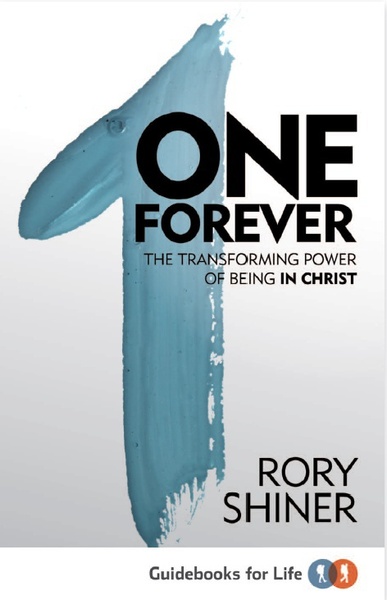
oneforeverI’ve recently received two books on union with Christ. One Forever by Rory Shiner and Paul and Union with Christ by Con Campbell. I’ve been keen to get into both these books and decided to bring one with me on a plane trip this morning. Rory’s book is 88 pages and Con’s is 479 pages. If I was flying to South Africa with the Brumbies, I’d have taken Con’s book, but given I was only flying from Canberra to Sydney, Rory’s it was. Con said his book would have helped me sleep on the plane! Hopefully, I’ll let you know later if that’s true. This is a great introduction to an often overlooked theme in the Bible. This book shows us how central and significant it is. Union with Christ belongs not only at the heart of theology, but at the heart of Christian experience.

Union with Christ is introduced against the backdrop of creation. We were created to be united with Christ. The picture of the man and woman being united in a one flesh relationship in Genesis 2 finds its ultimate expression in the union between Christ and his bride, the church, in Ephesians 5. We only become the people that God designed us to be as we are united together with Jesus. Fulfilment and completeness for human beings is experienced through entering into a genuine relationship with Jesus Christ.

The incarnation, where God became one of us, shows us God’s true intentions for humanity. Given our rebellion against God, it’s truly remarkable that God would enter into our world as a human being.

God doesn’t enter into humanity like a nuclear scientist holds radioactive material: with a massive suit on, at a distance, for fear of contamination. Rather, he enters into all that we are and is united to all that we are, so that all we can be healed and redeemed.  (p28)

The key to understanding the incarnation is the gospel. It reveals that God’s purpose in becoming fully human was to save people who’d turned their backs on him. Jesus, fully human, reveals the extent of God’s commitment to humanity and to restoring sinful people into relationship with God. The exalted post-resurrection Jesus shows us the picture of what God intends for humanity as we are reunited with our creator.

The heart of this book is the chapter on being a new creation in Christ. Very fittingly, given the context of me reading this book, Rory asks us to consider being on a plane! He asks what relationship we need to have with the plane if we are going to get to the destination. Would it help to be under the plane, or inspired by the plane, or following the plane? No, we need to be in it! He argues that the New Testament idea of being in Christ is something like this. In biblical terms, we get to participate in the benefits of salvation and justification because we are united with, or in, Christ in his death and resurrection. This is the plane journey that matters.

He develops the plane illustration further with some important pastoral implications. Contrast a business woman, well accustomed to flying, taking the journey in her stride, with an elderly man, an anxious first-time flyer, who keeps asking whether or not they’re going to make it. The woman clearly has stronger faith. The man is troubled by doubts and fears. But the plane gets both of them there! The heart of the matter is not how much faith you have, but where your faith is. (p41)

Union with Christ isn’t simply one angle to understanding what we have received as Christians. Rather, it’s the means by which we receive every blessing from God. We are justified, declared to be in right standing with God, through being united with Christ. Christ has paid the price of judgment for our sin so that when we are united with him by faith there is no further price to be paid. This is the basis of our assurance of salvation. Understanding the implications of union with Christ enables us to live in humble confidence, that is, a confidence that in Christ everything from God will be ours and nothing can take this away from us. As Paul writes in Romans 8:

38 For I am convinced that neither death nor life, neither angels nor demons, neither the present nor the future, nor any powers, 39 neither height nor depth, nor anything else in all creation, will be able to separate us from the love of God that is in Christ Jesus our Lord.  (Romans 8:38-39)

Rory includes an excellent chapter on dealing with sin in our lives. He describes union with Christ as our defence against the playground bullies of sin and temptation. (p56) He takes us to Romans 6, arguably one of the most important chapters in the Bible for understanding the life implications of being united with Christ in his death and resurrection. Many people, Christians included, believe that guilt is the way to change people. Rory argues instead that guilt, while being a good alarm system that something needs to change, is a lousy agent for change. Guilt lacks power to transform lives. By contrast grace is God’s power to change as we gain a clearer and stronger appreciation of the many privileges we have in Christ. I found this chapter compelling and faithful to the thrust of the New Testament.

One Forever reveals the implications of union with Christ for the church. There are many metaphors for church in the New Testament which reveal the corporate union between Christ and his people. Consider such pictures as the vine and the branches, the temple, the husband and his bride, the body of Christ, and so on. Christians belong to God and to each other. We are created and recreated, in diversity, with different gifts, for the purpose of sharing our profound unity in Christ. Rory asks: So why go to church? Answer: Because church is who you are. Church is the most concrete expression of your union with Christ. (p72) How we treat Christ and how we treat Christ’s people are intimately connected because the church is Christ’s own body.

The final chapter of this book takes us to the big issues of life, death and the climax of all things. Understanding union with Christ gives us clarity about what to expect in our futures. It’s the basis of a real hope beyond death. Christ died and Christ rose. Our union with him in his death guarantees our union with him in his resurrection. We can be freed from the despair of  living only to die, to devote ourselves to the things that will last for eternity – the work of the Lord (1 Corinthians 15:58). Our union with Christ will see us through, safe and glorified into the new creation. (p88)

If you’ve never thought much about what it means to be in Christ this book is a great primer. It’ll help you to head back to the New Testament and read it with clearer glasses. Dip back into John 15, or Ephesians 1, or Romans 6, or 1 Corinthians 15, and see how important is this theme. It’s far more than a theological window with which to view our relationship with Christ. It reveals the very essence of what it means to be Christian.

Fatigue

fatigueI’ve gone from sleeping 6-7 hours a night for years and years, to needing more than 9 hours a night. Some nights I need 11 or 12 and still wake up feeling tired. This on top of occasional nanna naps in the afternoons. It takes a huge effort in the mornings to open the eyelids and if I don’t get a shower and a coffee then I probably spend the first hour of every day sleep-walking.

No doubt it’s another effect of the chemo and, maybe, the high blood pressure caused by the chemo. It comes with its aches and pains, inability to concentrate, and the frustrations that go with both. I think it’s given me some small insight into how chronic fatigue sufferers might feel. Friends of mine have been struggling with fatigue for years and years. Some have given up any hope of life ever being different. Some are barely able to lift themselves from the bed, and time with family and friends leaves them exhausted. It’s difficult to know how to offer support sometimes, because a visit or phone call can deplete their already limited energy. One friend told me it takes days to recover from half an hour with a well-meaning visitor.

There’s also the difficulty of an illness that people can’t see and very few understand. Just go to bed earlier. Start exercising more. Change your diet. Snap out of it. It’s all in your head. I reckon you’re making it all up. This is some of the helpful advice that people get given. And then there’s often the person with the success story. My friend visited this specialist, started on that diet, discovered acupuncture, went to such and such healing service, moved to the beach… and now everything’s ok.

The reality of this life is that sickness, sadness, and suffering are all part of our experience. We ache and groan as we long for things to be better. But the truth is that things don’t always improve. More often than not they get worse. Old age sees our breakdown and decline. We don’t heal as quickly, illnesses become more complicated, some things become permanent. Our body struggles to recover, our mind isn’t what it used to be, and our spirit eventually loses the will to live. Sometimes it seems like life is one long tragedy. It might start well for some, but it always seems to end badly.

What a pessimistic post! Is this what fatigue does to me?! Let me presume to share a few thoughts with those of you who are struggling with fatigue.

Don’t give up hope. Maybe there will be a change for the better just over the horizon. Perhaps someone will understand what’s causing it. Maybe there is something that will help, even a cure. Keep looking, keep on trying. Pray. Talk to God. Ask God to take away your pain and suffering. Ask friends to pray for you or with you.

When everything feels dark and hopeless, cry out. Let your family and friends know how much it hurts. Ask for help, comfort, love, kindness. And call out to God. Your Father in heaven knows what you need. Maybe God wants you to depend more on him. If it’s not his intention to take away your suffering at this time, then ask him to help you trust in his grace. Ask him to strengthen your trust in his goodness. Ask him to help you draw near to him for comfort, even if he seems so remote.

Are there things you can do in your fatigue? Do your energy levels let you get up from time to time? How can you best fill that time? Is it your family who needs you most? Are you able to encourage others in your weakness? Can you spend time praying for other people? Can you make a list of things that you can do when you’re down and others when you’re up? Have you asked how God can use you in your frailty? Maybe you could brainstorm some ideas or chat to others about this.

But don’t compare yourself with others. “At least there are people who are suffering more than me!” How does that help, really? “Why do I suffer so much when those around me do whatever they please?” Self-pity, jealousy, anger, bitterness will only make things worse. There is one who is well acquainted with suffering, who understands what you are going through, who can help. His name is Jesus. He was betrayed, rejected, beaten, ridiculed, and crucified. He took the punishment we deserve in his body and paid the price. He endured all this in confident hope that God would raise him from the grave, as the first fruits for all who would follow after him.

Focus your hope on the future. Not just for this life, but for eternity. Keep your eyes on Jesus and remember the promise of a day with no more pain, suffering, fatigue or death. As your earthly body decays remember that God has in store a new, complete, and perfect body for all who trust in him. There is hope. God guarantees it!

For we know that if the earthly tent we live in is destroyed, we have a building from God, an eternal house in heaven, not built by human hands. Meanwhile we groan, longing to be clothed instead with our heavenly dwelling, because when we are clothed, we will not be found naked. For while we are in this tent, we groan and are burdened, because we do not wish to be unclothed but to be clothed instead with our heavenly dwelling, so that what is mortal may be swallowed up by life.
(2 Corinthians 5:1-4)

Growth Groups

Passing the Baton-text-S2Growth Groups by Col Marshall has been around now for a couple of decades. For many of us, it’s been the ‘go to’ book on small group ministry. As I’m currently reviewing how we support and equip our growth group leaders, I thought I should read over it again. My immediate thought was it could do with an aesthetic refresh. The number-dot-number section headings makes it look out of date and rather academic. However, the content is as relevant and helpful now as it was back in ’95. If you were to get one book on leading Christian small groups, this would probably be the one to get. It gets you into the Bible, but it also explores the other aspects relevant to leading groups – such as group dynamics, prayer, personal ministry, evangelism, training leaders, and the like.

The real strength of Growth Groups is how it places small group ministry within the wider context of gospel ministry in church. God’s agenda for transforming lives shapes the agenda for these groups. The training course at the back of the book involves studying Paul’s letter to the Colossians and this anchors the earlier material in God’s Word. Colossians takes us from the grand themes of Christ’s lordship and salvation to their practical outworking in the Christian life. For this reason the best way to read Growth Groups is in conjunction with the training course.

If you’re not able to participate in a training course, the book still provides an excellent resource for leaders. It’s full of biblical and experiential wisdom on ministry in small groups. The following chapter headings show the breadth of material covered:

  1. The strategy of growth groups
  2. Growth group basics
  3. Pitfalls of growth groups
  4. Preparing a Bible study
  5. Leading a Bible study
  6. Answers about questions
  7. The games people play
  8. Praying in growth groups
  9. Gospel growth through growth groups
  10. Leading for growth
  11. Growing the individuals
  12. The healthy growth group
  13. Starting a growth group
  14. Selecting, training and shepherding leaders
  15. Developing the growth group program

It’s most logical to work through the chapters in the order they appear, but you can dip back into them any way you like. I’ve found that over the years I’ve written all sorts of notes, supplementary ideas, questions and links to other resources in the margins of my copy. It’s covered in underlining and highlighting, with various scraps of paper lodged inside. In other words its a tool – a workbook that I keep coming back to on the job.

Having read this book again in close proximity to reading Spice It UpI can see the overlapping ideas between the two. The latter builds on the chapters about preparing and leading Bible studies and it helps us to engage well with the text and with the people in our groups. Col’s book presents the foundational issues very clearly, and I believe its an indispensable ‘Small Groups 101′ manual. It offers a philosophy of small groups ministry, that’s anchored in Scripture, and from which our practise should flow. The best example of this is the opening chapter that draws us deeply into Colossians and expounds on receiving Christ as Lord and living with Christ as Lord (Colossians 2:6-7).

Chapter 3, on the pitfalls of groups, offered some helpful warnings. With the ubiquity of small groups in churches today, and the variety of purposes they seem designed to fulfil, this book warns how they can easily lose their way. Community, experience, and mission can all become divorced from their biblical significance and growth groups can become much like many non-Christian groups in our world. We’re encouraged to keep God’s agenda front and centre. Sometimes groups can take on an independent life of their own, reacting against the church, the minister, or the preaching. Our purpose is not to create isolated, independent mini-churches, but rather to help the whole church to build itself in truth and love by meeting regularly in smaller gatherings.

Chapter 9, on gospel growth, reminds us not to let groups become introspective cliques. God’s agenda of bringing people into his family through the gospel is to shape the purpose of growth groups. This might not mean regularly inviting and welcoming non-believers into our groups (though some groups could have this purpose), but it will mean keeping the gospel on our agenda. Growth groups are an excellent context to support one another in reaching out to others and to pray for friends’ friends to become followers of Jesus.

Growth Groups is intentional in developing leaders – it’s a training book, after all! But it calls leaders to be committed to expanding the numbers of groups by raising up and training new leaders. Apprenticing leaders is the preferred model, to be supplemented with the material in this book. The course itself involves guided reading of this book, plus a 10 week practical Bible study and training program. Our church is following a similar strategy by encouraging our leaders to have core members in their groups whom they are mentoring into leadership. We will also be offering specific targeted training courses later in the year for these apprentices and others.

If you’re a leader and you haven’t come across Growth Groups, then I recommend you get hold of a copy, read it and scribble what you learn all over it! If you’re looking for a training program for leaders in your church then this is a great place to turn, especially as it’s so comprehensive. If you’re feeling rather stale in your leadership, and you want to up-skill a bit, then why not read a few of the chapters of this book with a friend and discuss them together? If you’ve been reading The Trellis and the Vine then you will find that these books are singing from the same song sheet. And that’s a good thing because it’s about churches, small groups and individual Christians being shaped by the gospel.

Creating Community

creatingcommunityI’ve come to recognise a disappointing fact about myself – well, another one anyway! Having been an advocate of small groups in churches for many years, I’ve only ever opened a couple of books on the topic. Contrast this with the dozens of books I’ve read on theology, leadership, preaching, evangelism, apologetics, and you could reasonably challenge my commitment to small groups. Am I really engaged with something that I don’t invest time into understanding and improving? I suspect that I’m not alone among pastors. Many of us have given only minimal thought to the purpose, function, expectations, priorities, and practicalities of small groups in our churches. For me, this is beginning to change and I’m seeking to share some resources and insights with others.

Creating Community: 5 Keys to Building a Small Group Culture by Andy Stanley and Bill Willits is a book born out of experience. North Point Community Church, where the authors serve, is a church with a small group ministry at it’s centre. There are literally thousands of participants in these groups, each with leaders that are trained, equipped and supported. Without agreeing with every emphasis in this book, I found that it raised numerous questions for me to answer and introduced me to many important issues I’d never considered. Most of my reading and thinking on small groups to date has focused upon leading Bible studies. The emphasis of this material is on relationships and creating community and it provides a helpful complement to the Bible input.

Creating communities is well written and easy to read. The chapters are clear and succinct. One distinctive of this book, not as relevant for an Aussie reader, is that small groups are advocated over the Adult Sunday School on site programs so prevalent in the US. There is a cost effectiveness and relational benefit to the in homes, off site approach of small groups. However, the benefits of building relationships and doing life together in small groups is the primary driver for small groups, as churches grow beyond their capacity for everyone to know each other. I’ve read this book twice now and I covered the 180 pages in a couple of hours on the second run through. I won’t summarise the book, but rather highlight some helpful points.

Leaders of groups are expected to meet five reasonable criteria.

  1. They have to be connected. Every leader needs to be a Christian, formally connected to the church, and committed to partnering with the church in leading others in their relationship with Jesus.
  2. The need to have godly character, to be known for their faith and integrity of life.
  3. They must embrace the groups culture in the church. In particular, this means they support the small group strategy and values. They will build up other leaders and seek to see groups multiplied in the church.
  4. They should have good chemistry with staff and other leaders – team players who willingly serve others.
  5. They need to have a suitable level of competence for their responsibilities.

The first of these criteria is established through formal church membership or partnership. The latter are determined through an application and interview process. Training is also offered and required.

North Point has developed six essentials that are critical to leading well. Each area must be fully embraced by the leaders and these essentials form the priority for leadership training and development.

  1. Think Life-Change
    Small groups are to be an environment where God is active in the lives of the members. People are encouraged to grow in their walk with God and to encourage one another also.
  2. Cultivate Relationships
    Leaders are called to build a sense of community in their groups. Relationships are like bank accounts – they don’t just happen, you need to make deposits!
  3. Promote Participation
    Shared participation creates broader ownership of the group. People are encouraged to use their gifts, take initiative, and build one another in love. The leader is not simply a teacher, but a facilitator who helps people to learn and discuss the Scriptures together.
  4. Replace Yourself
    Leaders are encouraged to apprentice others in their group for future leadership. This needs to be intentional. This is important for multiplying the numbers of groups over time.
  5. Provide Care
    Larger churches rely on small groups to be primary contexts of personal care. This requires that leaders are equipped to deal with issues as they arise, and also that the church is able to provide additional care resources.
  6. Multiply Influence
    The groups have a life cycle. At North Point this is 18-24 months. After this time, the groups disband and apprenticed leaders get to lead new groups. This means that they hope to double the number of groups with each change. This is a tough thing for many groups, so the expectation is built in from the start.

This book identifies five factors that contribute to a successful small groups ministry.

  1. Keep your strategy simple. They don’t try to do everything, but rather to do a few things well. They make it very easy for people to get into groups.
  2. Groups need to be visible. The more visible they are the more people get the message they’re important. This happens through preaching, promotion, clear paths to get into groups, and more.
  3. Groups need to be valued. They celebrate their groups. It’s part of the DNA of the church. It’s the destination where they want everyone to end up. The only numbers they’re interested in at North Point are how many are in groups.
  4. People invest in what they value. Groups need to be resourced. They’ve invested in personnel to direct, assimilate people into groups, and develop leaders. They put money into training. And they offer reimbursements to every couple who incurs childcare expenses by attending a group! This is a big budget item.
  5. Small groups must be modelled. If leaders aren’t passionate about groups then they can’t expect others in the church to be. The best case scenario is where the senior pastor and all other leaders are regularly involved in a small group.

This is a stimulating book. I’ve jotted down many notes to follow up on. Here’s a few:

Every new group with new leaders is offered a start up curriculum to help them get started.

New leaders receive intensive coaching support over the first few weeks.

Once a term run some kind of ‘group-link’ program to make it easy for people to find their way into a group.

Have some kind of ‘try before you buy’ offer. Allow people to step out of a group without shame if it’s just not working for them.

Review how visible our groups are and how easy it is to get into one.

Among the helps in this book there are also disappointments. There is virtually no discussion about the role the Bible and prayer plays in the groups. They speak of the Bible, prayer, and sharing together in groups, but I’d have liked to see more how this should work in this book. If life-change is the goal – and it should be – then we need to model how the Bible and prayer are integral to personal and group life. Nor was there any mention about how leaders are trained in these areas, though I suspect they are.

Creating Communities also included a critique of volunteer coaches supporting other leaders. They had found the expectations on coaches were too high. They changed their model from coaches supporting 5 leaders to employing a small groups director who supports 60 leaders. Another big budget item, as they have thousands of people in small groups! This jarred with me, as our church is poised to support and equip leaders through a network of volunteer coaches and mentors. We’ll take the warning not to overburden people and pray that our system will work! If it doesn’t then we’ll change it!

I recommend this book to pastors and small group directors. If your small group ministry is in need of an overhaul or a rethink, then you should find this book helpful and stimulating.

Spice it up

spiceitupSpice It Up, by Mike Hanlon and James Leitch, is not a Spanish cookbook, nor a guide to better sex! It’s a course to equip leaders to lead more engaging Bible studies. If Bible studies are your thing, then I hope you haven’t had the experience of being bored to death (especially if you’ve been in a group with me!) Far too many studies end up being mundane and pedestrian. Sometimes we plough through the passage, asking basic comprehension questions, and fail to understand what it really means or what we should do in response. This course aims to overcome these problems. Bible study should be stimulating and life-changing.

Spice It Up is an 8 week course aimed at giving confidence to leaders in handling the Bible in a small group environment. The beauty of this course is that it’s compact and simple, while integrating wisdom from other books and resources. It acknowledges dependence on ideas and material from Growth Groups by Col Marshall and Leading Better Bible Studies by Rod and Karen Morris. This is a great start for new leaders, but it’s also an excellent refresher for those who have previously received training in leading Bible studies. It covers the following topics:

Week 1   Why Bible Study Groups
Week 2   Basic Bible Study
Week 3   Making Bible Study Come Alive
Week 4   Group Dynamics
Week 5   Understanding and Integration
Week 6   Learning Cycle – Application
Week 7   Preparation
Week 8   Practice Sessions

A real strength of this material is how it pushes the leaders to be more interesting AND to go deeper into the Bible. It’s a big mistake to think that the Bible and fun are at opposite ends of the spectrum. Instead of superficial pedestrian yes/no type questions, we’re urged to use creative strategies that connect people to the text and highlight it’s relevance. For example, instead of asking…

  1. What does it say?
  2. What does it mean?
  3. What does it mean to us?

we’re encouraged to explore with the group…

  1. What is surprising?
  2. What is thought provoking?
  3. How does it inspire and challenge us?

This course helps us to use questions well. We should consider the likely responses to any question we ask, but avoid questions that are really a quiz, asking people to discover the answer in our heads. We’re encouraged to have prompting questions up our sleeve that keep the discussion going. These might include extending questions (e.g. Can you explain that a bit more?”), justifying questions (e.g. How does that fit with what we’ve been talking about?”), and redirecting questions (e.g. Any other thoughts?”).

People learn in different ways. Some are more auditory, some visual, and others kinaesthetic. Recognising this opens up creative opportunities for engaging the group. The authors are huge fans of engaging people in a common space, especially by the use of a whiteboard. If people speak and get to write things on the board, then all three learning styles are engaged to some extent.

Spice It Up encourages leaders to add a step between meaning and application. This step asks how what we are learning fits with or shapes our overall theology and connects with the rest of the Bible. It helps people to do theology in a practical way. It also demonstrates that our thinking and practice are to be shaped by the Bible, rather than simply filtering the Bible through what we already believe.

The course also pushes us to apply ourselves to application. Too often we overlook this area and then tack on a question like “So how does this apply to us?” if there’s time! If the goal of Bible study is to see people’s lives transformed by the Word of God, then this is simply not good enough. The advice is to use more concrete and specific questions, to probe more deeply, and to introduce scenarios that highlight what the passage will mean in specific situations.

There are so many practical tips in this material. A whole chapter is devoted to how to go about preparing a study. There’s a string of appendices covering issues such as discovering your learning and communication styles, templates for preparing and writing studies, specific issues for studies from the Gospels and parables, factors of group life, relationships between leaders and personal ministry to members of the groups, and memory prompts for quick Bible studies.

Spice It Up describes the groups as Bible Study Groups. In our church context we’ve given small groups a variety of names and the current one is ‘growth groups’. They’re not intended to be simply Bible study groups, but also involve prayer and personal ministry. For this reason, I’d be inclined to speak of Bible Study in Groups instead. Maybe, then, this course could be accompanied by a series of other courses such as Prayer in Groups, Relationships in Groups, Promoting the Gospel in Groups, Personal Ministry and Care in Groups!

However, the strength of the book is in assisting us with leading better Bible studies. It does this with clarity and simplicity. It’s an excellent resource that is backed up by a website that includes training videos, Bible studies and other resources. The course material can be purchased from this site.

Gospel centered leadership

gcleadershipGospel Centered Leadership by Steve Timmis was a hard book to find – simply because I couldn’t spell centered! Now that’s sorted, and I’ve worked through the book, I’d like to recommend it. If you’ve never read a book on Christian leadership, this is a great place to begin. It’s thoroughly biblical and engages the reader with the arguments and implications of the Bible for leadership. It’s Christ-centred (!) as it describes the principles and distinctives and practicalities of leadership. It’s easy to read, focused and brief, with each chapter raising substantial issues to get your teeth into. It’s a practical workbook offering biblical content, discussion of principles, questions for personal reflection or group discussion, and ideas for action.

Each chapter of this book hooked me in with a brief scenario about leadership issues in church. I could identify with each of them and wanted Timmis to continue the story and reveal what happened! This is an excellent way to start each chapter as it helps us to see its relevance before we read it. We quickly move from these cameo intros to looking at the Scriptures, and then the Scriptures are applied to the relevant leadership matters. The use of the Bible throughout is very good. I’ve grown accustomed to leadership literature using the Bible as a springboard for ideas or a proof text for principles. This book does neither. Instead it grounds our understanding of Christian leadership in a biblical theological framework that centres on Christ. I’ve not read much by Steve Timmis, but as I worked through this book I grew to trust his handling of the Scriptures more and more.

Jesus Christ is demonstrated to be the leader of the church and therefore human leaders are to conform to his servant-hearted, cross-shaped leadership and they’re called to expound God’s word so that people respond to Jesus’ leadership. In the chapter focused upon various leaders from the Old Testament, Timmis challenges the simple ‘copy this leader’ approach of so many Christian leadership books, and instead explores how they point us to Jesus. I found this very refreshing. All human leaders will have their failures. Take these, for example: Noah – drunkard; Abraham – coward; Moses – murderer; David – adulterer; Nehemiah – failure. The Old Testament looks forward to a spectacular fulfilment in Jesus. It is Jesus who shows us what true leadership is to be like. He is the true shepherd of his sheep.

Gospel Centered Leadership explores a number of leadership distinctives. These include character, aptitude, wisdom, service, authority, style and leadership. A godly character is the chief qualification for Christian leadership. Timmis draws especially on the letters to Timothy and Titus to reveal that how we live is absolutely critical to leadership. There is to be no disjunction between life and teaching.

The bottom line is this: as leaders we are called to  be examples. Being an example is the primary way we lead. We are called to be intentional in how we live so that we can commend our attitude and lifestyle to others.  (p37)

These verses from the New Testament back this up:

In everything set them an example by doing what is good. In your teaching show integrity, seriousness and soundness of speech that cannot be condemned, so that those who oppose you may be ashamed because they have nothing bad to say about us.  (Titus 2:7-8 emphasis added)

To the elders among you, I appeal as a fellow elder and a witness of Christ’s sufferings who also will share in the glory to be revealed: Be shepherds of God’s flock that is under your care, watching over them—not because you must, but because you are willing, as God wants you to be; not pursuing dishonest gain, but eager to serve; not lording it over those entrusted to you, but being examples to the flock.
(1 Peter 5:1-3 emphasis added)

The explanation of  a leader’s aptitude to teach is most helpful. It cannot simply be an ability to craft or deliver words. Rather it’s more the fundamental ability to bring the truths of God’s word to bear with relevance into people’s lives. (p43) This can happen in a sermon, a Bible study, a seminar, a personal conversation. The medium is not the most important thing. It’s how the content of God’s word is handled that counts most.

Other aptitudes mentioned in the book are: taking responsibility, influencing others, working hard, making a priority of people, and self-awareness. Each of these areas contain the potential for building and for breaking great leadership. They can become virtues or vices. For example, hard work for the gospel can demonstrate credibility, integrity and commitment. But it can also be mere activism, or an excuse for neglecting family and other priorities. Laziness, on the other hand, in not fitting for the Christian leader and it can sometimes be well hidden behind a facade of ineffective busyness.

Wisdom is essential to good leadership and gospel centered leadership will embrace wisdom by keeping God at the centre of all things. The Scriptures teach that the fear of the Lord is the beginning of wisdom. This means much more than trembling in the presence of God. It’s the intention to honour God in all that we do. The alternatives can quickly damage good leadership. The fear of men and women, worrying about what people will think of us, peer pressures, seeking to make a name for ourselves, will all compete with God’s agenda for leadership.

Jesus demonstrates ever so clearly that leaders are to be servants. This isn’t a leadership strategy or an aspect of leadership. Rather it’s the very essence of leadership. It’s what the Christian leader is called to do. Forget self-promotion, parading of titles or degrees, the wearing of special clothing that separates us from the people. When Jesus washed his disciples feet, in the light of his impending death upon the cross, he demonstrated the cost of sacrificial servant leadership. But the willingness of the leader to do anything for his people doesn’t mean that he should do everything. God doesn’t expect us to be omnicompetent. Rather, as we teach the word of God so we are called to equip and empower others to lead by serving also.

Servant leadership is not an oxymoron. Leaders are to lead, but they lead in serving the needs of others. The leader sets the direction for people to follow and they do this by teaching the Scriptures with an awareness of the cultural context of the people. The leader sets a direction to develop a new culture in the Christian community, differentiated from the culture at large. This will affect relationships, priorities and expectations. It will be created through prayer, Bible teaching, example and influence. (p88) Leaders will take initiative to lead, and failure to take initiative may be an important indicator of one’s unsuitability for leadership.

The final section of the book deals with putting leadership into practice. Timmis admits that his chapter on decision making might be controversial. He calls for a consensus approach to decision making, claiming that this is the best way to care for all people and their issues. He encourages us to take the time to hear people’s concerns and to take on board their ideas. A consensus approach still requires the leaders to lead. They need to convey their vision and seek to persuade people of where the church should be headed and why. Leadership is about guiding people in God’s way, not getting our own way, and this takes time, patience, and good two-way communication. The principles in this chapter are excellent and I can see them working in in obvious ways in a small church. However, they raise many complicated issues for a large church with multiple staff, congregations, ministry departments and so on. More thought is needed here and such issues are teased out in other places (including some helpful work by Tim Keller on changes to decision making with the growth of a church).

Very helpfully, there is a chapter on what to do when leaders fail. And they will! In a fallen world, many Christian leaders will fall into temptation. We only need to read our New Testaments to see how quickly this can happen. Timmis gives good guidance in such situations encouraging other leaders in the church to not despair, nor simply to echo the woes of others, nor to assassinate the leader. No leader can or should ever replace Jesus. At such times we need to be reminded explicitly that Jesus is our only Saviour and he cares for his flock. Being reminded that this is God’s church frees us from many burdens.

Gospel Centered Leadership is a brief but important book. I’d recommend it to church leaders to read through and discuss together. Do the homework, read the Scriptures, answer the questions, raise your own issues, and work on building a common understanding of Christian leadership in your context and culture. I’ll be recommending this book to our Growth Group leaders, youth leaders, children’s leaders and others. You can, of course, read this on your own to great profit, but I’d recommend grabbing a few others and getting them to read it with you. If you’re a leader this will help you to develop other leaders. And if you’re not it will help you evaluate whether you could or should be seeking to serve others in this way.

Not my problem

burdenI’ve noticed this phrase has made its way into our vernacular… Not My Problem. We can even send it as a text… NMP. It’s pretty callous and cold. It highlights our preoccupation with ourselves and our overall lack of responsibility. We watch the news and see terrorism and tsumanis, fires and famines, earthquakes and economic collapses, and maybe we think to ourselves… Not My Problem. Some of us have been inoculated against being contaminated by the plight of others. How easy is it for us to drive past the car that’s broken down, or make excuses why we can’t give to that appeal, or simply avoid the people whom we find awkward or demanding?

I don’t use the phrase much myself, except perhaps when the kids have left their homework until the night before it’s due! But I’m saddened that I regularly see evidence of it in my attitude. It’s so easy to ignore the plight of others, or simply feel too overwhelmed to be able to offer anything. As a Christian, I believe that relationship with God is the most important need people can have. I believe that we will all stand before God one day and give an account for how we’ve responded to him. And I’m persuaded that people desperately need to hear the outstanding news that peace with God is made possible by trusting in Jesus. I believe all that, and yet so often fail to do anything about it. I wouldn’t articulate it like this, but I think and speak and act as though it’s Not My Problem.

Let me tell you, I’m so glad that Jesus wasn’t like me. He engaged with people who were in desperate need. They were abused by their religious leaders and oppressed by their political leaders. They struggled with sickness, both physical and spiritual. They faced death in fear and without hope. Underlying all of their obvious problems, they were guilty of turning their backs on the God who’d given them everything. It would have been so easy for Jesus simply to have turned away and said Not My Problem. But he didn’t! In Matthew’s Gospel we read this about Jesus:

35 And Jesus went throughout all the cities and villages, teaching in their synagogues and proclaiming the gospel of the kingdom and healing every disease and every affliction. 36 When he saw the crowds, he had compassion for them, because they were harassed and helpless, like sheep without a shepherd. 37 Then he said to his disciples, “The harvest is plentiful, but the labourers are few; 38 therefore pray earnestly to the Lord of the harvest to send out labourers into his harvest.”  (Matthew 9:35-38)

Jesus showed extraordinary compassion for people. He connected with complete outcasts. He risked being contaminated by others. He sided with the powerless and vulnerable. He took on the pretence of the proud and powerful. He offered hope to the hopeless and life to the dead. Jesus was serious about the needs of his people. So serious that he went willingly to his death upon a cross, so as to offer the way to peace with God.

Whether I have compassion or not, there is genuine hope for people because of Jesus’ compassion. I thank him for this compassion, and how I wish there were more people like Jesus. How I wish I was more like Jesus! Jesus encouraged his followers to pray earnestly that God would raise up more people who were like him. I’ve been encouraged to pray the same thing. And I will ask God to transform my attitude and those of others so that we too will show compassion and concern, bear others burdens, and share the great news of Jesus, that he has taken their problems and made them his own.

A year in the blogosphere

Tomorrow marks the 1st anniversary of macarisms. What a year! I never dreamed of reading a blog, let alone writing one. I didn’t expect I’d have much to say, or that people would be interested… maybe I don’t and they aren’t! But really, I’m just a preacher dressed up as blogger and now I write more than speak. I thought I’d take a look back and see what’s gone on. Here’s a a bit of a picture of a year in the blogosphere.

Posts  153 (3 a week)

Words  138,864 (posts average 900 words)

Followers  260 (thank you!)

Views  103,679 (2000 a week)

Most viewed posts

An open letter to Sam Harris  6,797
Chappo’s gain  1,829
Religious crap!  1,561

Books read and reviewed  52 (1 a week)

Most referrals

Facebook  33,181
Twitter  895
jeaninallhonesty  354 (thanks Jean, and many others who’ve passed things on)

blogmapCountries reached  137 (who do you know in Greenland?)

It’s not about the stats, but I do find them interesting. The reach is amazing. I never imagined being read regularly by people in so many parts of the world. While most readers are in Australia, there are people reading from countries that I didn’t even know existed. And I won the HSC Geography award! It’s a privilege to be a blessing to people I’ve never met from places I’ve never visited.

I love it when people post comments on the blog. It’s encouraging to get feedback. I’ve approved every comment that I’ve received, other than spam and some bigoted comments that someone made about atheists. Some people find the process of replying to the blog a bit difficult or intimidating, and many more leave comments about the posts on Facebook.

Most times I write something, I send out an alert via Facebook and Twitter. I don’t have many Twitter followers (and I don’t really understand it anyway!) but Facebook has been very fruitful in spreading the word.

I’m humbled that so many people have been following my journey with cancer and offering so much encouragement along the way. The pledges of prayer have been overwhelming and I’ve felt very supported in this way. I’ve also met many people, from all over, who are battling cancer and serious illness or supporting others who are. Mutual encouragement has been a true blessing of macarisms. I thank God when I hear of others doing it tough who are being helped by reading my reflections on suffering, faith, and other matters.

It’s fascinating to see what people get into. Why were so many people interested in reading my thoughts on death and resurrection written to Sam Harris? I still don’t know for sure if they got through to Sam. I wasn’t surprised how many people wanted to read about Chappo given the widespread love and gratitude for this man. I was very surprised at the enthusiasm for the post on religious crap, but then maybe it shows that people are keen to get past all the junk to the heart of the matter.

The past year has been the year of reading and reviewing books. I doubt I’ve ever read as many, and I certainly haven’t summarised, reflected upon, and reviewed books as systematically. This has been a big help to me in consolidating my reading. It helps overcome the chemo brain to some extent. There’s a variety of books and they don’t interest everyone, but many pastors have commented that they appreciate the heads up. My tip to people starting out in their professional study or working life (especially if they’re involved in ministry) is to read aggressively! By this I mean, scribble all over your books, write notes, summaries, questions, ideas to question further, points to apply. If you take an extra few hours to write a review summary of the better books you read, I reckon you’ll thank yourself for doing it later!

One year of macarisms. Thank God! What does next year hold? More of the same, or different, God willing! I’d love ‘journey of cancer updates’ to report continued shrinkage and I long for the day when I can post:   IT’S GONE!!!   I understand that my heavenly Father hears our prayers and he will only give me what is best, and for this I thank him. My prayer is that macarisms will continue to be used by God to bring blessing to others.

I’m also keen to write a book. So many people’s lives are touched by cancer and so many find it very hard. Many are lacking any hope for this life or the next. I’m asking God to enable me to write on Living in Hope and I’d love it to be available to every person with cancer, every carer, every family affected, all oncologists, nurses, social workers, pastors, friends and any one else. But I need to write it first! Please pray that God will enable me to do this.

Thank you all for your support!

Bloody facebook

facebook

I have a love/hate relationship with Facebook. It’s awesome for staying in touch with people, good for keeping contact details up to date, more interesting and engaging than email, fantastic for hearing what people are doing, a nice way to share photos, helpful for remembering birthdays (Happy 21st Matt), you can advertise events, get people into important causes, and lots more. But, what a distraction! How many hours, or should that be years, are wasted on games like FarmVille, words with friends (my archilles heel), personality tests, and other highly addictive activities. The clever predictive advertising annoys me, along with the many dating sites, and the lack of accountability for people posting pretty much anything they want.

But my big concern with Facebook at the moment is Christians. Christians using Facebook to air their grievances, stir up trouble, attack the words or actions or motives of other Christians. The bloodshed created in recent times has left me deeply disturbed. And I’m not just talking about the disturbed schizophrenic who posts constant attacks on my character, claiming I’m an agent of Satan being punished by God with cancer for not submitting to this person’s authority. I’m far more concerned about the rational, calculated, vitriolic, acidic use of Facebook as a medium for engaging in and stirring up conflict.

Yesterday, I found myself lured into some threads discussing John Dickson’s comments on QandA last week. Young Earth Creationists criticising John heavily for his expressed views on science and Jesus. Others getting in on the act and firing back. The temperature rising. Name calling and ridiculing, Blow for blow. Attacks on character. Attacks on motives. Accusations of selling out, heresy, ignorance, pride. I found myself arcing up many times. It was bloody! In all this, I believe that John acted with calm, restraint and humility.

Public wall posts on Facebook are not the forum for criticising others. You can at least private message. Facebook can be a very risky forum for passionate debate. It’s much more the canvas for smart remarks, clever quotes and pithy sound bites. It’s a great place for fun and a grotesque place for fighting. (Like that sound bite?!) It distresses me that I see Christians increasingly using this public forum to fight with one another.

If I can pick on my mate, John Dickson, once again… I’ve had a number of disagreements with John on different issues. We’ve argued over the exegesis of James 5, 1 Corinthians 11, 1 Peter 2, Colossians 1 and probably other parts of Scripture as well. I’m not persuaded by everything John has written. We have different views on some aspects of Christian faith and understanding. But we talk. Sometimes we write things down and send them to each other. Privately. Hopefully, with respect. And a deep appreciation that we are limited and inadequate in our understanding, that we act out of pride all too often, and that maybe we’re both wrong!

When it comes to conflict, public Facebook is hopeless. Private messages and email at least constrain it between the people involved – until one, accidently or even deliberately, passes it on. Phone calls make it a bit more personal, especially if you’re willing to listen and not simply accuse. You can hear tone of voice, clarify, ask questions. Perhaps, skype can make things more personal still. But there’s no real substitute for meeting face-to-face, in-the-flesh. This is where disagreements are to be worked through.

When it comes to Christians using Facebook, here’s a few of God’s words to consider very carefully (and maybe you can think of many more) …

34 “A new command I give you: Love one another. As I have loved you, so you must love one another. 35 By this everyone will know that you are my disciples, if you love one another.”  (John 13:34-25)

If any of you has a dispute with another, do you dare to take it before the ungodly for judgment instead of before the Lord’s people?  (1 Corinthians 6:1)

Conduct yourselves honorably among the Gentiles, so that in a case where they speak against you as those who do what is evil, they will, by observing your good works, glorify God on the day of visitation.  (1 Peter 2:12)

Always be ready to give a defense to anyone who asks you for a reason for the hope that is in you. 16 However, do this with gentleness and respect, keeping your conscience clear, so that when you are accused, those who denounce your Christian life will be put to shame.  (1 Peter 3:15-16)

 “If your brother sins against you, go and rebuke him in private. If he listens to you, you have won your brother.  (Matthew 18:15, my emphasis)

19 My dear brothers and sisters, take note of this: Everyone should be quick to listen, slow to speak and slow to become angry, 20 because human anger does not produce the righteousness that God desires.  (James 1:19-20)

Building Leaders

Malphurs-Building-LeadersNow that my brief is building leaders, I figured that I should read a few new books in the area. Building Leaders, by Malphurs and Mancini, seemed on topic and came highly recommended. I must confess that I wasn’t looking forward to reading this book. I worry when people have written lots of books on the same topic that they’ll be stretching out material for the sake of more royalties. But I hadn’t actually read any of their books on leadership, so I shouldn’t have been too quick to judge. It took a while, but it was a helpful read. Much in the book was familiar, but it helped to have things organised and spelled out with detail and clarity. I’ve already begun putting into practice a number of its lessons.

The authors have identified a lack of churches committed to training leaders. Most would claim to be, but closer analysis shows that it isn’t really happening. It’s not that ministry isn’t happening, but that these ministries aren’t developing leaders who will continue and grow the ministry. People aren’t taking the time to train others to lead. Sometimes we don’t feel the effects of this until people move on and there’s no one to replace them or until the ministry becomes too big for the current leader to lead. When we compare the attitude of the military who make this an ongoing priority, or when we look at the model of a teaching hospital, we can see how much churches can take leadership development for granted. Unless we plan to grow leaders we won’t.

Malphurs and Mancini offer a definition of a Christian leader:

A servant who uses his or her credibility and capabilities to influence people in a particular context to pursue their God-given direction.  (p20)

They define leadership development as:

The intentional process of helping established and emerging leaders at every level of ministry to assess and develop their Christian character and to acquire, reinforce, and refine their ministry knowledge and skills.  (p23)

It’s important to recognise that this is intentional. We have a responsibility to make it happen, not simply to hope that it is. Notice also the emphasis on character, together with knowledge and skill. Christian character is essential for Christian ministry leaders, for this is what God is seeking (and producing) in his followers. You can’t follow what you don’t see in the leader, so all these things matter.

They also discuss the importance of empowering leaders to lead, describing empowerment as:

The intentional transfer of authority to an emerging leader within specified boundaries from an established leader who maintains responsibility for the ministry.  (40)

This contrasts with directing, abdicating and disabling. For leadership to develop it must be applied. You can’t simply learn to drive a car by reading a book or sitting in a classroom. People need to get into the driver’s seat and give it a go. Likewise leaders learn to lead by leading. Good tuition, support, ongoing guidance, feedback, and praise will all be helpful, but ultimately the emerging leader needs the opportunity to give it a go.

Malphurs and Mancini seek to ground their understanding of Christian leadership in the Bible. I don’t think this is the strength of their work. They are careful to avoid teaching that the model of Jesus or the apostles gives us principles of leadership to follow, but they highlight the practices they see for us to learn from. This boils down to a model of recruitment – selection – training – deployment. These chapters feel a bit like things are read into rather than out of the text, but they offer wise processes to follow nonetheless.

The book is divided into 4 parts and it’s the 3rd part, The Process for Developing Leaders, that takes us to the nuts and bolts for making it happen. The strength of these chapters are how things are broken down into identifiable strategies. I realised that we have implemented many of these ideas and suggestions, without always thinking through why or how things fit together.

It’s been particularly helpful reading this book in close proximity to The Trellis and the Vine. There’s much overlap between the two, with this book being a lot more prescriptive, descriptive and highly structured. One interesting point of comparison relates to what to we are seeking to develop in a Christian leader. The Trellis and the Vine highlights conviction, character, and competency, whereas Building Leaders identifies character, knowledge, skills and emotions. Or, to put it another way: being, knowing, doing and feeling. The extra emphasis on emotional intelligence is helpful, because it’s a good indicator of someone’s capacity for healthy relationships in an intensely people focused area (ie. ministry leadership).

Malphurs and Mancini identify four types of training:

      1. Learner-driven training
      2. Content-driven training
      3. Mentor-driven training
      4. Experience-driven training

This breakdown is very helpful in helping us to think about how we train and why. Some methods of training overlap or integrate the different approaches, and they each have different strengths and weakness.

Learner-driven training

The up-coming leaders effectively take responsibility for their own training. It focuses on what they can do on their own. Listening to talks, watching DVDs, interviewing other leaders, attending classes or seminars are among the possibilities on offer.

Content-driven training

This focuses on the transfer of knowledge. It often flows from a pre-determined curriculum and tends to be one-way communication where important content is delivered. This is often the ‘go to’ strategy because we want to make sure people have the right information before they are let loose. However, it is rarely sufficient to equip people to lead.

Mentor-driven training

The distinguishing feature of this training is the trainer. This approach combines relationship with information, and modelling with teaching. Such mentoring will normally involve a loop of instruction, modelling, observation and evaluation.

Experience-driven training

The emphasis here is hands on – actually doing ministry. It’s on the job training. Experience prevents us becoming theoreticians, knowing lots about leading without actually being able to do it.

Recognising these different approaches to training opens up new opportunities  and contexts in which to train prospective Christian leaders. Building Leaders identifies 16 different ‘venues’ – what I’d prefer to call ‘contexts’ – for training leaders, and it demonstrates some of the strengths and weaknesses of each. For example, a classroom is good for content-driven training, but weak on showing how things actually happen. Apprenticing is ideal for relationally-based training, but it’s harder to stick to a syllabus.

Some training will deliberately utilise a number of strategies and contexts together. For example, we are reshaping how we equip and support our growth group leaders and there are a number of aspects to the training. People will meet with a mentor at least once a term for a personal catch up and feedback. They will be part of a vision meeting with all the leaders once a term to prepare for the new program ahead. Leaders will be encouraged to find one or two core members of their group to apprentice as leaders for the coming year. These apprentices will be offered a small group leaders course later in the year which will impart important information on our expectations of leaders. By breaking down our thinking about training and what we are seeking to achieve, be can be far more effective in preparing our leaders.

There are some excellent, if not overwhelming, ideas in these chapters on developing leaders. If you are a leader of leaders, then I’d recommend you spend some time in this book. You could use it help you audit what you are doing in training, how you’re doing it, and why. This book could help you to add to your armoury of training strategies, to be more focused, and to rekindle your excitement for training. The authors urge us to build evaluation into our leadership development strategy. For me, this is the place to begin, but once we make changes and try new things we’ll need to keep on evaluating. Most churches had good strategies and programs once. We just forgot to evaluate them and many of them stopped working. Time to lift our game again.

Saving Eutychus

Saving_EutychesI should declare my hand on this book. I’ve only met the Irish author, Gary Millar, on one occasion as he and his family sat in front of me at Chappo’s memorial service. I’ve known the Aussie one for over 30 years. Phil and I met at uni, studied theology together, and have partnered together in ministry often over many years. Phil sent me an advanced copy of this book (pdf only – I’m waiting for my published copy!) and invited a review. Here’s a quote from Phil’s email …

If you like it, we’d love a review on macarisms. If you don’t like it, it would be good to just forget you ever saw it 😉

This might sound like a ‘suck up’, but I really did enjoy reading this book! It’s full of wisdom, tried and tested, Biblical, theological and practical. I don’t preach as much these days, but I’m pleased to have been given this book just prior to my next gig. As I prepare this week and next to preach on Matthew 9 and 10, I plan to filter my preparation through the advice of this book.

Saving Eutychus, by Gary Millar and Phil Campbell, grabs it’s title from a popular eclectic blog written by Nathan Campbell. Eutychus was the bloke in Acts 20 who fell asleep, toppled out of the window, and died during a very long sermon by the Apostle Paul. Without criticising Paul, this book is an OH & S workbook to keep sermon listeners alive.

Saving Eutychus doesn’t just mean keeping him awake. It also means doing our best to keep him fresh and alert so he can hear the truth and be saved.  (p15)

The chapter I most needed to read was the opening on prayer. I easily identified with Gary’s temptations to get up and get busy. No time for prayer – there’s too many urgent things to do… like check Facebook, twitter, read the sports results etc. Sad, I know! And I need constant reminding that talking to God about stuff is the most useful thing I could be doing. This chapter encourages us to pray for our preachers. It also encourages preachers to pray that God will work through our words to transform and change people. Even having been struck with cancer, I still have a temptation to self-reliance. I need continual reminding that I might sow, plant, water and weed, but only God gives the growth. These words spoke to my heart:

God doesn’t use people because they are gifted. He uses people (even preachers) because he is gracious. Do we actually believe that? If we do believe it, then we will pray – we will pray before we speak, and we will pray for others before they speak. It’s that simple.  (p21)

The authors want to help us preach faithfully without being boring. This means people being profoundly impacted by what they hear. We should expect to be changed as we hear God’s word preached. In recent times, I’ve heard two words too often when it comes to describing preaching – encouraged and challenged. Now, there’s nothing wrong with these two responses to preaching, but God’s word promises to do so much more. Gary writes: I want to be challenged, humbled, corrected, excited, moved, strengthened, overawed, corrected, shaped, stretched and propelled out into the world a different person. (p27) In short, we want preaching that changes people.

The key to heart-changing preaching is not about tricks of emotional manipulation. It’s about letting God’s message come clearly through the sermon. The Bible is the life-giving, transforming, re-creating word from God. So the preacher can do no better than to let God speak. It’s not up to us to come up with a message. We simply need to put in the hard work to grasp God’s message and then let him speak. Don’t get in the way of what God has to say. This is what expository preaching is all about.

Phil has been banging a drum for a long time now. Clarity, clarity, clarity! It’s so important. If there’s a bushfire approaching your home, then you want the warning to be clear. If you’re taking potent drugs for a serious illness, then you want the labelling to be clear. If you have a message of life for all eternity, then you want the preaching to be clear. It matters! Saving Eutychus gives us a top ten list for making our preaching clearer and it’s good stuff.

  1. The more you say, the less people will remember
  2. Make the ‘big idea’ shape everything you say
  3. Choose the shortest, most ordinary words you can
  4. Use shorter sentences
  5. Forget everything your English teacher taught you
  6. Am I repeating myself?
  7. Translate narratives into present tense
  8. The six-million-dollar secret of illustrating
  9. People love to hear about people
  10. Work towards your key text

Not all these headings are self-explanatory, but together they offer great tips on making things clearer. Many good communicators tend to do these things instinctively. They’re the building blocks of clarity, especially with the spoken word. If you’re starting out as a preacher, or if you suspect that you’re not keeping people’s attention during your talks, then take the time to work through each of these points.

I’d say the big idea of this book is discovering the big idea of the Bible passage. If you don’t understand what the passage is saying, then you’ll simply pass on your confusion and ignorance. Hard work is required. Interrogate the Bible text until you’re clear on the big idea. What does it mean? What’s it saying? What does this have to do with me? If we can’t answer these questions, then we have no right preaching… yet. There’s more work to be done.

big_ideaPhil is a high-tech computer geek, but when it comes to working out the big idea, he goes old school. Strictly pen and paper. Write out the text, work out the logic, create a visual map of the argument, note repetitions, connections, links, and jot down questions to be explored. This takes time, but its rewards are great. You get it in your head to mull over and over during the week. Visual learners are able to see what’s happening. This exercise goes a long way to uncovering the big idea. And once you’ve got that idea, then you can start working out how it applies in the light of the gospel. Application is the goal, but you need to get there via the text, and that takes time.

Both authors are concerned that we produce gospel-shaped sermons. Gary writes: Just about the worst thing that can happen when we finish preaching is that someone will walk out the door of the church buoyed by their own resolve to try harder. (p77) The preacher’s role is to be faithful to the Bible in pointing people to Jesus. This means reading backwards and forwards. Things happened to others in the past that have been recorded for us in the present. I read the Bible as a Gentile not a Jew. This has big implications for how I relate to the Old Testament. I’m also a human being (yes!) and that puts me on common ground with Adam and everyone after him. It’s all about reading the Scriptures with wisdom and care, seeing how things progress towards and climax in Jesus. This book offers some good advice on preaching in a way that is shaped by the big idea of the Bible.

Saving Eutychus also includes practical tips for delivery. Varying pace, volume and pitch helps keep the listeners awake and engaged. How do you know where to put the emphases? Again, the answer is the same. It needs to be shaped by the big idea. If you’re clear on what you want to communicate, then you’re much more likely to communicate clearly!

In the last couple of chapters and the appendix we get to read a couple of sermons by the authors. These are run of the mill Sunday sermons. Phil shares the what and the why of his preparation and we get to see him putting his ideas into practice. Gary and Phil both critique each other, offering helpful insights and feedback at different points. It’s useful to see this modelled and to be offered a framework for providing feedback. They provide a sermon feedback form that can be used to invite feedback on our sermons, or to train others in preaching. When it comes to feedback, I agree with the authors that feedforward is preferable. It’s better to be able to improve the talk before you go live, than to wish you’d changed it afterwards.

So… I want a real copy of this book! I’ll be recommending it to the preachers in our church and networks. I’ll be encouraging those training to give Bible talks to work carefully through this book. I’ll be suggesting they listen to some recordings of the authors to see how they model what they teach. I’ll be critiquing my own preparation and talks in the light of the wisdom here.

But just one question… in a book that says to choose the shortest, most ordinary words you can… what’s with the “illocutionary effect”? Really!!

The trellis and the vine

Trellis and the VineFor some reason I’ve kept putting off reading The Trellis and the Vine by Colin Marshall and Tony Payne. It might be the familiarity breeds… thing. After all, I did a ministry apprenticeship with Col nearly 30 years ago, and I overlapped with Tony doing the same thing a year behind me. It could be that I thought I’d heard it all before. And I pretty much had! But it’s for this reason, and the passion and commitment of the authors, and the quality of the book, that I’m now keen to recommend it to others. I intend to provide an overview of the material, highlighting what I see as some key issues, share some ideas of how we are seeking to grapple with these things, and make some suggestions.

The two images of the trellis and the vine are used to describe two aspects of Christian ministry.

The basic work of any Christian ministry is to preach the gospel of Jesus Christ in the power of God’s Spirit, and to see people converted, changed and grow to maturity in that gospel. That’s the work of planting, watering, fertilizing and tending the vine.

However, just as some sort of framework is needed to help the vine grow, so Christian ministries also need some structure and support. It might not be much, but at very least we need somewhere to meet, some Bibles to read from, and some basic structures of leadership within our group.  (p8)

The observation of the authors is that so often in our churches the trellis work takes over from the vine work. We get caught up in committees, structures, activities, fund raising, keeping the machinery ticking over, such that we lose site of the reason for the trellises – that is, to support the vine. Drawing on the great commission in Matthew 28, this book argues for vine-growing as disciple-making which should be the normal agenda and priority of every church and every Christian disciple (p13).

As churches move away from erecting and maintaining structures to growing disciple-making disciples, a radical mind-shift is required. These changes of outlook will include…

      1. Building people rather than running programs
      2. Training people rather than running events
      3. Growing people rather than using them
      4. Training new workers rather than filling gaps
      5. Helping people make progress rather than solving problems
      6. Developing teams rather than focusing all on ordained ministry
      7. Forging ministry partnerships rather than focusing on church polity
      8. Establishing local training rather than relying only on training institutions
      9. Looking at the long term picture rather than being constrained by immediate pressures
      10. Engaging in ministry with people rather than being consumed by management
      11. Prioritising gospel growth over specific church growth

Col and Tony ground their claim to the priority of the vine over the trellis in the Scriptures. They examine what God’s plan is for his world, what he has been doing, and what he is doing now after the finished work of Christ. God is saving souls through the Spirit-backed proclamation of the gospel and this has big implications. Our small ambitions need to be laid aside for the cause of Christ and his gospel. God is calling people to be born anew in Christ and to grow into maturity. And this growth happens by the power of God’s Spirit as he applies the word to people’s hearts. It’s evident that this has little to do with structures and organisations and much more to do with prayerful word ministry.

The Trellis and the Vine aims to show that every Christian is called to be a part of this vine work. Not everyone is gifted in the same way, but we are all called to the task of being and making disciples. The beauty of the body of Christ is we can support one another in this work. The common clergy-laity divide is broken down as leaders and congregations begin to work off the same game plan. Modelling and teaching from pastors, elders, teachers, group leaders and others is focused on God’s agenda of proclaiming Christ and calling people to follow him. We read, discuss, and prayerfully apply the Scriptures together at church, in groups, one-on-one, in formal and informal contexts, with the same aim of growing into maturity as followers of Jesus.

I especially appreciated the careful defining of ‘training’ in this book. They contrast our popular understanding of training as a focus on skills development and show from the New Testament that it should be more focused on Christian thinking and living.

Have nothing to do with irreverent, silly myths. Rather train yourself for godliness.  (1 Timothy 4:7)

All Scripture is breathed out by God and profitable for teaching, for reproof, for correction, and for training in righteousness, that the man of God may be complete, equipped for every good work.  (2 Timothy 3:16-17)

Though training is not simply the imparting of information, the faithful passing on of sound teaching is essential.

And the things you have heard me say in the presence of many witnesses entrust to reliable people who will also be qualified to teach others.  (2 Timothy 2:2)

Training is also modelling a way of life. It is caught as well as taught and we are called to set one another an example. The ultimate example is that of Jesus Christ himself.

Do not cause anyone to stumble, whether Jews, Greeks or the church of God —  even as I try to please everyone in every way. For I am not seeking my own good but the good of many, so that they may be saved.  Follow my example, as I follow the example of Christ.  (1 Corinthians 10:32-11:1)

Not that trainers will be perfect, but they are called to watch their lives and teaching carefully. They will impact others profoundly as their progress is seen.

Practice these things, immerse yourself in them, so that all may see your progress. Keep a close watch on yourself and on the teaching. Persist in this, for by so doing you will save both yourself and your hearers.  (1 Timothy 4:15-16)

This understanding from the Bible has led the authors to summarise the nature and goal of training by three Cs.

Through personal relationship, prayer, teaching, modelling and practical instruction, we want to see people grow in:

  • conviction – their knowledge of God and understanding of the Bible
  • character – the godly character and life that accords with sound doctrine
  • competency – the ability to prayerfully speak God’s word to others in a variety of ways.  (p78)

Following the lead and language of the Book of Acts, the authors describe training as more concerned with gospel growth than particular church growth. This happens in the lives of people, not structures. It means we should be generous and willing to send off many whom we train for the sake of God’s church elsewhere. It requires us to see people as people, and not just cogs in the wheel for our own projects. As more and more people are trained in godliness and a good understanding of the truth, then we will find churches as they should be – growing in numbers and maturity, with people serving one another, encouraging and setting an example to each other. In other words, a long way from the ‘professional minister with all of his clients approach’, which does little more than stifle gospel growth.

For churches to adopt this radical mindset, it requires pastors and leaders to grasp the essential importance of training. It’s not sufficient to be the preacher, clergyman, CEO, or business manager. Leaders need to encourage their churches to become centres of training where disciple-making disciples are nurtured, equipped, and encouraged. In this way the opportunities for outreach, teaching, modelling, service and care are shared among the body of the church. Churches can grow in health as well as numbers and more and more people are mobilised. We would do well to conduct an honest audit of our congregational programs, structures and and activities and see how we measure up against this picture.

Recruiting co-workers is key to promoting gospel growth, but there are mistakes to be avoided. Here are a few:

  • Don’t compromise on core beliefs and values.
  • Don’t be impressed by enthusiasm over substance.
  • Don’t ignore their track record.
  • Don’t choose people who aren’t good at relating to people.
  • Don’t recruit in desperation.
  • Don’t select unteachable co-workers.
  • Don’t simply choose ‘yes’ people.
  • Don’t just advertise for volunteers.

The best way to recruit co-workers according to convictions, character, and competence is to train them. Keep on the look out for people who might be suitable to share the load with you. Always be thinking about whom you could be training. Consider if there are one, two or more people that you could especially invest in. Make it happen. Share in their lives, work through the Scriptures together, pray with one another, open your heart to them, delight in their progress, be honest and speak the truth in love, as you encourage them to grow as a disciple-making disciple.

A chapter is devoted in this book to the Ministry Training Strategy. This isn’t surprising given that Col was one of the founders of this ministry and Tony was one of the early trainees. They have shaped and refined this ministry over three decades, and commend it as an excellent strategy for preparing new Christian leaders. It’s basically a two-year apprenticeship that gives people real opportunity to grow in gospel ministry, by doing ministry under the supervision and guidance of a suitable trainer. It’s often a precursor to more formal theological training and has the benefit of enabling a good assessment of a person’s suitability for ministry leadership before investing everything in 3 or 4 years at college. A good outcome is a wise and godly decision at the end of the apprenticeship. I’m an advocate for this training experience before formal theological training. I benefitted greatly from receiving it myself and have subsequently led more than 60 apprentices through a similar program.

So what have I learned from this book?

The big thing has been the reminder to see training as part of the DNA of a healthy church. Not simply skills development, but the making of disciple-making disciples in response to the commission of Jesus. As churches grow it is easy to be consumed by organisation, structure, vision setting, strategic planning, and the like. We can lose sight of the people. It’s been a good reminder that God is seeking people with him for eternity, not clever programs!

The Trellis and Vine has also encouraged me to be more purposeful in training workers for ministry throughout our church. Training is not simply for the ‘professionals’. It’s about being transformed into the likeness of Jesus, and that’s for all. We need to audit our Sunday meetings, growth groups, children’s and youth ministries, and ask the hard questions. Are we occupied with a gospel work that will make a difference for eternity? Are people genuinely seeking to follow Jesus? Are we making disciples of one another, or are we sitting back assuming it will just happen automatically somehow?

My current pastoral focus is particularly on ministry training and leadership development. I’ve begun to assess how we are travelling with equipping and supporting our growth group leaders. A quick analysis shows there are a number who would really appreciate some training. This book is a helpful resource as I seek to encourage the leaders to make growing disciple-making disciple a priority in their groups.

A couple of suggestions

Given that this book is called The Trellis and the Vine there is very little about trellises. The author’s main point is to get us focused on vine growing and not distracted by erecting and maintaining trellises. However, I would appreciate more on how to create helpful trellises for vine growing. A lack of trellis or the wrong type of trellis can become a serious impediment to vine growth. Disorganised strategies and structures can certainly prevent gospel growth in our churches, but the inverse can also be true. It seems to me that we need to find the right trellis that enables the vine to grow. More could be said on this.

However, and I’m not sure if this point is made explicitly in the book, The Trellis and the Vine is itself a helpful trellis! Here is a strategy with organisational advice to increase the disciple-making outcome in our churches. Chaos is affirmed in the book as an expected outcome when the focus is on vine growing, but sometimes the chaos is an indicator that some trellis work needs to be done to keep the vine growing healthily.

I also had a concern in the section on ‘people worth watching’. The call is to become ‘talent scouts’, looking for people with extraordinary gifts in leadership, communication and management; people with vision, energy, intelligence and entrepreneurial spirit; people who are good with people, and who can understand and articulate ideas persuasively. If these are also godly servants of Christ who long for his kingdom, then why not headhunt them for a life of ‘recognised gospel ministry’? (p140) My concern here is the order and emphasis. It’s too easy look on the surface, see the gifts and talents, and fail to look deeply at the life and character of the person. In a book that has highlighted this issue, it would have been more helpful to illustrate the things that might give evidence of godly character.

A similar concern is the limited mention of ‘love’ as a defining characteristic of the disciple and his or her life and ministry. Interestingly, the first FAQ in the appendix illustrates what makes a great sales person. The answer is love for the product and care for the people. When it comes to the gospel and Jesus and other people, this is so important. I think it’s a point that could have been much stronger and more up front in the book. 1 Corinthians 12-14 would have been an excellent starting point for a chapter on the importance of love in building the church and making disciples. I worry sometimes that our catch-cry of looking for FAT people (faithful, available, teachable) people is not enough. I used to add an S (self-starting or sacrificial), to make FAST people! Maybe we should add an L (loving) to make FLAT people instead!

Overall

This is a very helpful book. I commend it to pastors, ministry leaders, small group leaders and any Christian who is keen to make their life count for eternity.

Getting ready for Easter

easterThe department stores and supermarkets are always ready for Easter. I think once the Christmas stuff comes down, the Easter stuff goes up. There’s over-priced, over-packaged, hollow chocolate as far as the eye can see. I usually wait for the post-Easter sales and reductions on the broken eggs and rabbits. Churches don’t really need to advertise Easter because the shops do it for them!

But it does worry me that our shops are so focused on Easter, while many of our churches don’t seem to give it a lot of thought. We know it’s coming but we still seem to be ill-prepared and caught off guard when it arrives. The fact of the matter is that Easter is one of two occasions on the calendar when many people will visit church. I’m pleased that many take this step because I want them to hear and grasp why the Easter events are so absolutely crucial for all who follow Jesus.

Easter is a time where we remember a Galilean man of the first century who was executed by crucifixion under the Roman regime. It’s strange to celebrate this event two millennia later and stranger still to call it Good Friday. But this is the event that mends the broken relationship between God and us. That’s a whole lot better than good. And Easter Sunday demonstrates that this man is no longer dead. The empty tomb and the appearances of Jesus bear testimony to the efficacy of his sacrifice on the cross for us, and the fulfilment of his promises to die and rise again. Jesus is the risen Son of God, and we’re called to value him, turn to him, trust in him, honour him, and live for him. Resurrection beyond death is the hope of those who follow Jesus. Jesus’ death and resurrection has made this possible.

These are events of history that I’m keen for people to notice. There’s a fairly good chance they’ll get mentioned in churches over Easter (though no guarantee in some churches with little regard for the Bible) so I’d love my neighbours, workmates, teammates, relatives, occasional church-going mates, and anyone else to come along.

And if they’re going to be guests at our churches, then I want our churches to be ready. In the same way we prepare for guests at home – light up the barbie, organise food and drinks, welcome people, and seek to provide a good time – I want to prepare at church. I want people to feel especially welcome. I’d like them to feel comfortable with what’s going on. I’d love them to find us friendly, helpful and generous. I want the message of Easter to be so clear it can be repeated afterwards by one and all. I’m keen for people to get a window into how important it is, how much it means to people (like me) today. I’d like them to understand how they could find out more about Jesus, if they wanted to. And I’d love them to be pleasantly surprised about church, and want to come again… soon.

All this assumes people know it’s on, what’s happening, when and where to go. It requires advertising of some sort and people inviting others to join us. It would help if we could overcome a perception of ‘same old same old’ and ‘why would I bother coming cos I know what they’re going to do and say?’ Families would probably appreciate knowing what happens for kids and youth at church. We might want to check whether church is easy to find, whether their are clear signs directing the way. I reckon we should be offering top class refreshments to make it worth sticking around afterwards. And why not think about a gift that people could take home with them?

If you follow Jesus, let me ask have you and your church worked out what you’re doing at Easter yet? Now would be a good time to start if you haven’t already. Some churches have a season before Easter called Lent, so they’re probably ahead of the game. Our church doesn’t make much of lent, so we need to learn from the shops and get our act together.

If you don’t follow Jesus, but if you’re open-minded about Christianity and talking about God, then let me encourage you to check things out this Easter. If you know a Christian and you’re thinking of visiting their church, then I recommend you letting them know you want to get to the heart of message and not be distracted by religious fluff. Just saying!

And by the way, you probably shouldn’t buy me any Easter eggs. I’m supposed to be losing weight, lowering my blood-sugar levels, and reducing my blood pressure. Not fair!

Journey with cancer 17 Feb 2013 – chain reactions

I’m still rejoicing in Tuesday’s amazing news of my cancer shrinking. This has renewed my commitment to persevering with the chemo. Why else would I submit to being poisoned every three weeks, AND pay thousands each time for the privilege?

Digital Sphygmomanometer-500x500But Wednesday gave me a sober reminder that there are other costs. I stopped by a National Heart Foundation stall and let them take my blood pressure. I’m not sure who got the bigger shock – them or me? It was 180 over 106. This was off their charts and they told me I was high risk for a stroke or heart attack. Thanks guys! I checked it again at home. It wasn’t quite as bad, but still serious. I’ve been checking each day since and it’s not good.

I think it’s easy to explain. I don’t think it’s lifestyle or diet. It’s almost certainly the chemo, specifically the Avastin. So we may need to make a choice. Give up the Avastin or introduce new drugs to reduce the blood pressure. When the chemo is shrinking the cancer, I don’t feel like messing with the chemo cocktail. But I don’t want a stroke either, so I may have to take on another drug, and live with its side effects and repercussions.

There’s nothing simple about this cancer journey. If you pray, please ask God to grant us and the specialists wisdom to know how best to proceed. Please ask him to protect me from harm caused by high blood pressure. And please ask him to help me not be anxious, but to keep trusting him in all things.

Thanks,

Macca

Macca’s book

Macca

Wow! I have my own book. Last Sunday I was welcomed back onto the staff team at Crossroads and presented with a book. I was gobsmacked and completely humbled as I looked through it. In fact, it was hard to concentrate on the rest of church. Sunday afternoon was spent reading it from cover to cover.

The book is full of thank you messages from friends. It represents 23 years of relationships here in Canberra, and it’s a great encouragement to hear how people have been impacted by God over this time. Some share of how they became Christians as we examined together what the Bible reveals about Jesus. Others speak of the impact of church or the FOCUS ministry or various trips we made to be involved with other churches on the coast.

I don’t know for sure whose idea it was, but I understand that special thanks goes to Marcus and Kelly, as well as the super-crafty Sara Sparks. Let me also thank Derek and Anna, David and Jenny, Monica, Bernie, Cath and Jamie, Klaus and Jude, Matt and Carla, Matt and Annette, Bron and Con, Anthea, Revin, Matt, Mik, Snicko and Anita, Richard and Pinnucia, Cam and Sue, Anton and Kylie, Sarah, Micaiah, Michael and Trish, Michael and Julie, Tim and Kate, Dan and Emma, Rob and Jenny, Steve and Cathy, James and Ali, Jonty and Beth, Sonya, Cliff and Jen, Lexi, Janine and Chris, Phil and Laura, Michelle, Michael and Susan, Andrew and Tanuja, Kate and Hamish, Keith and Joyce, Rob and Arabelle, Grace and Jono (best photo!), Matt, Mark and Louise, Dan and Celine, Eben, Philip and Rosi, Jennifer and Adi, Dave and Kate, Jo and Stuart, Russell and Kiri, Kathleen, Pete and Kate, Kell, Anne and Ian, Jared and Angela, Dan and Simone, Sam, Kerryn and Nathan, Dave, Tom, Ben and Beth, Deb, Nicola and Harry, Tim and Tegan, Mark and Katherine, Tim and Alison, Graeme and Chris, Mike and Donna, Mal and Vicki, Tim and Louise, Roslyn, Shan and Paul, Dean and Jo, Anita and Dave, Ralph and Kylie, Dave and Elissa, Andrew and Wendy, and families, and anyone else too slow to get in it!

Please come over and check it out if you’d like to see it. I was very touched. Thank you 🙂

PS If you click on the image above you can view the contents of the book!