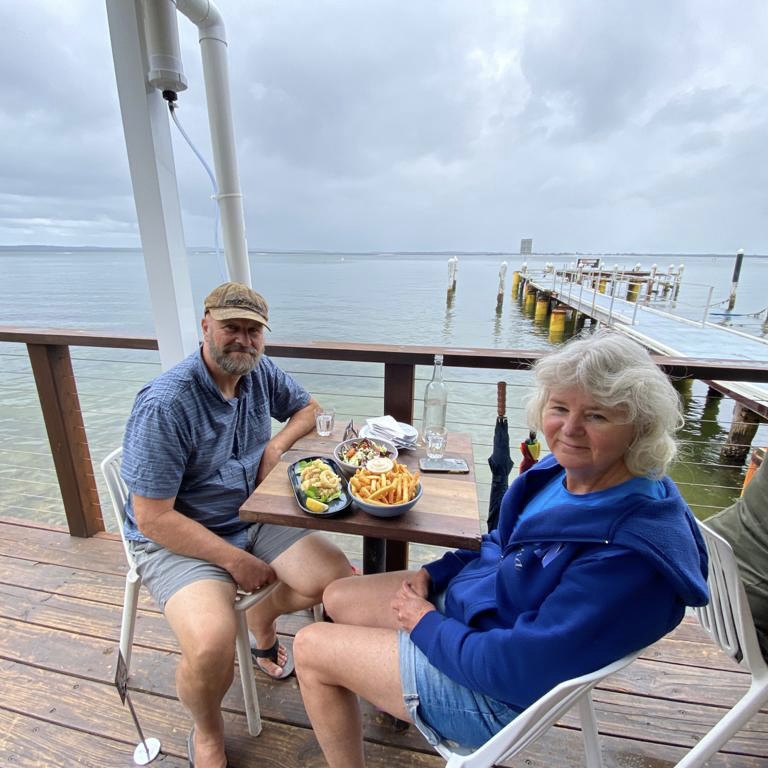
I have struggled to prioritise rest, often seeing it as an absence of work rather than a blessing from God. In the early years of my ministry I developed a habit of working late into the evenings (or early mornings) to achieve a high volume of work. When I had space, my tendency was to add more work rather than see it as an opportunity for margin. My proclivity to overwork, and working with insufficient rest, has continued through the years. Sadly, I’ve often taken my wife and family for granted in my busyness. Let me reflect on a few lessons that I am still learning about God-given rest:
1. The Scriptures encourage us to value the gift of rest. They move through the picture of God working and resting, establishing a pattern of daily and yearly sabbath rhythms, to the final eschatological fulfilment of rest in Christ. God made us to work and to rest, but we are not defined by the six days or the one. God calls us to keep our focus on the rest Jesus offers—a rest for our souls. Understanding this has rescued me from my early foundations of legalistically doing no work on Sundays, but I am yet to fully treasure God’s sabbath rest.
2. Rest is not optional. Recent health issues and the creeping of the years have led me to be more realistic about the importance of rest. Sleep is essential to nurturing our physical, mental, social and spiritual health. God could have created us without a need for sleep, but he did not. Even his Son required sleep while on earth, so why would I push on as though I had more capacity than Jesus?
3. Rest is vital to effective work. Rest is not merely the absence of work, but a variety of restorative processes that enable creativity, productivity, satisfaction, fulfilment and more. God has created us to function well and live productively through good rest. Such rest can take many forms. It can be active, challenging, playful, sleep, naps, exercise, sabbaticals and much more.
4. Rest creates margin. Margin enables us to cope with the extra demands that come our way. Given the complexity and uncontrolled nature of much ministry life, margin is critical to self-care and resilience. If we operate with full diaries and calendars, then any change or interruption will create a jam. This will lead to living in the ‘red zone’ of stress and burnout. Margin in emotional energy is an over-looked category for many Christian leaders. When we become emotionally overloaded, our resolve to serve God and love others gets eroded. Everything becomes more difficult. When we’re emotionally resilient, we can deal with much that happens.
5. Rest is loving to others. Overwork is unloving to others. Long hours, missed days off, for weeks on end, year after year. This isn’t a badge of honour. It’s a walk of shame. I’ve often failed to see or acknowledge that I’ve been taking others for granted. God’s call to take a day off has an impact for all around you. Others can rest because you are resting. Family can do things together, you can get time with your wife, go on holidays, contribute around the house, take an interest in what others are doing. Workaholism may not be as catastrophic as alcoholism, but it too can leave many people damaged.
6. Rest gives glory to God. As we embrace true rest in Christ, we are liberated from being pre-occupied with ourselves and our performance. I’ve recognised that some of my overwork has been driven by a desire to be seen as a high achiever. My unwillingness to value rest has been caused by a failure to see rest as a generous and vital gift from God. The Sabbath has always been about trusting God to be at work when we are not. True rest is about giving God the glory that only he deserves.
Further reading:
Alex Pang, Rest: Why You Get More Done When You Work Less. Great Britain: Penguin Life, 2018
Matt Perman, What’s Best Next. How the Gospel Transforms the Way You Get Things Done. Grand Rapids: Zondervan, 2014 (Chapter 16)
Geoff Robson, Thank God for Bedtime. Sydney: Matthias Media: 2019
Peter Scazzero. The Emotionally Healthy Leader. Grand Rapids: Zondervan, 2015
Richard Swenson, Margin: Restoring Emotional, Physical, Financial, and Time Resources to our Overloaded Lives. (Revised Ed.) Colorado Springs: Navpress, 2004
I grew up reading something from the Bible most days. We would often read a few verses as a family around the dinner table. I would read bits of the Bible as I headed to bed each evening. Sometimes I would find help from reading guides or devotional books that drew application from the Bible passages or gave explanations as to their meaning.
My first Bible was a Revised Standard Version given to me by my grandparents, and I shifted to a Good News Bible in my teens. This gave way to a New International Version when I started university and began exploring the Bible in more detail. These days I have multiple translations available and a Bible App on my phone and computer that allows me to read the Bible in any version.
Reading the Bible is both similar and different to reading other books. Most books are intended to be read from cover to cover. You start at the beginning and follow the plot to its conclusion, usually on the final page. However, when it comes to the Bible very few of us read it this way. The Bible is one book, but it is also a compendium of sixty-six books. There is a coherence to each book in the Bible and an overarching coherence to the Bible as a whole. There’s a kind of dialogue that takes place with each part informing the overall picture and the overall picture informing each part. Some parts only start to make sense after we’ve read other parts and the key to understanding it all is discovering the central place of Jesus Christ. The Old Testament points to Jesus Christ and only makes sense once we recognise that all God’s promises find their fulfilment in him. The New Testament spotlights the life, death, and resurrection of Jesus and explains how this good news transforms people’s lives for eternity.
So, let me ask you, have you read the Bible? Not just sampled it—but have you really read it? Have you searched the Scriptures to discover God’s word to you, God’s purpose for life, God’s love for his world, God’s hope for our future? Have you delved deeply into the Word that brings life, and have you done this with regularity, and purpose, and effort, and humility? Have you drank deeply from God’s Spirit-inspired Word?
Why not make 2022 the year you either begin or get back to searching the Scriptures? Some years back I made the decision to do exactly that. I found a plan called Search the Scriptures that would help me read the whole Bible in three years. It took me close to five years as I would keep missing days! It provided a plan that led me through the whole Bible and let me move between Old and New Testaments. It didn’t spoon-feed me answers or give me inspirational stories. It just kept me on track by asking helpful questions of each section of the Bible and I’d write my answers in a notebook.
When I first bought Search the Scriptures it came in three volumes — one for each year. Now you get the whole three years packaged together into one volume. You can even get an English Standard Version of the Bible with the Search the Scriptures questions inserted into the text. This might be helpful if you were travelling and only wanted to carry one book, but I prefer to keep my notes separate to my Bible.
Over the years I have given away dozens of copies of Search the Scriptures. And I’m still getting feedback that it genuinely helps people to read the Bible for themselves. Why not give it a shot?
Would you like to join me in reading the Bible in 2022? My plan is to read it cover to cover following a plan that gets me reading Mondays to Fridays every week. The beauty of this plan is that I can use weekends to catch up if I get behind. Or I can do something different on Saturdays and Sundays.
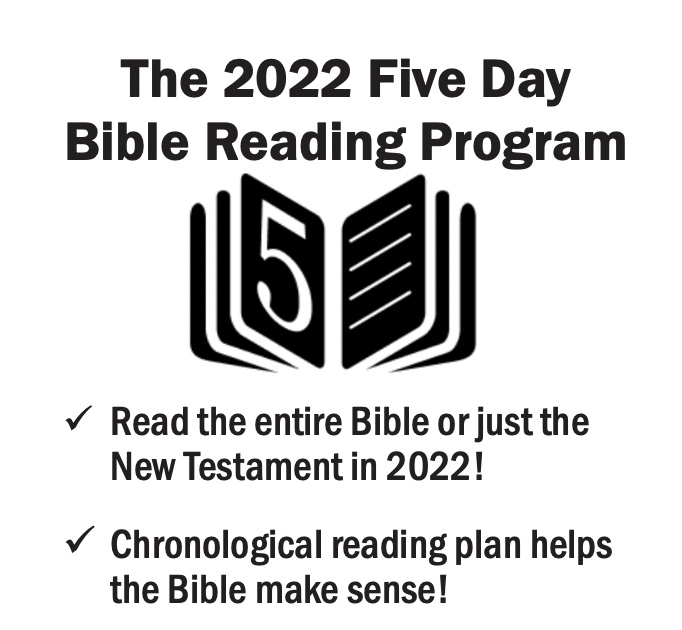
Tim Challies recommends this Bible reading program, which enables you to read the entire Bible (or just the New Testament) in one year while only reading five times a week. Reading the whole Bible in a year is doable — even for those who wouldn’t see themselves as good readers. It just takes stickability. If you’re like me, and have failed repeatedly to read the Bible every day for 12 months, then this plan might well be the answer.
The Old Testament readings follow an approximate chronological order. The New Testament readings spread the Gospels out throughout the year to keep you regularly coming back to the life and teachings of Jesus.
Challies recommends doing the readings in the order they appear on the Schedule. You can check off each day’s reading, and then check off each week in the Weekly Progress Register. If you really want, you can get ahead by continuing the plan on weekends. It’s encouraging to see how systematically you progress through the Bible and how rewarding this can be.
Before you start each reading, ask God to help you get to know him better, that you might trust him more completely and follow him more closely.
I will be kicking off my plan on 1 January 2022. If you’d like to join me, then I’d love to hear from you. Click below to download Bible Reading Program.
My other tip for reading the Bible in a year is to write a few notes as you go. Get yourself a cheap exercise book, spend a little more for a fancy notebook, or find a diary with enough room to write some notes. Jot down what you learn, any questions to follow up, and what you plan to do in response to God’s Word. This can also give you things to pray each day, as you talk to God about what you are learning.
Today marks 10 years since I was diagnosed with Stage 4 ALK+ lung cancer. 10 years! I’d been given 10 months. And it’s been 10 years! That’s 3650 days, plus 3 for leap years. God has given me 3653 more days to number. What does it mean to number my days? The words come from Psalm 90:
12 Teach us to number our days, that we may gain a heart of wisdom.
13 Relent, Lord! How long will it be? Have compassion on your servants. 14 Satisfy us in the morning with your unfailing love, that we may sing for joy and be glad all our days. 15 Make us glad for as many days as you have afflicted us, for as many years as we have seen trouble. 16 May your deeds be shown to your servants, your splendor to their children.
17 May the favour of the Lord our God rest on us; establish the work of our hands for us— yes, establish the work of our hands.
I’m learning not to take my life for granted. It’s not random or accidental—it’s a gift from God. He has made me for his purposes. And his purposes are far greater than any I could manufacture for myself.
I’m a very slow learner. So it’s taking some time to start each day with my heart fully satisfied with God’s unfailing love. Gratitude hasn’t been my strong suit. I fail to see what’s in front of my face. A beautiful wife, an awesome family, a fantastic church, some fabulous friends. I struggle to say thank you to doctors and nurses, and scientists and pharmaceutical companies (yep), and my cancer crew who’ve walked this challenging journey with me. But worst of all, I often forget the solid constancy of God’s unfailing love.
I’m so tempted to attach God’s love to my circumstances: It’s sunny—he loves me. It’s raining—he doesn’t. I’m NED—he loves me. The cancer’s back—he doesn’t. I’m happy—he loves me. I’m depressed—he doesn’t.
God’s love is truly unfailing and deeply satisfying. He has demonstrated his love by sending his precious son. The death of Jesus is God’s promise of love, written in blood. If you grab hold of this love, then no one and nothing can take it from you. Do you know this love? Does it satisfy you every morning?
I’ve been given 10 years. 3653 precious days with my family. 3653 days to love and serve my Father in heaven. 3653 days to make a difference in this world. 3653 days to face my failures and find forgiveness from my Father in heaven. And every one of these days has been a gift from above.
I thank God for his kindness. I thank you for your prayers and support over the past 10 years. I have no expectation and certainly no claim, but I’d love 10 more years, and perhaps 10 more after that. But deeper still, I have a hope beyond this life, a hope beyond cure. And I look forward to the day when there will be no more tears, no more pain, no more suffering, and no more death. God has promised an eternity with him for all who trust in Jesus.
If you want to know more about this hope, then send me a note.
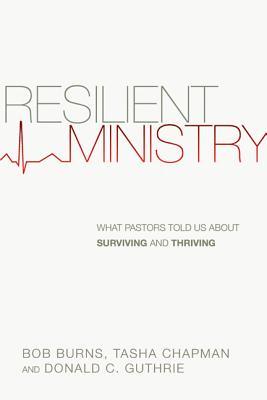
Resilient Ministry by Burns, Chapman, and Guthrie has remained unopened on my bookshelf for the past five years. This has been an unfortunate mistake. It is a rich resource that would have served me well in my ministries of leading churches, a denomination and, more recently, in mentoring, coaching, and pastoral supervision. Anachronistically, I wish this book had been required post-theological college reading when I began ministry in 1990.
The central thesis of Resilient Ministry is that there are five themes integral to resilient ministry. These themes emerged from analysing the data from multiple pastors’ summits, where cohorts of pastors shared together about their joys and struggles in ministry. The authors have continued to test-drive and implement these themes to build resilience among pastors and their teams. The five themes for resilience are spiritual formation, self-care, emotional and cultural intelligence, marriage and family, and leadership and management. Each of these themes is addressed in two parts that can be described loosely as diagnosis and prescription.
Spiritual formation Theological knowledge does not automatically translate into maturity. A theological degree or ongoing Bible study can fill the head without filling the heart or shaping the hands. Pastors must remember they are always sheep first and shepherds second. Pastors are at risk of “building their identities and worth around their roles and performance rather than being beloved children of God.”[1] It is essential to be nourished by a deep interior life with God in order to be equipped to work for God.[2] Spiritual ministry should come from the overflow of a heart shaped by God.
Data from the pastors’ summits identified key practices for growing in spiritual maturity. These included building rituals and rhythms into life, especially around spiritual disciplines such as prayer, keeping Sabbath, personal and corporate worship. Pastors craved confidantes with whom they could be accountable. Intentional reflection was recognised as essential for watching your life and doctrine and can lead to ministering from a place of humility and ongoing learning.
The importance of spiritual formation resonates for me in ministry. I have learned to apply every sermon and Bible study to myself before asking how it might apply to the congregation. I need to slow down, reflect, and spend more time meditating on God’s Word, asking God to transform my heart. However, I tend not to use the language of ‘spiritual formation’, preferring to speak of being ‘transformed into the likeness of Christ’ (Romans 12:1-2). I believe this helps me to be more discerning about the range of spiritual recipes on offer by asking “will this help me to grow in Christ-likeness?”
Self-Care Pastors must admit and appreciate that they are creatures with physical, mental, emotional, social and spiritual needs. This impacts such areas as sleep, boundaries between family and work, exercise and diet. Some pastors embrace a formula of ‘burning out, rather than rusting out’. The authors identify this as a false polarity, recommending a better approach is “burning on, not burning out.”[3] They describe many pastors as people-pleasers, struggling with the “never-ending treadmill of trying to satisfy others whose expectations cannot be met.”[4] Ministry can also become an idol, leading to people neglecting self-care in order to achieve ‘success’ in their ministries. The problem of pastors finding their identity and purpose in their work rather than in God means that a perceived ‘successful’ ministry may cover over personal failure.
Engaging in quality relationships is promoted as vital to self-care. Especially significant is the opportunity to find encouragement from cohorts of peers outside the pastor’s immediate ministry context. Creating margin in life and ministry and taking time to recharge are important for longevity in ministry.
Self-care has been an ongoing challenge for me. As I reflect on three decades of ministry, I can see how I have sacrificed self-care on the altar of ministry drive and ambition. This has led to patterns of inadequate sleep and exercise, insufficient margin in daily timetables, missing days off, and pushing on until sickness has caught up with me. Many years I would expect to crash physically and emotionally after a particularly busy period in June and July. Annual holidays became an important but insufficient ‘catchup’ for my periods of neglecting self-care.
Being diagnosed with terminal cancer confronted me with critical questions around my identity and my dispensability. No longer able to preach, lead, or pastor a church, I was painfully and yet wonderfully reminded that my true and enduring identity lies in being my Father’s adopted son. Over the years since, as my health has improved and I have returned to pastoral ministry, these bad habits have continued to haunt me and I have sought help from my mentors to keep addressing challenging matters of self-care.
Emotional and cultural intelligence A strong theme in both these areas concerns how easy it is to “assume that our way of looking at things is the only way to look at things.”[5] Emotional intelligence involves insight into our own emotions and the ability to respond well to the emotions of others. Cultural intelligence involves awareness of the different belief systems, values, customs, assumptions, practices, and the like, that shape how people see themselves and relate to others.
Reflection is one of the key factors identified for building emotional intelligence. The authors suggest such practices as journaling, exploring family genograms, differentiating to connect with people, and welcoming feedback as strategies for growth. My experience concludes that growth in EQ is a critical characteristic of effective and safe ministry to others. It bridges the categories of character and competency and should be considered when appointing, assessing, and coaching leaders.
Cultural intelligence is also a critical factor for effective ministry. Empathy is required to understand where people are coming from, what has influenced them, and why they hold certain values or worldviews. One of the reasons that ministries fail to embrace changes in society around them, and subsequently die, is that ministry leaders lack cultural intelligence. Again, the authors highlight reflection as one of the necessary means to building CQ.
Marriage and family The summits identified marriage and family as playing a critical role in sustaining pastors. Thus, spouses were invited to participate in aspects of the program. The challenges lay in the areas of navigating boundaries between marriage and family life on the one hand and the job of ministry on the other. There are significant stressors for pastors who often work from home, don’t clock off, and don’t tune out. Damage can easily be done to marriages and families when the pastor is unable to manage the complexity of dual or multiple relationships.
I have especially felt these challenges and pains. There have been many times when I have been overly busy to the neglect of my family. While I have sought to be present with my wife and family, I know there have been times when they have been left with the dregs. This has been compounded over the years of juggling cancer treatment and trying to maximise ministry in the good periods. Loving my wife, children, and now grandchildren, is a matter of importance where I want to keep improving.
Leadership and management The authors embrace the images of poetry and plumbing to describe the differences between leadership and management.[6] They identify reflecting as an important and real leadership work. This is the picture of working on the ministry, not just in the ministry. In my experience, and as I have observed and coached other pastors, this is a neglected discipline. Efficiency often trumps effectiveness. Leaders, operating without margin, keep getting more and more busy without seriously evaluating what they are doing.
Resilient Ministry highlights the treasures to be gained through systems analysis, especially through deliberately building maturity into our church systems. Understanding church systems opens new doors of EQ and CQ that can lead to a growing calm among leaders. This has been a watershed resilience area for me, as it has led to growing awareness of what I can and cannot do, and to trust God more and more.
The authors identify “modelling, shepherding, managing expectations, supervising conflict, and planning”[7] as essential plumbing tasks. I am aware that not all these are adequately explored in theological training, which means that many pastors are ill-prepared for the pressures of leadership. There is a need for specialised professional development throughout ministry. My early experiences of conflict in ministry, grappling with leading organisations, learning to train, supervise and mentor leaders, quickly highlighted the gaps in my college education and set me on a continual life-long learning trajectory.
Further reflections
Firstly, the integration of features contributing to resilience in ministry is a big strength of this work. There is no silver bullet for resilience, but rather a complex interaction of many factors.
Secondly, personal reflection is a valuable practice that helps builds resilience in all five themes. Busy ministers must set aside time to slow down and reflect on themselves and their ministries. Without such reflection pastors will burn out, while repeating the mistakes of the past over and over.
Thirdly, Resilient Ministry leads pastors to recognise the vital impact that can be made from reflective practice in conversation with a confidante. As a ministry mentor, coach, and pastoral supervisor, I will draw on this book in shaping my work in helping pastors and ministry leaders to grow more resilient. This book contains excellent questions for reflection, modelling what it preaches. I intend to ask these questions of myself and others.
Lastly, one weakness of this book is its limited engagement with the Bible. Being primarily the analysis of data gleaned from summit participants, it requires further analysis to determine how well the diagnoses and prescriptions fit with the Scriptures. I know that many of them will fit well, and I plan to explore these themes with my Bible open.
[1] Bob Burns, Tasha Chapman, and Donald Guthrie. Resilient Ministry: What Pastors Told Us About Surviving and Thriving. Downers Grove, IL: IVP Books, 2013. P32.
[2] Peter Scazzaro in Emotionally Healthy Spirituality, quoted in Burns, Chapman, and Guthrie. P37.
[3] Dave Gibbons in The Monkey and the Fish, quoted in Burns, Chapman, and Guthrie. P61.
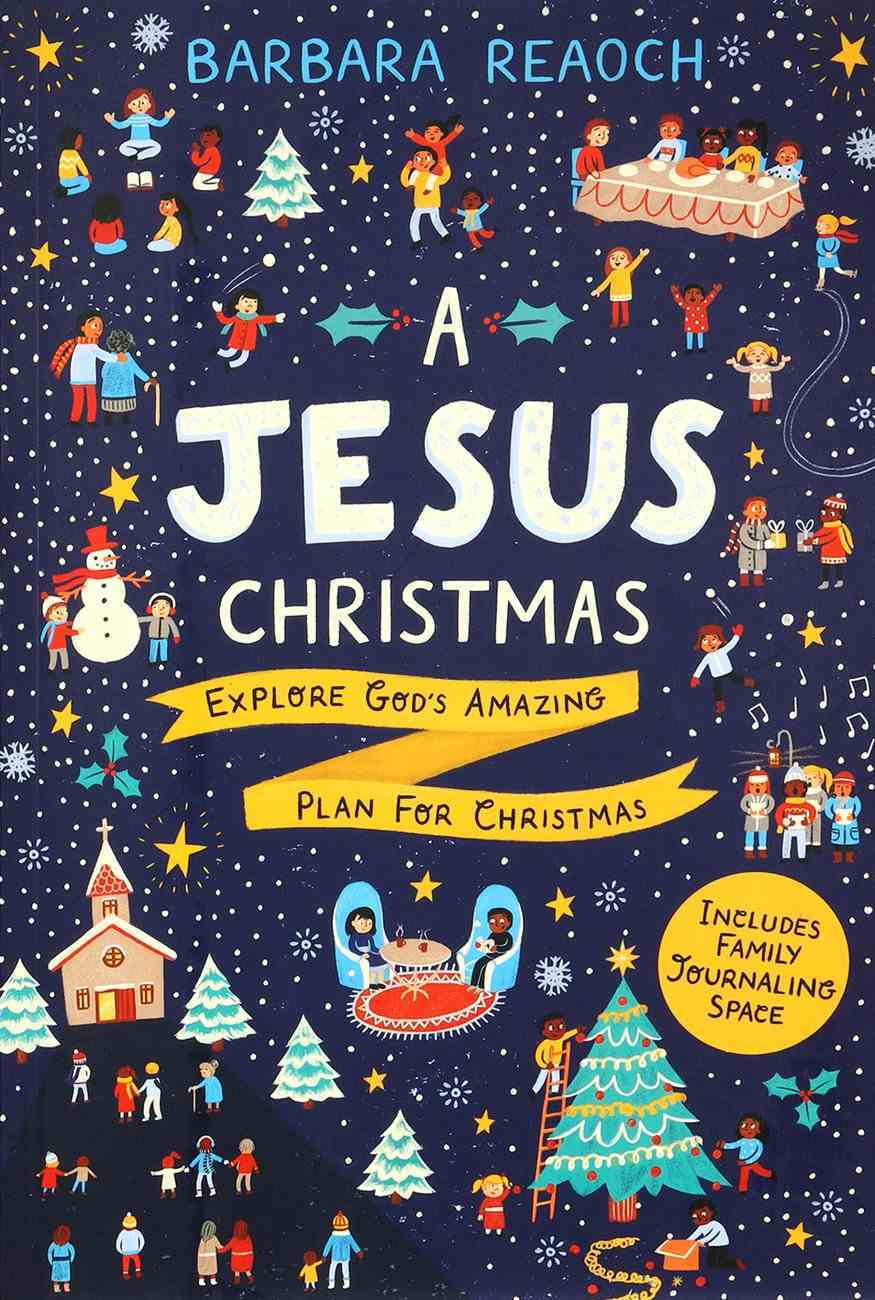
December has arrived and there are now only 25 days until Christmas. How is your planning going? Are you planning to cross state borders, to holiday at the beach, to catch up with family, to put on a big lunch, to splurge on presents? Have you ever stopped to consider God’s plans for Christmas? Not just our annual public holiday, but the very first Christmas—the arrival of Jesus. God’s plans had a very long lead up and they were far more expensive than we could ever imagine.
I want to invite you to join with me reflecting on the real meaning of Christmas over the next 25 days. We will spend the first 12 days of Christmas exploring God’s advance planning in the Old Testament. The next 12 days we will look closely at what God was doing as he sent his Son into the world. I will be following a book, written for families to help adults and kids understand Christmas beyond the festivities and consumerism. This is a message of rescue and we are the ones who need it.
If you would like to explore A Jesus Christmas: Explore God’s Amazing Plan for Christmas by Barbara Reaoch, then I encourage you to seek out a copy asap. If you would like to join me as I present daily short talks on YouTube, then you will find the first talk here. You can subscribe and click on the bell to receive notifications of each new talk.
Confronting Christianity: 12 Hard Questions for the World’s Largest Religion by Rebecca McLaughlin is one of the most impressive defences of the Christian faith that I have read. It is robust, educated, well researched, gentle, and empathic. This is a book for people willing to take the time to consider challenges to Christian beliefs. Today’s culture tends to shut down reasoned discussion of theology, humanity, religion, and ideologies running counter to the winds of society. McLaughlin reopens the discussion and argues persuasively that Christian faith is a very reasonable worldview to hold.
McLaughlin doesn’t shy away from the tough questions. A scan of the chapter headings reveals her willingness to confront the big challenges:
Aren’t we better off without religion?
Doesn’t Christianity crush diversity?
How can you say there is only one true faith?
Doesn’t religion hinder morality?
Doesn’t religion cause violence?
How can you take the Bible literally?
Hasn’t science disproved Christianity?
Doesn’t Christianity denigrate women?
Isn’t Christianity homophobic?
Doesn’t the Bible condone slavery?
How could a loving God allow so much suffering?
How could a loving God send people to hell?
This isn’t a book that sweeps the problems under the carpet. McLaughlin acknowledges the harm and problems created in the name of religion and, specifically, Christianity. The history of Christians is a history of failure and weakness, but it doesn’t destroy the credibility of the faith. McLaughlin shows a deep understanding of history, she faces the challenges of contemporary culture front on, and she displays a deep understanding of the biblical text. Her experience in the world of academia, her empathy for people struggling with their identities in a changing world, her willingness to listen carefully to the critiques of others, and her clarity of conviction in her argument are all on display in this book.
There are many surprises in the pages of this book. We discover things about the author, her research and experience, her family and friends that give us confidence that she is not one for trite or simplistic rhetoric. She understands and feels what she writes about.
It is no surprise to me to discover that Confronting Christianity has been awarded the Christian book of the year in 2020. Having read it, I have already started giving copies away to others. I anticipate keeping one or two extras on my shelf for interested enquirers and religious sceptics alike. I will recommend it to new and old believers who are wanting to better understand their beliefs in today’s critical climate. I suggest purchasing at least two copies. One for yourself and the other for someone you care about.
O Christmas Tree by Judith Hickel and Sarah Ang takes a gospel-shaped musically-inspired, fresh look at the meaning of Christmas. This is an attractive book that invites small children (and their adult readers) to explore a deeper significance to some traditional Christmas decorations. Children are drawn into the story through guessing games and familiar musical introductions. We are invited to rethink Christmas trees and baubles and presents and a star. If we’ve grown a little tired of Christmas decorations—ho ho ho, hum, hum, hum—then this book reminds us what an amazing event we are celebrating . We are lifted beyond predictable nativity scenes to explore the good news of Jesus with fresh eyes and ears. The message gets embedded and reinforced as we sing along to Christmas songs with some new and improved lyrics. And I think they might just catch on.
The author, Judith, is an Australian living in Germany, who writes within a European context. Those who love a white Christmas with all the trappings will warm to this book. That said, Christmas is a universal message, that is just as relevant under the heat of an Aussie summer. O Christmas Tree makes a great gift idea for small children this Christmas. And especially those who love a singalong.
Every now and then I read a book that really captures my heart. The majority of them are written for adults. Most require a significant investment of time and attention. Many require me to read back over material to allow it to sink in, permeate my thoughts, convict my soul, and drive my future. Few, if any, have pictures.
This one is different. Melissa Kruger has written and Isobel Lundie has illustrated a delightful book that captures our hopes and prayers for our grandchildren. Had it been written twenty years ago, we would have said our children. We are buying in bulk and there will be more than one family receiving this book for Christmas. It is a life-affirming, adventurous, fun-loving, focus on the question—What do you want to be when you grow up?—with a punch line that is all about Jesus.
This week I have achieved my goal of walking 60 kilometres—specifically, 61.8 km in the last seven days. That might not seem like much to some of you, but it is the furthest I’ve walked in over 10 years. And, to be honest, I wouldn’t have thought it possible. Fiona and others have been calling me for years to pay more attention to my health and fitness, so I am hoping this is the beginning of something, rather than a flash in the pan.
The reason for this week has been to join a bunch of my ‘cancer buddies’ raising support for the Peter MacCallum Cancer Institute in Melbourne. This place is so important to overcoming cancer, not only in Australia, but it the world. And how amazing to have a public hospital devoted to world class outcomes for people with serious and often terminal diseases. I was inspired by one of my friends Lisa, to join this fund raiser on the day it started. And I’m so glad I did.
I set a target of raising $10000. To be honest, I thought $2000 at first. But then I realised, let’s be a bit more aspirational. After all, that is only 100 friends giving $100. Well, we are over 40% of the total and the campaign continues for a few more days. Please consider whether you can give a little or a lot to support this valuable centre that is helping my friends and I to live longer and better with a terminal disease.
This morning I read some stats from a US research company on how Americans are managing the pandemic. The results aren’t at all surprising, but they are a cause for alarm. I haven’t seen equivalent research for the Aussie context, but I doubt our figures would show any improvement.
To help them cope with the pandemic, most Americans said they are staying home to watch Netflix and chill: 89% reported that they are watching TV or movies daily or weekly. This includes 90% of all Christians, 87% of Jews and 88% of the religiously unaffiliated, according to Pew.
Many Americans (84%) also are spending time outdoors or talking by phone or video with family and friends (70%), the survey said.
But fewer are turning to their faith for support.
More than half (55%) reported praying at least weekly, followed by reading Scripture (29%), meditating (26%) and practicing yoga (8%).
This confirms indications that there has been a rise in prayer during this period. Though, I wonder if longitudinal studies will demonstrate a spike in ‘crisis’ prayers tapering off with things becoming more ‘chronic’.
A worldwide crisis calls Christians to worldwide prayer. Now is the time above all to be drawing near to God for comfort and strength. Now is the time to listen to God, to be reminded of his intense glory,hissovereign power, his promise to judge the wicked, is loving mercy, his grace to the humble, the incarnation of his Son, and his promise of restoration to come.
As I speak with my Christian friends, I fear we have the balance wrong. Some of us are watching news almost ever waking minute of everyday. Our minds are saturated with numbers, testing, positive cases, epicentres, hotspots, clusters, close contacts, numbers in ICU, deaths. The numbers are staggering, catastrophic, overwhelming, even numbing. And then, as if for relief, we add US-China tensions, Beirut blasts, political posturing, and football.
I tend to watch an hour of news most days, local and international. I flick around the internet, checking reports, reading an online paper, following news feeds. We often watch a show in the evenings. Maybe a miniseries, or a movie, or a catch up of some old series we enjoyed. Some are glued to screens most of the time. The most honest advertising I’ve seen recently was the introduction of Foxtel’s new streaming service and calling it ‘Binge’. (If only the gaming, alcohol, and tobacco industries were so honest about their intentions.) The aim is addiction. You can escape into another world and leave the real worries of this world behind—until you have to work again tomorrow after 2 hours sleep.
OK, so what am I recommending? Listening to God daily. Taking the time to read from the Bible. Hearing God’s perspective on what matters matter most. Discovering an antidote to anxiety and fear. Being reminded of God’s deep secure love and his promise to never leave nor forsake us. Grappling with the questions of suffering and pain, death and disaster. Having our hearts warmed by the rich mercies of God in Christ Jesus. Being comforted by the Comforter, who dwells in all who trust in Jesus. Being moved beyond ourselves to show love and compassion to others.
Can you find time each day to turn off the TV, put away your device, open a Bible—yes, a real one, with a cover, paper pages, where you can highlight, jot notes, flick between passages, and come back to things you’ve read before?
Why not change the TV diet. A little less Netflix. Listen again to the sermon from Sunday. Start a reading program. Mix it up. Dwell deeply in the Psalms. Explore the existential questions in Ecclesiastes. Take an attitude check with James. Rediscover worship in Romans 12. Recharge for ministry from Philippians. Investigate Jesus from the Gospels.
During the pandemic I’ve been aiming to record a Bible talk each day, with the aim of encouraging people from our church, and others, to keep a regular balanced diet of God’s word. There are talks for enquirers, equipment for people in ministry, encouragement to godly living, and calls to persevere under trial. Why not replace a little TV, with a regular Bible Bite.
It started as a pandemic project, but I’m hoping to keep it going. It’s been encouraging to hear from husbands and wives who watch an episode each day over coffee to explore God’s word together, from people who are sick and appreciate a brief exposition, from a Christian radio station who are broadcasting them, from Bible study leaders who have used them to supplement their programs, and from people isolated here and abroad, who have been encouraged by God’s word.
Please have a think about your spiritual diet. Check out the talks at http://youtube.com/c/davemcdonaldbibletalks and subscribe for regular updates. I’d love to hear how you use them and if they’re a help in any way.
You can find the following Bible Bites (5-10 minutes): Psalms (3 talks ongoing) Ecclesiastes (38 talks) Philippians (22 talks) Titus (19 talks ongoing) James (23 talks)
And the following sermons (roughly 20 minutes): Romans 12 (10 talks) 2 Corinthians (2 talks ongoing)
I listened last night as representatives of the World Health Organisation described our world as a tinder box. It will only take a spark here or there to keep fuelling the flames of our global pandemic. I watch with dismay as the state of Victoria records the highest total daily coronavirus cases on record. Sydney is declared a hotspot and people around me are starting to wear masks. I’m distressed as I hear that my nephew is infected with Covid-19 and quarantines from family and friends.
How long, O Lord? When will we meet again? When will you bring relief from our pain?
Being a Christian isn’t a sprint—it’s a marathon. We face many trials and difficulties of many kinds. There are stresses and struggles to hinder our path. There are threats and dangers to persevering in Christ.
James offers us half-time encouragement. He cheers us us on from the sidelines, and his letter offers refreshment and sustenance for the race.
James also warns us of the threats within us. There are huge dangers of going through the motions. We can easily pay lip surface to our Christian faith, failing to watch our mouths, ignoring the needs of the poor and needy, and being double-minded in our attitudes.
Please join me in listening to James. You can find short talk ‘Bible Bites’ on You Tube at http://youtube/c/davemcdonaldbibletalks
You could listen to a talk a day
Grab a coffee, open your Bible and laptop
Join with your spouse and discuss a couple of points together
Use in your growth groups face-to-face or via zoom
Share with your mission partners
Stimulate a conversation with friends via facebook
That’s been my (almost) daily refrain during lockdown. I’ve worked slowly through Ecclesiastes. This is the end of Philippians. And now I’m beginning the book of James.
Philippians has been a huge encouragement to me to realign myself with the gospel. To see afresh the humility of Jesus and to give myself for the sake of others.
This final chapter of Philippians calls us again to work out our differences and be united. We are encouraged not to be anxious, but to seek God’s help. We are reminded that we need spiritual food to survive. And we learn the secret of contentment.
I hope you are encouraged by these Bible Bites from Philippians.
In Philippians 3, the Apostle Paul exposes the vulgarity of self-righteous religion. He explains how Christianity is not about what we do for God, but what he has already done for us. He reveals how following Jesus is a relationship, not a set of rules and rituals. He shows how we can know God deeply.
Covid-19 isn’t the only big C going around. Do you remember cancer? Yep. It’s still with us. We haven’t found a cure and there is no vaccine.
I was shocked this morning to hear that Tim Keller has been diagnosed with pancreatic cancer. Who is Tim? I’d say he’s one of the most thoughtful, winsome, well read, visionary, author, preacher, and church leaders of our day. If I get fifty people listening to a sermon, then he’ll get upwards of fifty thousand. If we’ve seen a new church started in a neighbouring suburb, then he’s overseen the planting of large churches in major cities all around the globe.
But “Who cares?” says cancer. It doesn’t discriminate. It will take down the rich and famous, the powerful and erudite, the Chinese and the Americans. Cancer is no respecter of persons. It hides in the background, waits until you least expect it, then… pounce! It finds a location, sets up a base, assembles its troops, and plans its attack. Sometimes it fires a few warning shots—a lesion on the skin, a lump in the breast, a cough that doesn’t pass, some blood in the faeces. But more often than not it works secretly, stealthily, silently, scheming its next moves.
Or so it seems. The truth is that cancer is not ‘out there’ to be avoided by social distancing, lockdowns and hand hygiene. It’s inside us, and from us, and part of us, fighting the rest of us. Cancer is like the internal riots we’ve seen recently in the US. Only it’s happening inside us all the time. Damaged cells. Genetic change. Mutations in the chromosomes. Glitches in the DNZ code not picked up by the spellchecker. Cancer is me going rogue and attacking me.
Cancer brings grief, heartache, pain, suffering, and loss. Many, many will pray for Tim Keller. Many prayed for me. I thank you. Please keep praying. Pray also for wives, husbands, children, parents, siblings, grandparents, friends, and communities.
On Sunday my heart sank to hear that my good friend Andrew has lymphoma. I will be praying for him, and his family. And I will keep praying for many other friends in the grip of this disease. To live with cancer is to walk in the valley of the shadow of death.
The coronavirus has reminded our world that we are mortal. But I fear that it has only half-reminded us. It’s warned us of the possibility that we will die. We’ve heard that we are all at risk. We must take every precaution. We have to protect the vulnerable. If we don’t, then people will die, and in catastrophic numbers.
All that is true. Well, almost. The deeper reality is that we all walk through the valley of the shadow of death. That is our life. The shadow is ever present. We just choose to ignore it. When coronavirus threatens, it gets harder to ignore. When cancer hits, it becomes almost inescapable.
My networks are filled with people finding it very hard to escape this awful truth. Our cancers won’t let us. Lisa, Paul, Lillian, Corey, Alison, Alastair, Anita, Marilyn, Gary, Paul, Graham, Kim, Rita, Zack, Liam, Stephanie, Vangie, Sam, Wendy, Linnea, John, Natalie, Norman, Colin, Jim, Drew, Janet, Steve, Jack, Peter, Max, Jill, Lachlan… and I could go on. We need these words from the 23rd Psalm.
1 The Lord is my shepherd, I lack nothing. 2 He makes me lie down in green pastures,
he leads me beside quiet waters, 3 he refreshes my soul.
He guides me along the right paths
for his name’s sake. 4 Even though I walk
through the darkest valley,
I will fear no evil,
for you are with me;
your rod and your staff,
they comfort me.
5 You prepare a table before me
in the presence of my enemies.
You anoint my head with oil;
my cup overflows. 6 Surely your goodness and love will follow me
all the days of my life,
and I will dwell in the house of the Lord
for ever.
Jesus said in John 10:11
I am the good shepherd. The good shepherd lays down his life for the sheep.
Paul’s letter from prison lockdown to the Christians in Philippi is a warm, heartfelt encouragement to following Jesus. In chapter 2 Jesus’ extreme humility is presented as the model for Christian relationships. Impossible? Certainly, unless God is at work within us to will and to act. We are called to lives of humble gladness rather than selfish grumbling and arguing. Paul’s colleague, Timothy, and his Philippians friend, Epaphroditus, give us a picture of what humble service looks like in practice.
You can link to any of the Philippians chapter 2 short talks via the links below.
I have recorded more than 50 talks during the coronavirus lockdown and you can find talks on Ecclesiastes, Romans 12, and Philippians on my You Tube channel at http://www.youtube.com/c/davemcdonaldbibletalks. Please subscribe.
You are invited to join me working through another book of the Bible. I will be exploring Paul’s letter to the Philippians in bite size chunks each day. Please subscribe to my You Tube channel and click the little ‘bell’ to receive notifications of new posts. Being a novice to You Tube, I had accidentally prevented people from getting notifications, so if you aren’t receiving them, please go back to the channel and hopefully the bell will appear for you to click! Rather than post a link to the talks on my blog each day, I will only post updates from time to time.
Below is a link to the trailer for these talks to introduce people to what I am doing.
My hope is that you are encouraged to get to know Jesus better as you read Paul’s letter to the Philippians and watch these short talks. Click on any of the links below to the talks on You Tube:
We’ve been told that things will never be the same again, and they won’t. The world has shifted. Massive movements of global social tectonic force.
Destruction, disease, death, disaster. People overwhelmed, unprepared, ill-equipped, devastated, helplessness, anxious. Panic, blame, fear, and conspiracy theories. The best of governance and the ugly, narcissistic, worst from leaders. Massive loss. Lives, futures, prosperity.
So much has shut down. Businesses, bars, clubs, sports, homes, schools, churches, parks, beaches, borders, transport and travel.
Everyone is buying phones, tablets, computers, and faster internet. Life has gone online. We compete for screen time. We cry out for more bandwidth. Zoom has become the new Uber.
Learn the tech. Use the tech. Master the tech.
We’re tired. And we don’t know when or where it will all end.
Our values are being challenged. People are three dimensional, not two. We crave touch and intimacy. We weren’t meant to live in isolation. We long to be together. And yet we fear what this will mean.
And now things are changing. Lockdowns are being lifted. We are peering out the window. We’re wandering down the street. People are starting to gather.
What will happen with church?
Pastors are anxious.
We’re being told this is the single most important moment in living history. The platform has burned down. Everyone knows it. We can’t go back. We get to rewrite the script. Lose the bad. Tweak the awkward. Hang on to the good. Create the new.
Unprecedented numbers of people visiting church online. Questions being asked about the meaning of life. New opportunities. Fresh vision. Now is the time.
You’ve got one shot. One opportunity. One episode in time. One opening. One responsibility.
Pastor, don’t blow it!
So much is riding on your shoulders. Your shoulders. This is your moment. God is counting on you. Get it right. God needs you. We need you. They need you. Your family needs you. Your neighbours need you. The community needs you. Everyone needs you.
Be strong. Be resilient. Be wise. Be clear. Be balanced. Be purposeful. Set a vision. Shape your future. Lead your people. Make every word, every decision, every move, every moment count. Don’t mess it up.
Read this blog. Listen to this podcast. Subscribe to this channel. Enrol in this workshop. Come to this conference. Buys these tools. Get this coach. Read this book. Join this movement.
Grab this opportunity. It will only come once. This is a Halley’s Comet moment of momentous magnitude. Don’t waste it. Don’t let it pass. Don’t blow it.
Go harder. Go smarter. Go faster. Go deeper. Go wider.
Are you ready? On your marks. Get set. Go.
Think.
Outside the box.
Design a new box.
Break free from the traditional constraints of boxes.
Create a new box.
Look inside the box.
Look outside the box.
Open the box.
Get into the box.
Close the lid on the box.
Curl up in the box.
Close your eyes.
Gently rock from side to side.
And weep.
Pastor, you are not God. You are not the Messiah. Everything does not depend on you. This is not your one chance in 100 years to make your mark for the gospel.
You may be a shepherd, but you never cease to be a sheep. You shine a light and send a message—not as a lighthouse, but as a flickering candle.
This is not the time to be relying on your strengths, your achievements, your experience, your talents, your gifts. It is not about you. Really. It’s not. This is not your moment.
This is God’s moment.
Do you feel ill-equipped? Do you feel everyone is watching you? Do you feel the pressure of your peers? Do you feel the burden of your congregation? Do you feel the urgency of the times? Do you long to make a difference, not blow it, not crumble, not give up?
Then don’t panic! Truly, DON’T PANIC!
Come to God. See his grace. Hear his kindness. Trust him in your weakness. Listen to his voice…
8 We do not want you to be uninformed, brothers and sisters, about the troubles we experienced in the province of Asia. We were under great pressure, far beyond our ability to endure, so that we despaired of life itself.9 Indeed, we felt we had received the sentence of death. But this happened that we might not rely on ourselves but on God, who raises the dead.10 He has delivered us from such a deadly peril, and he will deliver us again. On him we have set our hope that he will continue to deliver us,11 as you help us by your prayers. Then many will give thanks on our behalf for the gracious favour granted us in answer to the prayers of many. (2 Corinthians 1:8-11)
7 But we have this treasure in jars of clay to show that this all-surpassing power is from God and not from us.8 We are hard pressed on every side, but not crushed; perplexed, but not in despair;9 persecuted, but not abandoned; struck down, but not destroyed.10 We always carry around in our body the death of Jesus, so that the life of Jesus may also be revealed in our body.11 For we who are alive are always being given over to death for Jesus’ sake, so that his life may also be revealed in our mortal body.
(2 Corinthians 4:7-11)
16 Therefore we do not lose heart. Though outwardly we are wasting away, yet inwardly we are being renewed day by day.17 For our light and momentary troubles are achieving for us an eternal glory that far outweighs them all.18 So we fix our eyes not on what is seen, but on what is unseen, since what is seen is temporary, but what is unseen is eternal. (2 Corinthians 4:16-18)
Therefore, in order to keep me from becoming conceited, I was given a thorn in my flesh, a messenger of Satan, to torment me.8 Three times I pleaded with the Lord to take it away from me.9 But he said to me, “My grace is sufficient for you, for my power is made perfect in weakness.” Therefore I will boast all the more gladly about my weaknesses, so that Christ’s power may rest on me.10 That is why, for Christ’s sake, I delight in weaknesses, in insults, in hardships, in persecutions, in difficulties. For when I am weak, then I am strong. (2 Corinthians 12:7-10)
14 May the grace of the Lord Jesus Christ, and the love of God, and the fellowship of the Holy Spirit be with you all.
(2 Corinthians 13:14)
It is better to go to a house of mourning than to go to a house of feasting, for death is the destiny of everyone; the living should take this to heart. (Ecclesiastes 7:2 NIV)
The horrors of the COVID-19 pandemic have plastered our screens with death, day after day after day. We watch death tolls rising in the virus epicentres. We follow, in fear and relief, the flattening of the curve in our midst. Everything has changed. And yet nothing has changed. We all face death and the coronavirus is inescapably confronting us with this harsh reality.
(This post is by another member of my family, Sharon, who used this material with our three grandsons)
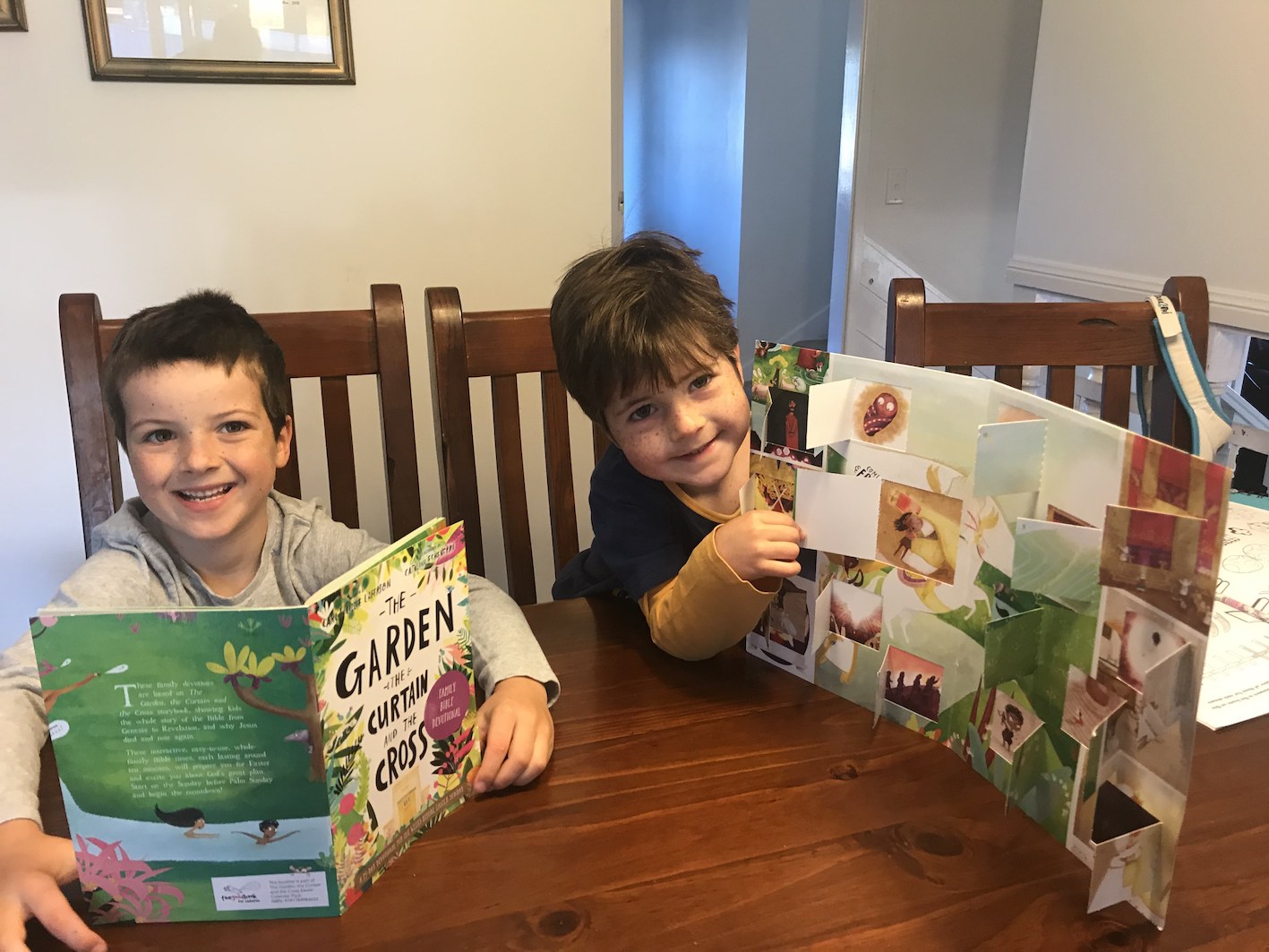
This Easter Sunday morning our family, with our three boys aged 6, 4 and 2, finished The Garden, The Curtain and the Cross Easter Calendar. This is a 15 day family activity program. Each morning for the last 15 days our family has dug into God’s word together. Each family ‘devotion’ takes about 10 minutes. They creatively take us from creation, through the early Old Testament, to the crucifixion of Jesus, and finally to the book of Revelation. The activities are based on a children’s picture book of the same name.
The devotional material is probably aimed at a family with children a little older than ours—primary school-aged children and older. However, even our 4 year old was able to grasp the main concepts and came away challenged in his faith. The pack comes with a booklet of devotions to follow each day from the Sunday 2 weeks before Easter and an “advent” style calendar with 15 flaps to open revealing a picture related to each days study.
Each devotion starts with prayer and a question to get you thinking about the topic. A passage from the Bible is followed by questions about the passage and its application. The material has a guide for how to pray in response to each passage of the Bible, which I found really useful with my young family, as they are still learning to pray. Each day includes a ‘Let’s think a little more’ section, in which the main theme is explored further. We found the main content enough for our family so didn’t use this section.
I particularly loved the way the material walked you through the Bible, clearly showing God’s rescue plan and the reason it was needed. It places a big emphasis on the ‘Keep Out’ sign (angels with swords) that God placed at the Garden of Eden. It then draws a strong link to the curtain ‘Keep Out’ sign at God’s dwelling place in Israel, the temple. Finally, this is torn in two at Jesus’ death on the Cross. The way it explains these symbols, combining them with the pictures in the ‘Advent-style’ calendar worked really well for my boys. My 4 year old was able to remember and explain what the curtain meant for God’s people and how it being torn showed that we were allowed access to God through Jesus once again.
My favourite was day 6, when the solution to the problem of sin was covered. The Israelites needed a sacrificial swap to give them access to the Most Holy Place in the temple, a once a year sacrifice of two goats—one that is killed and one that is sent away— for their sins. The discussion questions and conversation that followed with my boys saw them really grasp their need for a swap and how great it is that Jesus has done this once and for all.
I am already looking forward to revisiting these devotions next year.
Postscript
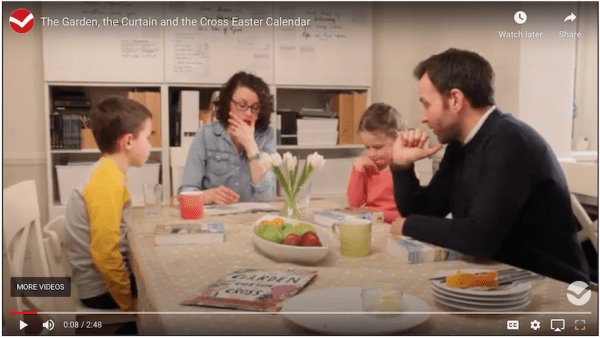
Whether you’re reading this over Easter, Christmas, the school holidays, a COVID-19 lockdown, or any time really… this is a great resource for families. The Good Book Company are currently making available some related free resources. Download these while you can, and watch a video by the authors explaining why they have made this.

 I have struggled to prioritise rest, often seeing it as an absence of work rather than a blessing from God. In the early years of my ministry I developed a habit of working late into the evenings (or early mornings) to achieve a high volume of work. When I had space, my tendency was to add more work rather than see it as an opportunity for margin. My proclivity to overwork, and working with insufficient rest, has continued through the years. Sadly, I’ve often taken my wife and family for granted in my busyness. Let me reflect on a few lessons that I am still learning about God-given rest: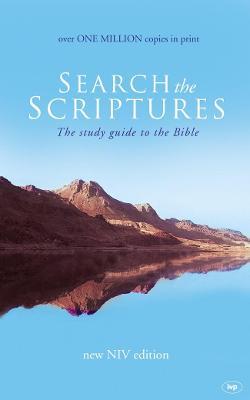
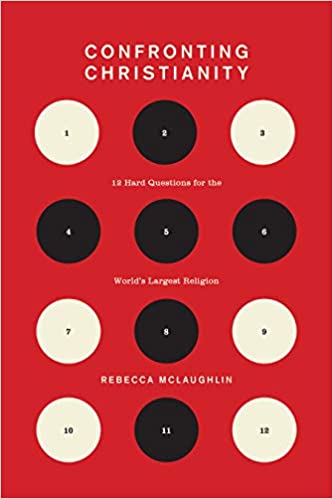 Confronting Christianity: 12 Hard Questions for the World’s Largest Religion by Rebecca McLaughlin is one of the most impressive defences of the Christian faith that I have read. It is robust, educated, well researched, gentle, and empathic. This is a book for people willing to take the time to consider challenges to Christian beliefs. Today’s culture tends to shut down reasoned discussion of theology, humanity, religion, and ideologies running counter to the winds of society. McLaughlin reopens the discussion and argues persuasively that Christian faith is a very reasonable worldview to hold.
 Every now and then I read a book that really captures my heart. The majority of them are written for adults. Most require a significant investment of time and attention. Many require me to read back over material to allow it to sink in, permeate my thoughts, convict my soul, and drive my future. Few, if any, have pictures.
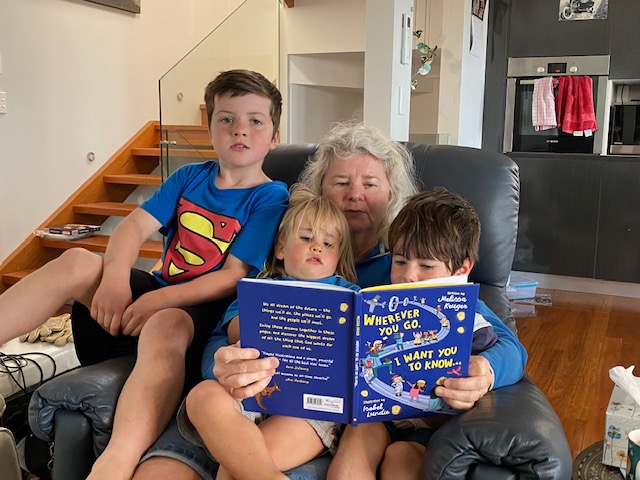 This one is different. Melissa Kruger has written and Isobel Lundie has illustrated a delightful book that captures our hopes and prayers for our grandchildren. Had it been written twenty years ago, we would have said our children. We are buying in bulk and there will be more than one family receiving this book for Christmas. It is a life-affirming, adventurous, fun-loving, focus on the question—What do you want to be when you grow up?—with a punch line that is all about Jesus.
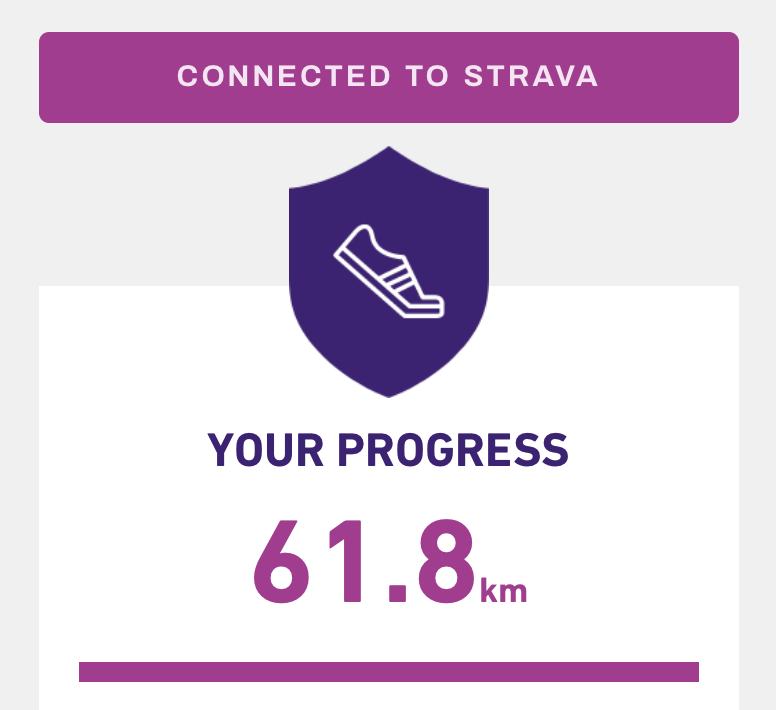
 This morning I read some stats from a US research company on how Americans are managing the pandemic. The results aren’t at all surprising, but they are a cause for alarm. I haven’t seen equivalent research for the Aussie context, but I doubt our figures would show any improvement.
 I listened last night as representatives of the World Health Organisation described our world as a tinder box. It will only take a spark here or there to keep fuelling the flames of our global pandemic. I watch with dismay as the state of Victoria records the highest total daily coronavirus cases on record. Sydney is declared a hotspot and people around me are starting to wear masks. I’m distressed as I hear that my nephew is infected with Covid-19 and quarantines from family and friends.
 “G’day, Dave here, and we’re looking at…”
 Covid-19 isn’t the only big C going around. Do you remember cancer? Yep. It’s still with us. We haven’t found a cure and there is no vaccine.
 Paul’s letter from prison lockdown to the Christians in Philippi is a warm, heartfelt encouragement to following Jesus. In chapter 2 Jesus’ extreme humility is presented as the model for Christian relationships. Impossible? Certainly, unless God is at work within us to will and to act. We are called to lives of humble gladness rather than selfish grumbling and arguing. Paul’s colleague, Timothy, and his Philippians friend, Epaphroditus, give us a picture of what humble service looks like in practice.
 We’ve been told that things will never be the same again, and they won’t. The world has shifted. Massive movements of global social tectonic force.