Listening, learning, laughing

Following my recent post on preventing foot in mouth disease, a friend suggested that I highlight words and actions that people with cancer would find encouraging or helpful. As a ‘newby’ to cancer I thought it’d be wise to seek feedback from others who’ve had the disease for some time. So I posted on a lung cancer survivors forum and asked for feedback. It’s hard to summarise the comments because everyone is different, but I’d like to highlight just few things that resonated with me:

Be willing to listen.
Seek to understand by asking questions.
Humour is a wonderful balm.

Most helpful was a reply I received from Lori Hope, who has Stage IV lung cancer like myself. She is an author and blogger who has written extensively on the experience of having cancer and caring for those who have the disease. I’ve just begun to work through her writings and have already found many wonderful insights. If this is something you’re keen to understand more fully, then I recommend you check out her website or blog. I’ve ordered a copy of her book, Help Me Liveand I anticipate drawing on her ideas for encouraging those around me. Here’s a taste of her wisdom in an acrostic that I grabbed from her website:

ope  – Keep it positive; no horror stories; highly suggestible.

mpathy – Imagine what your friend is going through; don’t pity, which implies rank.

isten – Your friend may need to talk; but don’t try to force them.

ermission – Ask before giving advice, sharing info, visiting.

ake it about them – It’s not about you, what you think they should do or feel.

scape – Help them escape through humor, light media.

ove – Say I love you if you do; what people with cancer said they most wanted to hear from family and friends.

nitiate contact – Check in, leave messages saying you don’t need to call me back; send cards (#1 form of social support women said they wanted); visit (after asking permission).

alidate their feelings – Say things like, “That must be difficult”; don’t minimize feelings by saying they just have to think positively; don’t deny their feelings by saying they shouldn’t feel sad/angry, etc.

ducate yourself – Who is the person with cancer? Educate yourself about the disease; about what your friend enjoys and needs and wants, including their interests.

What comfort?

I didn’t make it to church this morning. The toxic effects of chemo were still knocking me around and I didn’t feel up to leaving the house. I’d been bed-ridden most of the past few days and was feeling rather miserable, so I thought I’d stay at home and read a bit of the Bible. I’m glad I did because it helped me get my eyes off my misery and onto the source of comfort and compassion. These verses stuck out for me…

Praise be to the God and Father of our Lord Jesus Christ, the Father of compassion and the God of all comfort, who comforts us in all our troubles, so that we can comfort those in any trouble with the comfort we ourselves receive from God. For just as we share abundantly in the sufferings of Christ, so also our comfort abounds through Christ.
(2 Corinthians 1:3-5)

Sometimes God can seem so remote, disinterested, uncaring, even cruel. Suffering, injustice, oppression, sickness, pain, disaster, corruption – they all seem to testify against God. But the trouble is we’re only looking at part of the evidence. If we look closer we’ll see that God cares deeply about all this misery and he promises to support us in our suffering. This doesn’t mean he’ll take the pain away or remove the suffering, but he promises to comfort us in our struggles.

Last week we listened to a friend explaining the message of Psalm 23. We were reminded that while these words are often read at funerals, they have great comfort and significance for the living. Verse 4 speaks of God being with us in the darkest times…

Even though I walk
through the valley of the shadow of death,
I will fear no evil,
for you are with me;
your rod and your staff,
they comfort me.

Notice that it doesn’t promise that we’ll avoid walking through very difficult places. Nor does it say that God will come in a helicopter and lift us above the dark valley. This is not a promise that suffering will be taken away, but that God will be with us every step of the way. He’ll be our guide and protector. He offers us comfort even in our darkest hour.

But in what sense is God the Father of compassion or the God of all comfort? Is it just rhetoric? Is this just religious pep talk to help us cope with our misery? Is it no better than a cliché in the centre of a sympathy card? Friends, I’m confident that there’s substance behind these words that means they’re powerful and true. The Apostle Paul bases his convictions about God on the evidence that Jesus died for our sins and that God has raised Jesus from the dead. God’s promise is to do the same for all who call on him. A few verses later in 2 Corinthians he writes…

Indeed, in our hearts we felt the sentence of death. But this happened that we might not rely on ourselves but on God, who raises the dead.
(2 Corinthians 1:9)

The resurrection of Jesus gives grounds for relying on God. If God has done this for Jesus, then we can trust him to do the same for us. And it’s not just pie in the sky when you die. The promise is that God will comfort us in our troubles now. He’s with us when we’re sick. He understands when we’re conflicted and confused. He cares when we fearful. He will not leave our side even when we’re dying. And the comfort he brings is that he’s fully guaranteed our future in Jesus Christ.

The challenge to me in these verses is to pass on the comfort that I’ve received from God. This comfort isn’t for my sake alone – it’s for all who groan and struggle and grieve. It’s for all who’s souls are restless and troubled. I don’t need to despair. I have no reason to spiral in self-pity. No, God has comforted me that I might bring his comfort to others. He calls me to be a blessing to those around me, by pointing people to the compassion and comfort that comes from him alone.

Preventing foot in mouth disease

foot-in-mouthCancer is a scary topic and it’s hard to know what to say to someone who has it. I admire people who’ve taken the time to ask me questions, share some encouragement, and speak up even when it’s awkward. I’ve been overwhelmingly encouraged by the words of so many. It’s understandable that some people will simply want to avoid the topic, but there will likely be one or two who plunge right in with both feet in their mouths! For the most part, I’ve had very supportive and helpful things said to me, but here are a few things I’ve heard that you might want to avoid…

I know how you must feel.

Everyone’s experience is different. Most of us will know someone who has cancer, either now or previously, and we may have learned a lot from them. But it’s impossible to know how each person is handling it, or to understand their feelings, emotions, and thoughts. I’d suggest it’s far more helpful to ask how the person is feeling and then respond to what they are willing to share.

So how long have you got?

This is a brave question, but it’s kind of blunt, isn’t it! The truth is no one but God really knows. If the doctors have given a likely prognosis, it is simply that – likely, not guaranteed. We want to be in control and know how long we or others have to live, but it’s presumptuous to think that we can know the future. What’s more, if the doctors have warned that the patient does not have long to live, I doubt it will be encouraging to focus in on this.

Yeah, I had a friend/relative with cancer and they died…

It’s common when hearing of another’s experience to springboard into speaking of our own. I’ve heard (and participated in) some conversations that bounce backwards and forwards, with each person talking about their own stuff, without either acknowledging or engaging with what the other is saying. And besides, just because you know someone who’s died of cancer, it doesn’t mean that I will be encouraged to hear this!

Yeah, I had a friend/relative with cancer and they’re now completely healed…

Nor will it necessarily encourage me to keep hearing stories of remission, survival, wonder treatments, or miraculous healings. As I’ve said, everyone’s experience will be different. Even two people with the same cancer and receiving the same treatment will experience a different journey and have different outcomes. Having said this, I have found it helpful to hear words of empathy from those who are well experienced with the impact of cancer. It’s about engaging with one another, rather than just trading stories!

You’ll be right.

I might not be. What do you know, that I don’t? Positive thinking needs reason and substance behind it. Platitudes and blind optimism don’t offer much encouragement.

So what do you do with all your time?

People who are chronically ill often struggle with their lack of productivity. If they’ve previously been active, employed, and busy, then they could hear such a question as a criticism or judgment. While the question may be intended as a simple enquiry, it may induce grief and longing for better times.

I know God will heal you.

Do you really? How do you know? We need to be very careful about presuming to speak the will of God. A number of people have told me this already and, while I’m sure they are well intentioned, I’m a little suspicious. God hasn’t said anything specifically to me about it. While I pray that he will heal me, and I would love you to join in this prayer, I believe that God wants me to trust him whatever he has planned.

Let me say as I finish, that I haven’t written this to shut people up! It’s so important we talk with each other. I’m so grateful that people care enough to speak with me. It often takes real courage. Most people are keen to be encouraging and I want to express my appreciation. My prayer is that these words of mine will help us all to better support others who are are struggling. I recommend reading through the Book of Proverbs in the Bible which has many wise words to say about how we speak with one another. Try these:

12:18  The words of the reckless pierce like swords,
but the tongue of the wise brings healing.

16:24  Gracious words are a honeycomb,
sweet to the soul and healing to the bones.

A strange urge

I’ve developed a strange urge this year. It hits me every time I see someone smoking. I feel like going over to them and asking them to give up – to quit. I’m seriously tempted to take off my shirt, show them the scars on my side, and let them know that lung cancer is no fun at all (even though mine isn’t from smoking). But you know what? I don’t! I just turn away and keep on going. The problem is I’m gutless!
I have another urge, a deeper urge. Every time one of my friends shows a disinterest in God or dismisses Christianity, I feel like pleading with them check it out – to reconsider. I want to point to the scars on Jesus’ hands, the wounds in his side, and let them know that God offers each of us a fresh start because of Jesus’ crucifixion. The consequences of rejecting God are serious, but I want to speak of the love of God, his offer of forgiveness, and his promise of life beyond death. But you guessed it! Too often I say nothing at all. I just ignore the issue and continue as though it doesn’t really matter. Let me apologise for being gutless! Seriously, let’s talk.

Waking up with a Harley

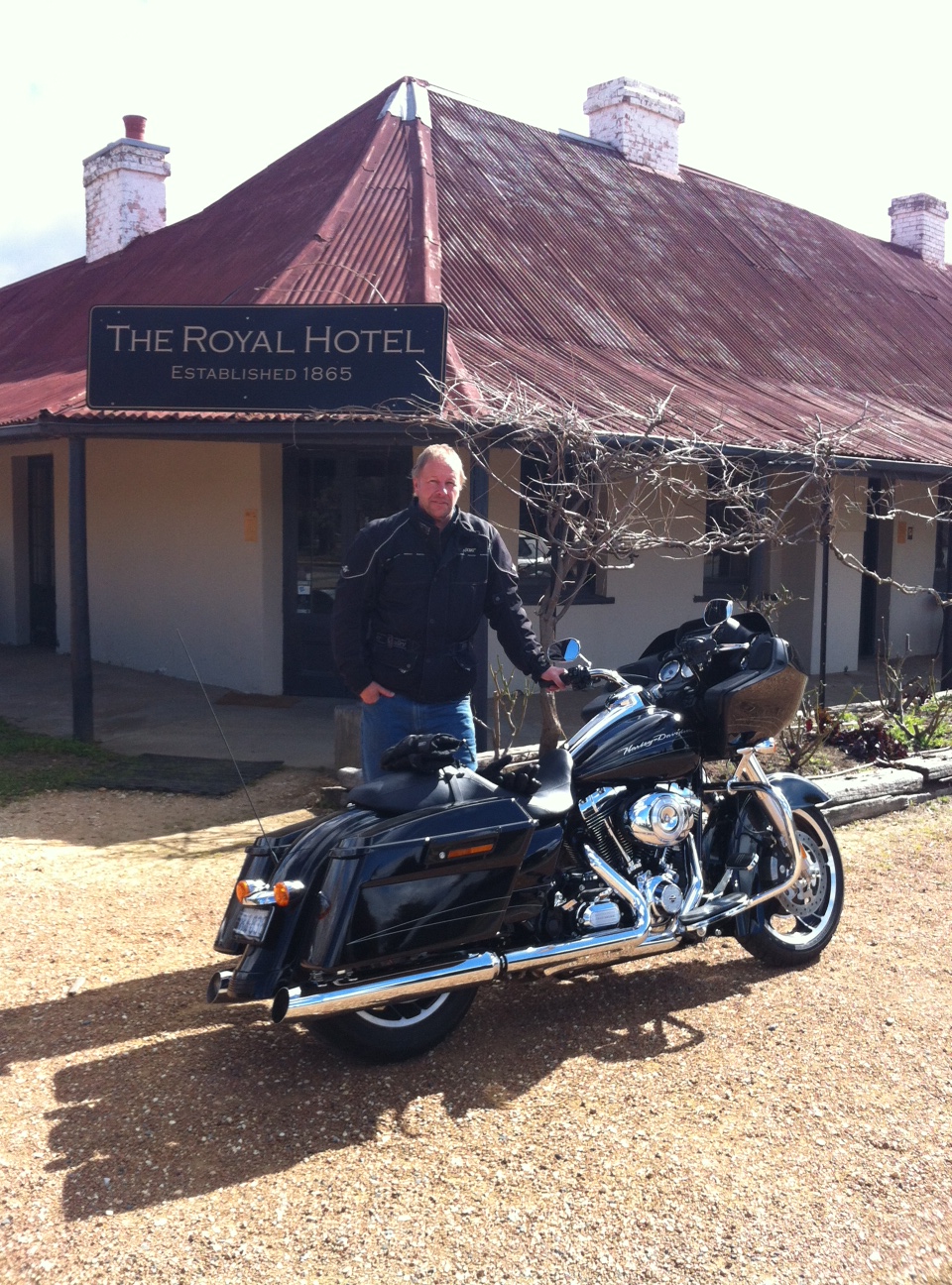
This morning I woke up with a Harley! To be specific, it was a 2012 Harley Davidson Road Glide Custom. It was my birthday present from Fiona – what a woman! Let me say this is an awesome machine. It’s got serious grunt with it’s V-twin 1690cc engine. It’s built for touring and has twin headlights, a fairing, saddle bags, glove boxes, cruise control, ABS brakes, radio, CD player, GPS, intercom, and even a cigarette lighter!

Fiona planned to hire me a Harley for my birthday but couldn’t find anywhere in Canberra that would do that. Not a problem though, because she discovered the Wake up with a Harley program. The local dealer would loan us a cruiser for 24 hours at no cost, unlimited mileage, no insurance premiums, and no excess! Thank you God!

I must admit I was pretty anxious before I picked up the bike. I hadn’t ridden since I don’t know when. The bike, weighing 370kg, was bigger than I’d ever ridden. And I’m not exactly in peak fitness. In fact I had a restless night, prior to picking it up, that reminded me of the night before I hired my first tinnie on the crocodile infested Mary River!

Yesterday I spent time getting the hang of it myself, before taking Fiona and the kids on various trips up and down Black Mountain, Mount Ainslie and around Lake Burley Griffin. My youngest paid me a compliment when we’d finished a loop, saying “Dad, you’re gun!” Not sure what that means, but it sounded good!

Today, after delivering the kids to school on the bike, Fiona and I went for a cruise together. Out to Bungendore for a coffee, across to Gundaroo, around past Murrumbateman, back to Canberra. You take in so much more on a motorbike than sitting behind the windscreen of a car. The wind, the bends, the scenery, the vibrations. It was exhilerating! Just me, the Harley, and my girlfriend hanging on behind! I felt very alive and I thanked God so much for this awesome opportunity. What a privilege to be alive and I’m so thankful to be well enough to enjoy such a treat. Who’d ever have thought I’d be cruising around on a massive motorcycle in August this year?!

The sad part was taking it back. But as they say, all good things… Would I get one? Probably not one of these cruisers. I felt a bit like one of those old blokes from the Ulysses Club. The one who’s motto is grow old disgracefully! But don’t you have to be 50 to join that club? Oops, I am!

Journey with cancer 15 Aug 2012 – a quick update

Dear friends and family

We received a progress report on the cancer this week and can happily report that there’s been no progress! The CT scans revealed that the cancer hasn’t grown or spread in the past 11 weeks. Given that I didn’t receive any aggressive chemo during this period, this is good news. We’re smiling! 🙂 In fact, our oncologist was smiling too – very good news! 🙂 🙂 Thank you God!

The plan is for me to go back on the Alimta/Avastin cocktail that I’d been on previously. We hope this will lead to the tumour shrinking even further. Preferably down to nothing! The dosage of Alimta will be reduced by 20% with the aim of keeping peripheral neuropathy at bay. I’ve also been prescribed some anti-depressants – not for depression – but because there is evidence that they may help prevent the development of neuropathy.

For those of you who pray, could you please ask God for these three things: 1) that the chemo will be effective in destroying the cancer; 2) that the side effects of the chemo won’t be too harsh; and 3) that I won’t get further neuropathy.

With thanks,

Dave

50 not out – thank God!

photo[1]Had my birthday on Sunday. 50 not out! To be honest, late last year I seriously doubted I’d see this day. As the news of cancer hit us like a tsunami… as we sat drawing up my will… as I talked seriously with some of my kids about life without their dad… as I collapsed in the x-ray room, unable to breathe or support my own weight… as I struggled to think about all the things Fiona would need to know… as my whole life seemingly passed before my eyes, with people travelling from everywhere to see me… I didn’t hold a lot of hope of seeing my 50th birthday.

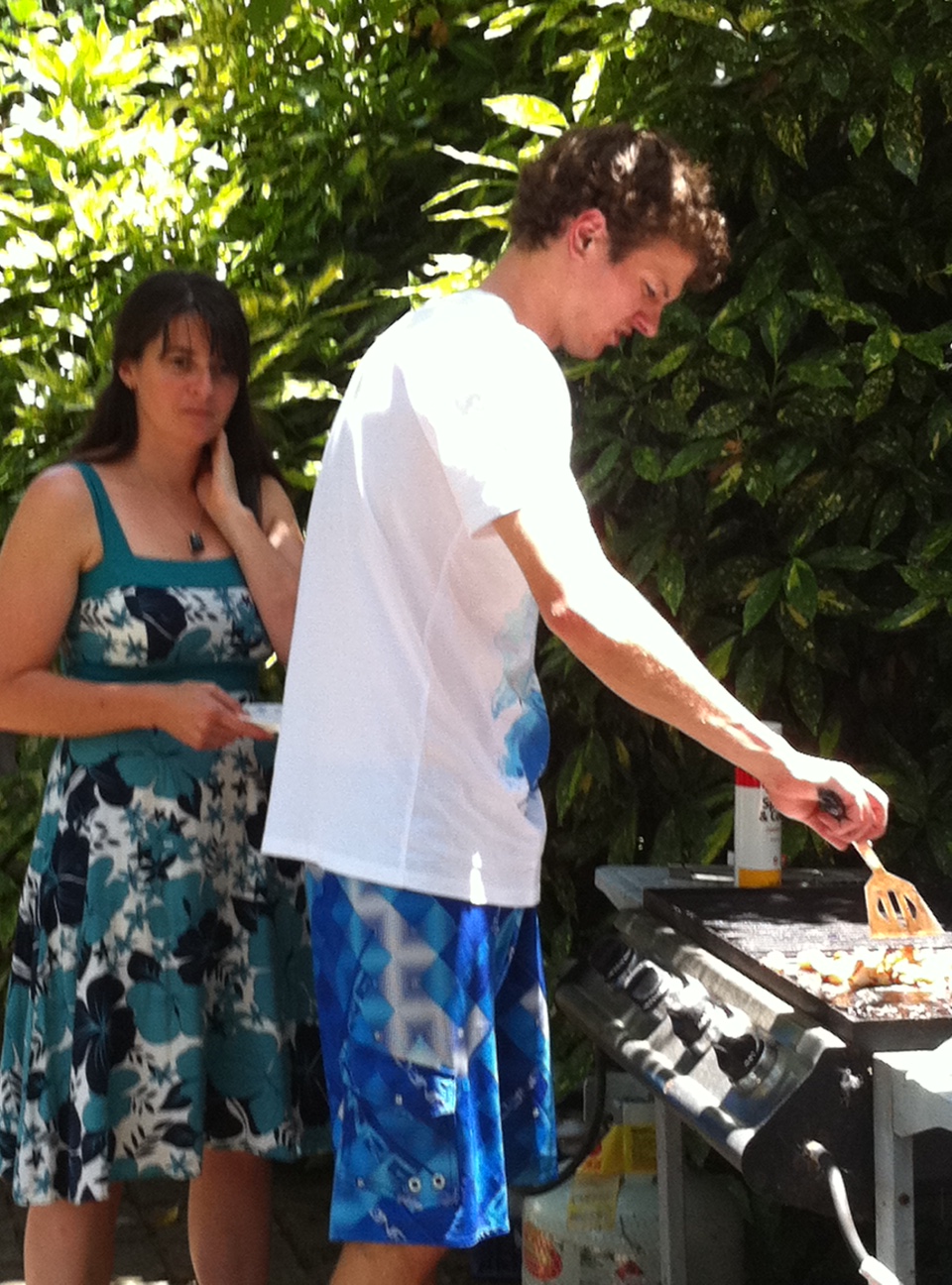
But God has been very kind, and I not only reached my birthday, but I thoroughly enjoyed it! It was cool to be bombarded by facebook messages, emails, cards and greetings from friends all over the world. It was a great joy to share an afternoon in our backyard with a number of our friends. Fiona was awesome, she had gone to so much trouble to give me a special day – and it was! Our church sang Happy Birthday to me and gave me an incredible cake! It was a fun day. 🙂

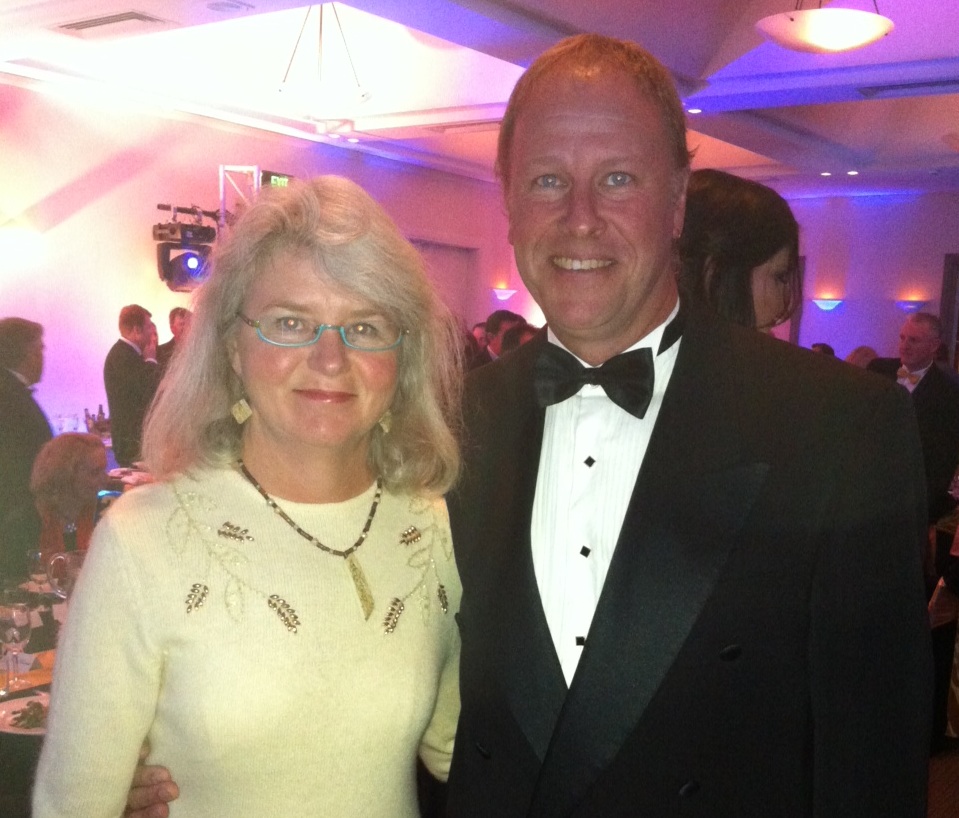
In fact, this has been a special weekend in other ways as well. Saturday night was the annual Brumbies Presentation Dinner – a black tie affair! I couldn’t remember ever wearing a dinner suit before and I thank the two men who offered me all the bits and pieces I needed. It felt kind of cool to be all dressed up like James Bond for a night, with a pretty girl on my arm! The dinner is a night to celebrate the season and give awards to the best players. Over the years some of the best players I’ve ever seen have taken out the awards. Notably George Smith winning Players’ Player on 9 separate occasions!

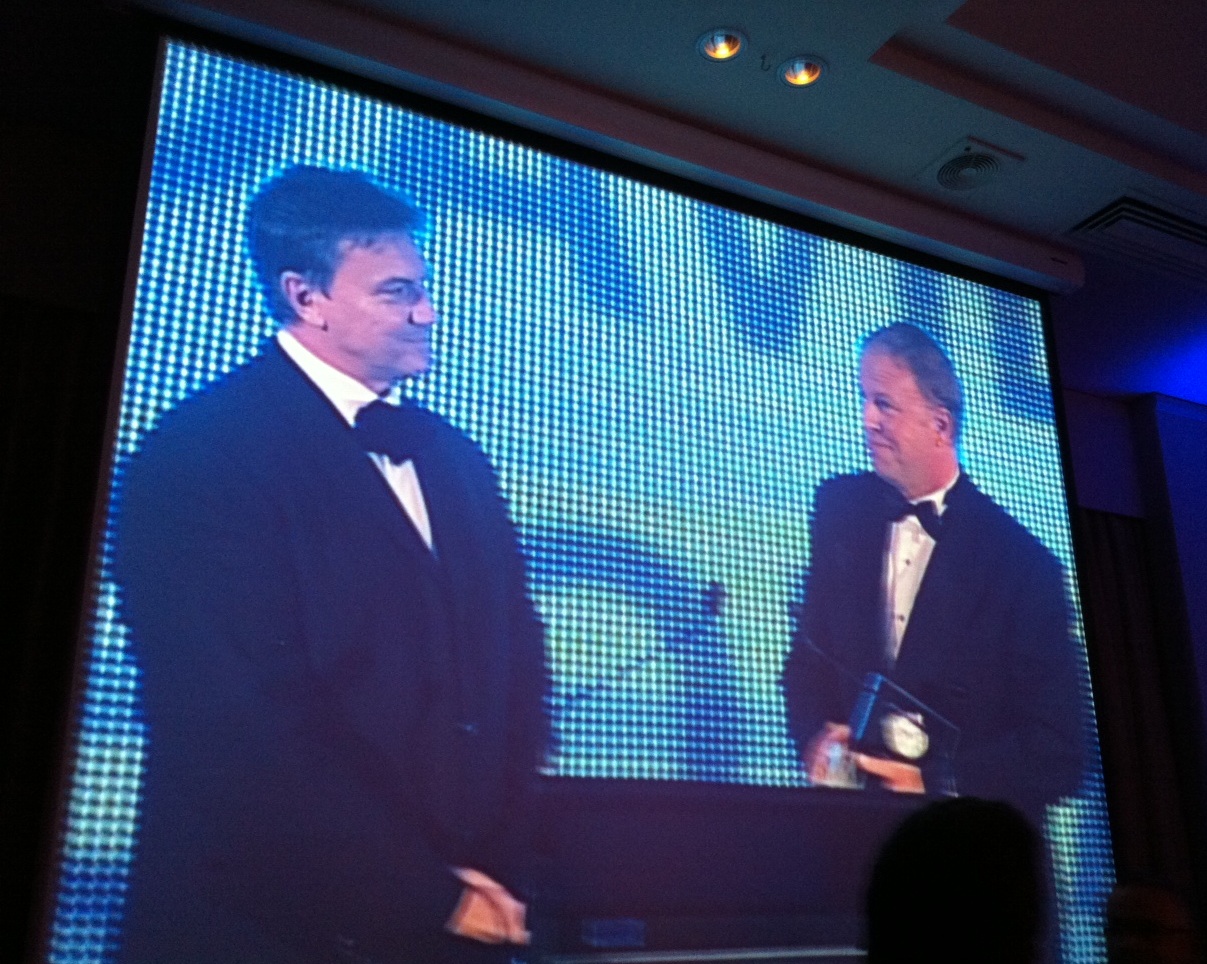
awardThe shock of the evening was the announcement that I’d won an award – Best Left Right Out of the Team! No, I was given the Garry Quinlivan Service Award in recognition of service to the Brumbies. It’s an absolute honour to receive this award named after Quinzo. He’s a living legend at the Brumbies, having given his everything in serving the players since the club began. It’s been my privilege to serve as their chaplain for ten seasons. Most of the time my efforts are well hidden, behind the scenes. I don’t do it for money or recognition, but it was lovely to receive this show of appreciation.

Some weeks back I asked Marcus, our lead pastor, if I could preach on this Sunday. “But it’s your birthday”, he said. “What would you want to preach on your birthday for?! You’d better check with Fiona, and your oncologist!” I count it a special gift from God to have been able to preach from the Bible at church on my birthday. I debated whether I should, because I didn’t want to do it for my sake, just because I like preaching. But deep down I wanted to be able to share God’s word with those I love. It’s the greatest gift I had to offer them.

I love teaching God’s word to others and I love sharing in people’s lives, so it was a delight to look at this part of the Bible. 1 Thessalonians 2:8 especially stands out:

Because we loved you so much, we were delighted to share with you not only the gospel of God but our lives as well.

These words are an encouragement to me to make a priority of both truth and relationships. It’s hopeless to be a preacher who is doctrinaire and disinterested in people. It’s dangerous to be a people-pleaser who is cavalier with the truth. Genuine knowledge of God shows itself in real love for people. Real love for people will be shaped and guided by the truth. Real love leads to humbly making the truth known to others.

God’s love, revealed in the gift of Jesus Christ, is the truth that keeps me going. It’s a message of hope and life and a future beyond death itself. I know it will seem to some as wishful thinking or religious superstition. But I ask you to give the message about Jesus’ life and death and resurrection your serious consideration. If it’s true, then you have nothing to lose and absolutely everything to gain.

I don’t know how many more birthdays I’m likely to see. I do pray there’ll be many more to come, but the message of Jesus gives me hope beyond birthdays. These words by John Newton express what I believe and where my hope lies:

Amazing Grace, how sweet the sound,
That saved a wretch like me.
I once was lost but now am found,
Was blind, but now I see.

T’was Grace that taught my heart to fear.
And Grace, my fears relieved.
How precious did that Grace appear
The hour I first believed.

Through many dangers, toils and snares
I have already come;
‘Tis Grace that brought me safe thus far
and Grace will lead me home.

The Lord has promised good to me.
His word my hope secures.
He will my shield and portion be,
As long as life endures.

Yea, when this flesh and heart shall fail,
And mortal life shall cease,
I shall possess within the veil,
A life of joy and peace.

When we’ve been here ten thousand years
Bright shining as the sun.
We’ve no less days to sing God’s praise
Than when we’ve first begun.

Scanxiety

I discovered a new word the other day…

scanxiety
n. the tension which builds particulary amongst those who have or have had cancer as they move towards their regular check up scan, hyperscanxiety being the period as they await results!
Usage: His scanxiety, though suppressed, grew as he awaited his next scan in the certain knowledge that hyperscanxiety would cut in as soon as the scan was over as he awaited the results!

I can relate! Just returned from the hospital following another CT scan. I’m becoming well acquainted with this machine! It’s a couple of months since my last scan and we’re pretty keen to know what’s been going on in the interim. Especially as we’ve backed off the serious chemotherapy in this time.

Scans are my reality check. They provide the best evidence for what’s going on inside. The experts can compare scans to determine whether the tumours are growing, shrinking, spreading, or just staying much the same. Whatever’s going on, they provide objective information on which to base decisions about my treatment. This is so important, because the externals can give a false picture. Having had less chemo and having returned from a couple of weeks in the Queensland sun, people have been saying “You’re looking so well!” Maybe, but this doesn’t mean I’ve been getting better! That remains to be seen.

I’ve experienced my share of anxiety in the face of scans, but overall I think I look forward to them. Not totally sure, but I’m keen to know what we’re dealing with. Even though the scans remind me of the harsh reality that I have cancer, I’d prefer to deal with the facts. I don’t want to be flying blind. And I know that worrying won’t do me any good. I’m not going to get a better outcome by becoming more anxious. If anything, it’ll make things worse.

God’s word provides me with good reasons for not being anxious and a good alternative when anxiety creeps in. Jesus said these words to his followers in the famous ‘Sermon on the Mount’:

25 “Therefore I tell you, do not be anxious about your life, what you will eat or what you will drink, nor about your body, what you will put on. Is not life more than food, and the body more than clothing? 26 Look at the birds of the air: they neither sow nor reap nor gather into barns, and yet your heavenly Father feeds them. Are you not of more value than they? 27 And which of you by being anxious can add a single hour to his span of life? (Matthew 6:25-27)

Paul wrote to the church in Philippi:

6 Do not be anxious about anything, but in every situation, by prayer and petition, with thanksgiving, present your requests to God. 7 And the peace of God, which transcends all understanding,will guard your hearts and your minds in Christ Jesus. (Philippians 4:6-7)

These are excellent reasons not to be overcome by scanxiety or any other form of anxiety. Worrying is a normal response to fear and uncertainty, but it’s what we do with those worries that matters most. We are invited to pray – to share our worries with our Father in heaven. God knows me more precisely than any scan will reveal and he has my life in his loving hands. Rather than placing my hope in CTs and doctors and chemo and special targeted therapies, I will put my hope in God. I will hand my anxieties over to him. I will tell him my wants and desires, and trust him to meet all of my needs. I will ask him to guard my heart and my mind in Christ Jesus.

Carer’s brain

Appears it’s contagious! When Fiona saw my tee shirt, she immediately thought she should get one that read ‘Carer’s Brain’. We couldn’t find one online, so our daughter came to the rescue and made this one for her. I like the shirt, but I prefer what’s in it!

The reality is that the chemo experience isn’t simply for the patient. Chemo impacts the whole family. I’m very thankful for my family, for their patience, love and support. But it takes it’s toll on them too. Fiona has been juggling so many extra things this year, and often has to function as a single parent. She shares the worries and anxieties. She soldiers on through the ups and downs. She also grieves the ‘what could have beens’. This is not the year she had planned!

She might not remember everything, she forgets to finish sentences, she often misplaces items around the house, and she’s always having a fight with the computer… and I love her deeply!

Chemo brain

One of the effects of being treated for cancer is what’s known as ‘chemo brain’. It’s real, not imagined, and some reckon it could impact as many as 50% of chemotherapy patients. These are a few examples of what I’d describe as chemo brain:

  • Forgetting things that I usually have no trouble recalling (memory lapses)
  • Trouble concentrating (having a short attention span or ‘spacing out’)
  • Trouble remembering details like names or dates
  • Trouble multi-tasking (especially when it’s someone else asking me to do something I’m not keen to do)
  • Taking longer to finish things (disorganized, slower thinking and processing)
  • Trouble remembering common words (starting a sentence, but being unable to find the right words to … umm … umm … finish, that’s it!)

Personally, I’ve found it weird and occasionally a little worrying. I’ve usually prided myself in having a good memory and being able to multitask. I enjoy word games and puzzles. Leading a multi-congregational, multi-staff-church has meant being able to keep many balls in the air at once. Teaching and preaching most weeks for over two decades has required me to think quickly on my feet, especially as I only use brief notes. I’m hoping this will be a temporary symptom rather than the new normal!

photo[1]In the meantime I will keep exercising my brain, eat more vegetables (apparently it helps), keep up the crosswords, go for walks in the fresh air, drink coffee (not sure if it helps or not), read good books, use my diary, keep better notes, file things carefully, spend time talking with people, try to increase my physical exercise, make sure I get enough sleep, ask for help when I need it, have a bit of fun with friends and family, blog a little, pray that God will heal me, and try not to let a bit of mental fog here and there bother me too much!

Sorry, what was I talking about again?

It’s a tough gig being a dad

I’ve been challenged recently about the importance of being a good father. To be honest, I’ve been challenged for the past 22 years, but having cancer brings a lot of things into sharp focus. It’s made me see more clearly how often I’ve been consumed by work, rushing from one thing to the next, and not making time for the family. I’ve felt rebuked for taking my children for granted. Having my life expectancy drastically reduced is a big incentive to make the most of every opportunity with my kids.

Over the recent holidays our family watched a movie called Courageous. Friends had recommended it. It’s an inspirational movie, with an explicitly Christian challenge for dads to step up. The funny thing is that as I reflect on Courageous it’s a line from Eminem’s 8 Mile that sticks in my head… You only get one shot! One shot at being a parent per child. You can’t rewind the tape and do it again. In Courageous we see a father lose his little girl and his life being turned inside out. Through this tragedy God challenges him and his mates with the importance of being better dads.

As movies go, this isn’t a bad one. It’s well produced, it’s got a bit of action and humour, and it’s certainly motivational. But it should come with a warning: Explicit Christian themes and parental advisory content! We enjoyed watching it as a family and I think it inspired each of us. By the way, Fiona and I also watched Family Man with Téa Leoni and Nicolas Cage during the holidays. This movie reminded me how hopelessly unromantic I can be as a husband. 😦 Maybe, I should stop watching movies so I can feel good about myself!

The most recent challenge to consider my role as a dad has come about as I’ve prepared to preach at church this weekend. I’ll be opening up 1 Thessalonians 2 with the congregation at Crossroads. It’s not a passage about parenting, but has some big things to say in passing. The Apostle Paul reminds the church in Thessalonica about his attitude towards them and he uses the illustration of being like a father to them. (He also describes himself as a nursing mother, but that’s for another time!) Take a look at his words…

10 You are witnesses, and so is God, of how holy, righteous and blameless we were among you who believed. 11 For you know that we dealt with each of you as a father deals with his own children, 12 encouraging, comforting and urging you to live lives worthy of God, who calls you into his kingdom and glory.

To be honest, if you’d asked me to write my job description as a dad, I’m not sure I’d have focused on these things! The first thing I notice here is the importance of being honest and real. He’s open and transparent before them. They can testify to his words, his actions, his priorities, his values. And he’s not cleverly pretending to be someone he isn’t. God knows his heart. This is not to say that Paul is perfect or self-righteous. He knows intimately the grace and forgiveness of God shown to him in Jesus Christ. Here’s the challenge to be fathers who our kids look up to as examples of integrity.

The second personal challenge is to allow God’s priorities to shape my priorities as a parent. Paul passionately encourages and urges his ‘children’ to take following God seriously. He understands that life is short and that we’re called to live in the light of eternity. This means not being all-consumed with education, careers, hobbies, homes and possessions. There are much more important matters demanding our attention. Interestingly, the father is also described as comforting his children. Life isn’t easy and won’t always go our way. The father is called to deal with his children with tenderness and compassion. This is my calling and I need to take it seriously.

Earlier this week I was having lunch with a friend and we were discussing our experience of being fathers. He shared with me that his kids were now following Jesus Christ as adults. They were making big decisions about their futures based on how they could best serve God. I was encouraged by the legacy that he’d left as a father. Not that he’d got it all right. He also shared with me that his daughter had recently asked him why he’d never taught her to read the Bible! It made him sit up and think.

My desire is to keep becoming a better dad. I want to prioritise my kids and do the best I can by them. It won’t happen unless I make it happen. And it won’t happen without God’s help.

Please God, forgive me for the times that I have been slack as a dad. Forgive me for the times I’ve taken my family for granted. Forgive me for my selfishness and failure to be the father you’ve called me to be.

Please make me a good example to my children. May they look at me and see someone who is seeking humbly to trust you and to serve you. May your word guide my steps. May your priorities and values shape my thoughts and words and actions. May my heart be filled with gratitude to you and overflow in love for others – especially my family.

Where seldom is heard an encouraging word

Olympics-2012Much has been said about the poor performance of our athletes at this year’s Olympics. Much is also being said about the poor performance of our journalists. Much more could also be said about our poor performance as a nation. There’s something ugly in our psyche.

Before our athletes even arrived in London, they were already champions. After all, how many people get to represent their country? When someone misses out on a medal does that make them a failure? Is a silver medal really code for ‘number one loser’? How stupid to push a microphone in an athlete’s face and say ‘you must be so disappointed’. Where’s the applause, the celebration, the encouragement?

Our behaviour as a nation is not something to be applauded. We carry on as though a lack of medals is a personal affront to our dignity as Aussies. What gave us the right to gold medals? To any medals? What exactly have we done? As we sit on the couch, and whinge and moan, how much training have we put in? How did we contribute? What sacrifices did we make?

Sadly, I’ve seen this same attitude on the sidelines watching kids’ sports. The coach who yells abuse at his team. The parents who criticise their children for making mistakes or simply failing to win. I’ve seen the tears in the eyes of the children. Their heads hung low. The lesson we teach is that you’re only worthwhile if you win. And I can only be somebody when you win for me. How wrong is that! How crass! How selfish! How demeaning! How discouraging!

We’re all flawed human beings. We need to own up to our own failures and weaknesses. Once we recognise our own shortcomings we’ll begin to learn to treat others with dignity and grace. A little humility will go a long way.

If I’m going to be honest, then I must confess that I see this same selfish spirit of discouragement in myself. My shortcomings are huge and my failures are many. And yet I can testify to the grace of God towards me. His word to me is one of encouragement. He builds me up rather than cutting me down. The Bible reminds me that God has reached out to me while I was a failure (Romans 3:23-24). Christ died for me while I was a rebel (Romans 5:8). God reconciled me to himself while I was his enemy (Romans 5:10). I’m so grateful to God that I don’t get what I deserve. Grace is an awesome thing. God’s grace is immeasurable.

There is a saying that says “There but for the grace of God go I.” How true it is! Left to my own resources I will mess up, fail, disappoint, and look to lay the blame on others.

Thank you God, that you don’t treat me as I deserve.
Please remind me of your grace. Please fill me with humility. Please enable me to build up rather than tear down. Please make my lips an instrument of blessing and encouragement, rather than discouragement and blame.

Physical inspiration

I’ve just returned from a walk/jog/walk/jog/walk… Week 1 Day 1 of C25K. The plan is to get from the couch to running 5 kilometres. It hurt! The body didn’t have a clue what I was trying to do! My lungs got their biggest workout in 8 months. The muscles were a bit stiff, the joints a bit creaky, and I had to hold my chest so it didn’t bounce around and cause pain! All I did was jog for 60 seconds, walk for 90 seconds, and keep repeating the cycle for 20 minutes. But I felt inspired to look ahead, set a plan, and achieve some fitness goals.

The inspiration came from a few places. Watching the Olympics might have had something to do with it. Marvelling at pensioners surfing on the Sunshine Coast helped. This morning I renewed my driver’s license until 2017 and I don’t want to waste the money! Research is showing that exercise plays an important role in fighting cancer.

… maintaining a healthy weight, getting adequate physical activity, and eating a healthy diet can reduce the chance of recurrence and increase the likelihood of disease-free survival after a diagnosis.

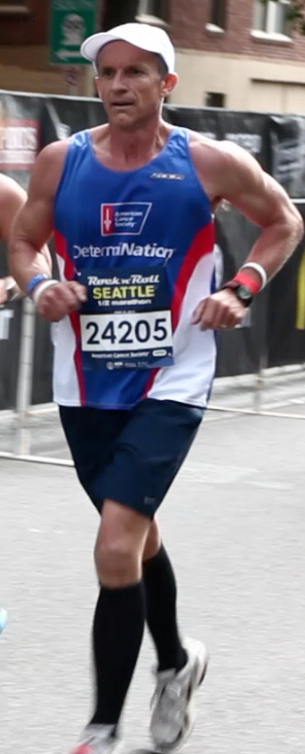
Last night I read about Paul Goebel. He’s my age and in January this year he was diagnosed with the same cancer of the lung. Admittedly, he was starting from a much higher baseline of physical fitness, but I was inspired that on June 23 this year he completed a marathon running at an 8.30 pace! Wow!

But the real inspiration is more personal. I want to be able to contribute to my family, enjoy activity, share with friends, return to work, get out and about. The disease and the treatment have a big impact on my capacity to do things, but I don’t want to give up. God has numbered my days and he calls me to use them for his glory. I have no idea how many days I have, nor does my oncologist, or anyone else. But I want to make the most of whatever days I have.

The blessing of thanks

Saying ‘thank you’ is a powerful thing. We appreciate people recognising our efforts and we get deflated if we’re taken for granted. These two little words can make all the difference in a relationship. Not that we should do things for the praise of others, but receiving their praise brings joy and encouragement. It puts fuel in our tanks.

I’ve been planning, preparing, leading and teaching at an annual student conference every year since we’ve been in Canberra. Last year was to be my final Focal Point Conference. I finished the week to an emotional farewell and many expressions of thanks from my co-workers and the students attending the conference.

I wasn’t going to be involved this year because we were planning to be 4000 km away in Darwin. But those plans have changed and I was able to attend the teaching sessions each evening. A good friend of mine was the speaker and I was keen to learn from him on the topic of Grace. On the Thursday night, I was to be interviewed about the student ministry in Canberra and the impact it’s had over the previous two decades. However, I suspected something else was happening when I saw my parents seated in the auditorium! They’ve never been to one of these conferences and they live at least 4 hours away.

The interview took place, I shared a few stories, and then my good friend and co-worker Marcus Reeves, stood up to say a few words. To be honest, I don’t remember anything he said! But I know what he was saying. It was thank you! He expressed his and others appreciation to Fiona and I for the work that had gone into all of the Focal Points. We were thanked for the investment we’d made in student ministry in Canberra.

We were presented with two pictures to hang on the wall. The first is a ‘word picture’ containing the names of just about everyone who has ever attended a Focal Point. We’ve put this up in our dining room so that when people drop round they can read through it searching for their names. If you’ve been to one, then maybe you will find your name here! Click on the picture and it will grow!

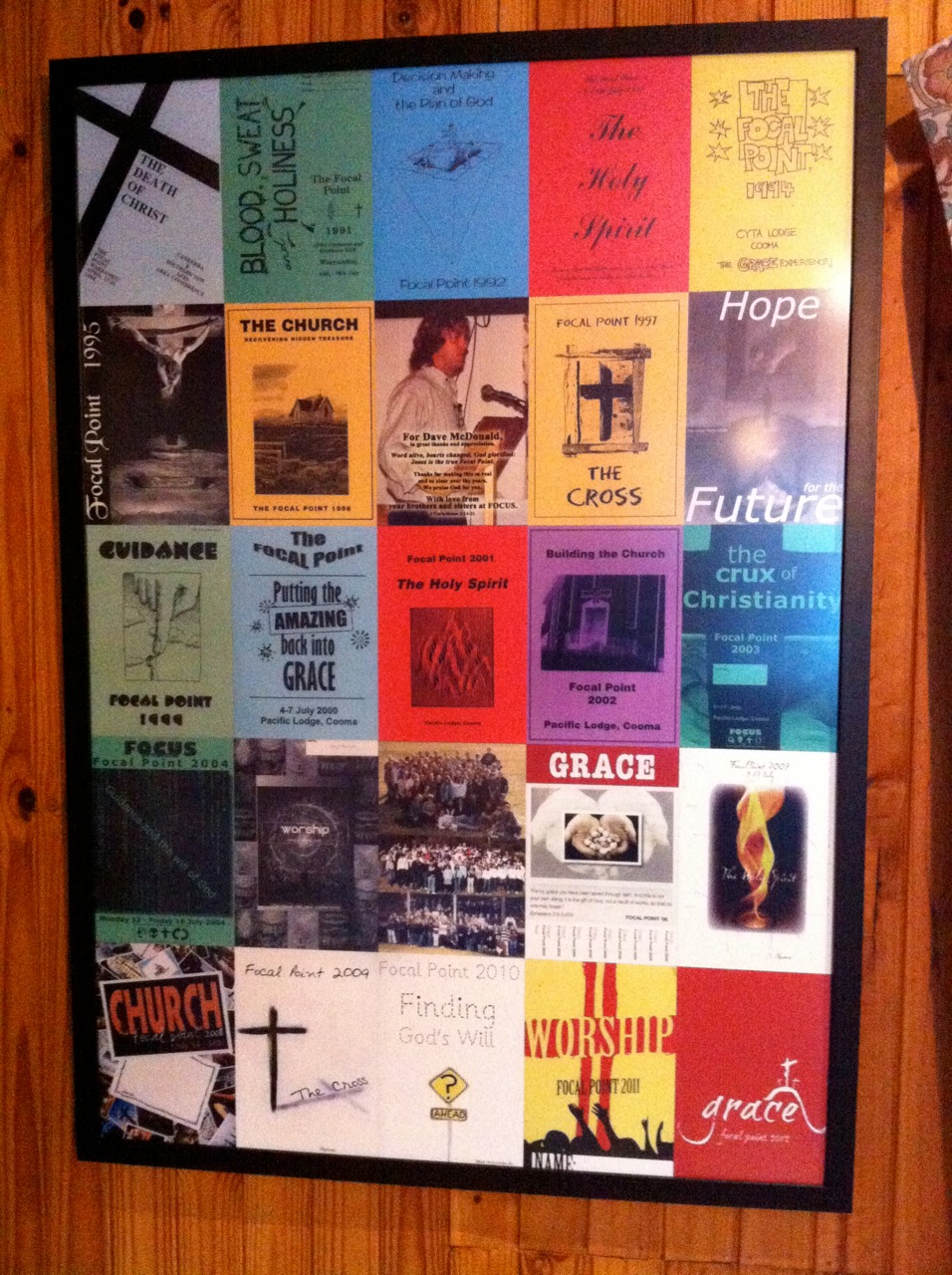
The second picture is a mosaic of the covers of every book we produced for the conferences. Some of them aren’t particularly inspiring – they’re the ones I designed – but they have a special significance. Each one is a record of our effort to bring blessing to others and the collage is a great blessing of thanks in return. This picture has gone ‘straight to the pool room’ (replacing the framed limited edition 2004 Brumbies jersey)!

However, the thanks doesn’t primarily go to us. It belongs to God. It’s been his work. He’s the focal point of everyone of these conferences. It’s been his word and his work that has changed the lives of the people attending. God deserves all the honour and glory and praise. It was highly appropriate that we spent time that night thanking our great God for what he has done.

The apostle Paul is a good example to us of giving due thanks to God. Notice how he writes at the beginning of a number of his New Testament letters…

I thank my God every time I remember you. In all my prayers for all of you, I always pray with joy because of your partnership in the gospel from the first day until now, being confident of this, that he who began a good work in you will carry it on to completion until the day of Christ Jesus.  (Philippians 1:3-6)

We always thank God, the Father of our Lord Jesus Christ, when we pray for you, because we have heard of your faith in Christ Jesus and of the love you have for all God’s people — the faith and love that spring from the hope stored up for you in heaven and about which you have already heard in the true message of the gospel that has come to you.  (Colossians 1:3-6)

We always thank God for all of you and continually mention you in our prayers. We remember before our God and Father your work produced by faith, your labor prompted by love, and your endurance inspired by hope in our Lord Jesus Christ.  (1 Thessalonians 1:2-3)

Let me encourage you to say thank you. You can be a huge encouragement to others simply by noticing what they do and expressing your appreciation. I don’t think I’m that good at offering thanks to others, but I do want to get better. Giving thanks to others is an important way to bless them.

And most of all, why not stop and take the time to say thank you to God. For the little things as well as the big things. We tend to say thanks before we have meals, but we’ve received a whole lot more than the food we’re about to eat. All we are and all we have is a gift from God. He gave us life and he offers us life eternal through Jesus Christ. Do you think maybe it’s time we gave him the thanks he deserves?

Thank you for reading this. May God bless you.


Journey with cancer 29 July 2012 – time out

I’ve been enjoying taking a break lately. A break from the harsh Canberra winter. A break from chemo. A break from writing. The break has been good. Relaxing, refreshing, rejuvenating. A change of routine. We’ve been holidaying on the Sunshine Coast in southeast Queensland. Walking on the beach, paddling the surf ski, fishing off the pontoon, reading Anh Do’s The Happiest Refuge, watching The Voice, eating out, sleeping in, time with family. Much to thank God for.

It’s now 9 weeks since my last dose of Alimta. My head has been clearer, my body has felt less sick, and I think my feet and hands have improved. The burning sensation and the pins and needles continue at night, but it’s less painful to walk during the day. I’ve been for many walks along the sand recently. To be honest, I’ve often felt reasonably well. Just weaker and less fit. Many times I’ve had to pinch myself. Do I really have cancer? Or is this just an awful dream, and I’m going to wake up from it soon?

At times I’ve been anxious about what this break means for the cancer. Is this just a calm before the storm? Is it growing, spreading, preparing for a new onslaught? Or has it been kept in check? I’ll need to wait for the next scan to find out. It’s hard not knowing. Sometimes I wish I had an instrument panel with dials and gauges on my chest. I could keep track of the cancer, differentiate the side effects, measure the neuropathy, and do my own blood tests without the need for needles. But… I’m a person… not a car!

Big decisions need to be made in the next week or so. Do I go back on the chemo? If so, what dose, so that the neuropathy doesn’t get worse? If not, will we be able to begin targeted treatment and get access to Crizotinib? If you have a minute to pray… I’d ask that you pray for wisdom for our oncologist; access to the Crizotinib (preferably at no cost); an end to the neuropathy; healing from the cancer; and for our stamina, patience, continued faith in God, hope for eternity, and love for others.

With thanks,

Dave

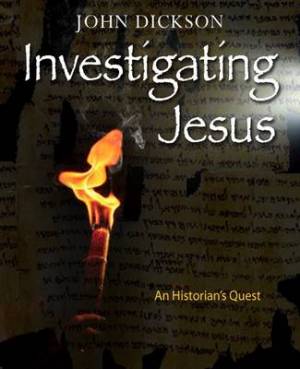
Investigating Jesus – An Historian’s Quest

I was never a great fan of history. Stuff done in the past. Dust and cobwebs. Rote learning names, dates, events and details. It all seemed so boring and irrelevant. I had to study some history at school, but from the moment I could choose my subjects I left it behind. History was history as far as I was concerned!

Of course, this attitude is pretty naive. History helps explain who we are, where we’ve come from, what’s influenced us, what things matter and what don’t. Every time we watch the news or read the paper we’re studying history. When we flick through our family albums or read over our diaries we’re reflecting on our own history. What I didn’t appreciate for sometime was that whenever I opened my Bible I was engaging with history. I was reading of people and events in the past that were shaping my life in the present. How reliable was that history? Could it be trusted? Was it something I could stake my life on? These are important questions for those of us who want to consider, or reconsider, the basis of our beliefs.

I’ve just finished reading Investigating Jesus – An Historian’s Quest by John Dickson. Firstly, let me say it’s a beautiful book! Hardback, stitch bound, colour photos of archeological sites and ancient papyri, laced with wonderful paintings and works of art, helpful diagrams, pithy quotes … and it’s well written!

More significantly, this book is entirely about history. It’s about how historians do their job. It’s not a theological book. It’s not religious propaganda aiming to persuade people to become Christians. Investigating Jesus offers a good introduction to anyone wanting to learn the tools and strategies available to historians, and it demonstrates how they’ve been applied in examining the evidence regarding Jesus.

John focuses the bulk of this book on examining the various sources that provide historical data about Jesus. He considers the Gnostic Gospels, that came to fame in Dan Brown’s The DaVinci Code, and shows both their value and limitations in gaining information on Jesus. He examines various non-Christian sources, from the first and second centuries, that make reference to Jesus and he argues that it’s important not to exaggerate or underestimate the value of these sources. In fact, without any reference to the Bible, the evidence from these sources leads all reputable historians to agree that a Jewish teacher named Jesus really did live and die in the first part of the first century AD.  (p84)

The New Testament provides the bulk of the information we have about Jesus. It’s common for people to dismiss this evidence as one source that’s biased and therefore unreliable. However, the New Testament is a collection of many sources, not just one. And the biases of the authors doesn’t mean that they’re therefore fabricating evidence. Historians are used to handling documents with obvious biases and they’ve developed a number of tests to evaluate the reliability of their evidence. These include:

  • The criterion of dissimilarity
  • The criterion of date
  • The criterion of multiple attestation
  • The criterion of embarrassment
  • The criterion of coherence
  • The criterion of historical plausibility
  • The criterion of archaic language
  • The criterion of memorability

These criterion are explained and illustrated in this book to show how they can be applied to the various accounts of Jesus in the New Testament. We are continually reminded that these are common tools of the trade for historians. These are the normal processes that historians, be they atheist, Christian, Jewish, or otherwise, apply to weighing the evidence before them.

Archeology is also considered alongside these criterion. In recent years there have been some very important archeological discoveries that have given insight into the world of the New Testament. Some incidental details in the Gospels have been confirmed and some previously held theories about Jesus have been overturned.

The concluding chapter of this book considers the difference between probability and proof. The discipline of history deals in degrees of probability rather than repeatable scientific proofs. This doesn’t mean that history only offers second class knowledge. In fact, there are strong similarities with our legal system that gains knowledge by weighing up the evidence. Historical (and legal) proof is really probability beyond reasonable doubt. 

Examining all the sources that refer to Jesus, both outside and inside the New Testament, and applying the aforementioned criterion for testing these sources, leads historians of all persuasions to agree on the following:

… while many doubts remain over the details, the core elements of Jesus’ life are in fact known … there is an overwhelming scholarly consensus today that a Galilean teacher and (reputed) healer named Jesus proclaimed the arrival of God’s kingdom, wined and dined with ‘sinners’, appointed a circle of twelve apostles, clashed with religious authorities, denounced the Jerusalem Temple and wound up dead on a Roman cross; shortly after which his first followers declared that they had seen him alive again, announced he was the long-awaited Messiah and sought to preserve and promote (first in oral form, then in writing) all that they could of their memorable master’s life. The sources and methods contemporary scholars use allow certainty on at least these elements of the ancient Gospel story. (p155)

If, like me, you’ve never been much into history, then Investigating Jesus is a great introduction. If you’ve never considered the reliability of the evidence for Jesus, then here’s a place to start. If you’re after an easy to read, well illustrated, clearly argued book on the historical bedrock of Christianity, then I recommend this one. In writing this, John Dickson set out to bridge the gap between popular perception and scholarly judgment about the figure of Jesus and in my humble opinion he does this well.

At the end of the day, this is a ‘second order’ book. It’s like an instruction manual that shows how something works and helps you to use it. Investigating Jesus is aimed at helping the reader to investigate Jesus. It’s not an alternative to investigating Jesus for yourself. Having read this book you’ll be better equipped to go back to the primary sources, read them over and over, and weigh up their implications. If you’ve never done this before, let me encourage you to get hold of a New Testament (and any of the other primary documents mentioned in this book) and discover all you can about Jesus.

Journey with cancer 29 June 2012 – family bits and pieces

Dear family and friends

Time to share some personal updates on how we’re travelling. People have been asking how things are going with the changes to chemo. I’ve dropped the Alimta (the ‘poison the cancer and lots of other things’ chemo) for two cycles in an attempt to clear the neuropathy in my feet. I’m continuing with the Avastin (this chemo works by restricting the growth of new blood vessels that are required to deliver nutrients to the cancer). Without the Alimta in my system, I’ve felt the least toxic I’ve been in over 5 months. They say there’s a ‘chemo haze’ where things feel foggy, memory lapses and you can be rather vague. This has been me – or at least my excuse – for some time!

The neuropathy still exists in my feet, but the oncologist has recommended a 6 week break from Alimta in the hope it will clear. In the mean time, I’ve purchased some new shoes that are more supportive and comfortable, and I continue to go for walks as I’m able. I was reminded recently that I’d been talking about walking the Kokoda trail with a friend this August. It won’t be happening!

The costs of chemo have been very high over recent months and we are thankful to a number of people who have supported us in this. Recently, we received great news from Roche Pharmaceuticals saying that they were willing to share the costs of the Avastin on a 1 in 3 basis. This is a wonderful answer to prayer.

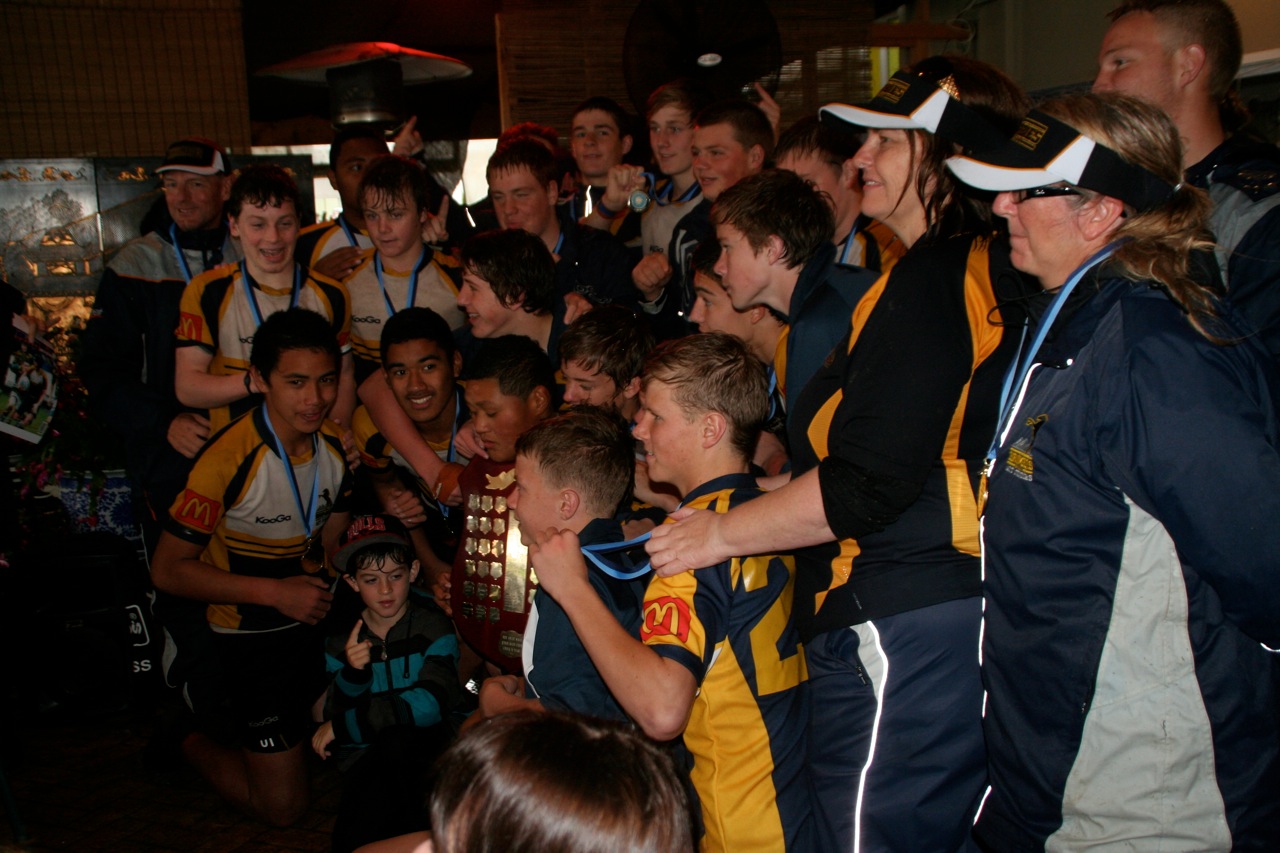
On the family front, June is always a busy birthday month for us. We celebrated Marcus’s birthday by watching him play for the Brumbies under 14s rep team at the NSW Junior Rugby Championships. They had a strong side and easily disposed of their opposition in the pool games. However, the finals were another story. The semi final was a bruising encounter as they played a Penrith side stacked full of boys twice as big as Marcus. At one point a boy, considerably bigger than me, cleared Marcus from the ruck by simply picking him up and throwing him out of the way!

The final was against a well-drilled Gordon side who were the reigning champions. It was played in torrential rain and the Brumbies toughed out an 8-5 victory to take the State Championship. We thoroughly enjoyed the weekend, staying with friends in Orange for the pool games (in beautiful sunshine) before heading to Sydney to play the final (in torrential rain). This worked well, as Marcus was able to enjoy a birthday dinner and an overnight stay with his grandparents as we passed through the Blue Mountains.

Grace’s world has been dominated by the school musical production of Footloose. They’ve spent this term learning parts and rehearsing for the public performances being held this week. Our whole family watched the show last night and thoroughly enjoyed it. Grace had a part that involved rollerskating (the old fashioned way) around a cafe on stage. It was great fun. Grace has also been counting down the days until she is able to get behind the wheel of a car. She picks up her learners permit this Monday and the fun begins!

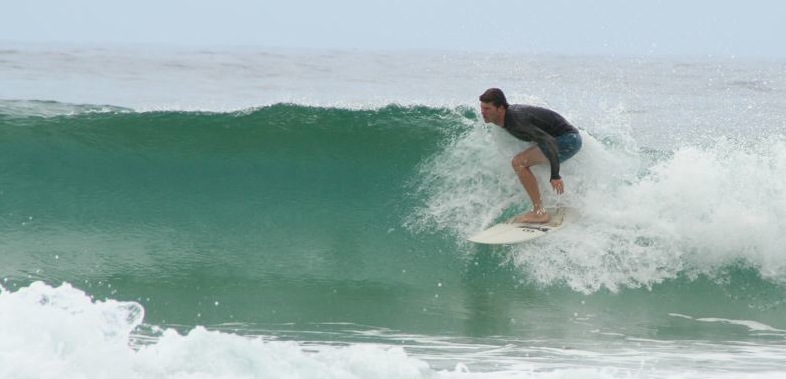
Matt is home from uni this week, enjoying his mid-semester break. He had a tough start to the year, especially given all that we’ve had going on, but seems to have thoroughly settled back into things. His church in Sydney is a great encouragement and the ministry on campus continues to spur him on. He still enjoys surfing in Sydney, mainly at Maroubra, even in the winter months! As I write this he’s out for a 15km run, up and down Mt Ainslie, in training for a marathon in September. I wish I had that energy!

Luke and Sharon are doing well. Sharon’s still managing the new Kings Swim School near the airport. Luke continues his training in Physical Education and Maths teaching. They’re both busy at church, assisting with children’s and youth ministry and other things. We love having them nearby and appreciate their support and encouragement. Luke’s birthday was last week and the family enjoyed a night out listening to Nathan Tasker and his band. The music was great, but it was also encouraging to hear Nathan share how God had helped his wife and him to cope with the recent deaths of her father and their twin babies. There was a strong message of hope in the midst of great sorrow.

I’m very thankful for Fiona’s ongoing love and support, both personally and medically. This journey with cancer is often a tough one, and I probably don’t consider enough how it’s affecting my wife (or kids). Fiona’s the one who does most of the work keeping our home and family on track. She’s had a very busy term due to taking on an extra day relief doctoring at the Aboriginal Health Centre. She invests a lot into people and has laboured long and hard for a number of her patients. I think it’s been harder than usual lately, having to care for a few patients who are battling cancer. There’s a lot of emotion tied up with her work. Fiona also celebrated her birthday last week and we had a special dinner at a restaurant on Red Hill that has superb views of Canberra.

We’re looking forward to a couple of weeks away as a family in the school holidays. Friends have kindly offered their place on the Sunshine Coast in Queensland. We’re hoping to experience some warmth (please)! It’ll be good to enjoy some surf, maybe catch a few fish, visit some fun places, read a book or two, and generally relax together.

We continue to thank you for your support in this journey. Please keep asking God to heal me of the cancer and that our family will trust God in everything that comes our way.

May God bless you,

Dave

Telling the truth in your 80s

John Chapman is as bold as brass when it comes to telling the truth. He knows that when you’re 82 it’s not too smart to keep putting things off. Especially the things that really matter. Life’s too short. There’s no point in pretending. And certainly not with the people you deeply care about. So he just tells it like it is, and he gets away with it. Addressing a bunch of oldies in his retirement home he says…

I can see there are a lot of snow-capped mountains and barren peaks here today. Now put your hand up if you think you’ll be alive in 10 years … what about 5 years? … if you’re not right with God, and you’ve only got 3 years to go, wouldn’t you make that a high priority? I would, if I were you!

Chappo has been a follower of Jesus since his teens and he’s learned a great deal over the years. In a recent interview, at an AFES student workers conference, he shared at length about his experiences as a Christian. It’s a long interview (86 minutes) but it’s full of priceless gems of encouragement amidst his trademark story telling and humour. The topics cover such areas as being a Christian at school, connecting with people in country towns, his experiences with the 1959 Billy Graham crusade, how to become a better preacher, communicating about Jesus Christ on university campuses, getting organised with prayer, the struggles of growing old, why heaven will be so much better, and more.

A particular highlight for me was hearing about Chappo’s commitment to praying for other people. (It occurs between 54 and 60 minutes into the video.) He explained how 6 weeks of hospitalisation over Christmas gave him more opportunities to pray. He described his strategies for prayer that include his photographic prayer diary, his daily lists, his 9 day cycle, and his special prayers for people in need. He mentioned that he prays for his ‘oncology patient’ friends, including myself, each time he gets up to go to the toilet at night. I feel very privileged to be on this exclusive prayer list! Furthermore, Fiona and I were so encouraged to hear Chappo share how he also prays for our youngest son, and how they’ve been writing to each other and found this mutually encouraging. God bless you brother!

Do yourself a favour. Skip that meaningless forensic pathology television show, or that B grade multi-repeat movie, or that footy game you were planning to watch… and listen to Chappo get fired up about what’s really important. Click here to watch.

I can do all things through God who strengthens me

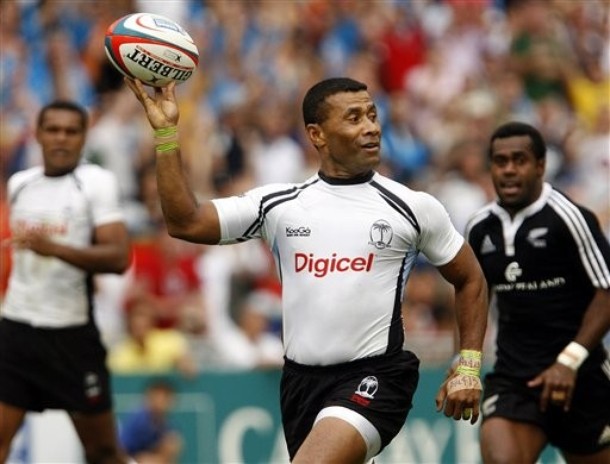
Waisale Serevi is arguably the greatest rugby 7s player ever. He represented Fiji from 1989 until 2007. This is an astonishing feat in a game that demands the utmost in speed, strength, stamina and skill. I remember the first time I noticed Serevi on television, as he had the words “Philippians 4:13” written (somewhere) on him. I understand he’d later have these words on his boots, strapping and jersey for every game. In fact, there are a number of high profile athletes who have taken to writing this reference on their arms or strapping, and some have even had them tattooed on their bodies. Joe Tomane, of the Brumbies and Wallabies, in a recent interview revealed that he has the whole text inked on his torso. It’s a verse from the Bible and this is what it says:

I can do everything through him who gives me strength.

What does it mean exactly? And what’s the appeal for athletes in particular? Is it saying that I can score more tries, kick more goals, lower my golf handicap, run faster times, improve my win/loss record, gain Olympic gold? Does it mean that with God’s help I can pull off anything I put my mind to? Are these words a recipe for success, reaching our dreams and achieving personal bests? And what’s the ‘everything’ spoken of in this verse?

As with any Bible reading, and all responsible reading in general, we need to take the words in their context. Someone once said that a text without a context is a pretext for a proof text. I just wanted to write that! Nobody likes having their words taken out of context and made to say something that they never intended. So let’s have a look at the verse in its context:

10 I rejoice greatly in the Lord that at last you have renewed your concern for me. Indeed, you have been concerned, but you had no opportunity to show it. 11 I am not saying this because I am in need, for I have learned to be content whatever the circumstances. 12 I know what it is to be in need, and I know what it is to have plenty. I have learned the secret of being content in any and every situation, whether well fed or hungry, whether living in plenty or in want.13 I can do everything through him who gives me strength.14 Yet it was good of you to share in my troubles. 15 Moreover, as you Philippians know, in the early days of your acquaintance with the gospel, when I set out from Macedonia, not one church shared with me in the matter of giving and receiving, except you only; 16 for even when I was in Thessalonica, you sent me aid again and again when I was in need. 17 Not that I am looking for a gift, but I am looking for what may be credited to your account. 18 I have received full payment and even more; I am amply supplied, now that I have received from Epaphroditus the gifts you sent. They are a fragrant offering, an acceptable sacrifice, pleasing to God. 19 And my God will meet all your needs according to his glorious riches in Christ Jesus. (Philippians 4:10-19)

We can see from its original context that the Apostle Paul is expressing his thanks to the Christians in Philippi for supporting him in his time of need. He thanks God for their gifts, not so much because he was in need but because it shows they have generous hearts. The immediate context is verse 12, where he reveals that he has learned the secret of contentment. He is able to be content in any and every situation.

The extraordinary thing is that Paul’s contentment is not contingent on his circumstances. His words are powerfully backed up by the fact that he’s in prison as he writes. He’s not waiting for good things to come his way. Winning Lotto won’t make him content. Having a supermodel wife won’t make him content. Winning the championship won’t make him content. Having his book published won’t make him content. He’s learned to be content even when he’s hungry, even when he’s abandoned, even when he’s imprisoned. How can this be? How can Paul find contentment even when things go pear-shaped? Here, in context, is his answer:

I can do everything through him who gives me strength.

Left to his own resources, Paul would be unsettled, dissatisfied, complaining, grumbling, miserable, and always wanting things to be different. In other words, he’d be like a lot of us – desperately hanging out for his circumstances to get better. Then we’d be content – or so we think. But for Paul contentment doesn’t come from his circumstances. Nor does it come from his inner strength, his resilience or his personal resources. It comes from the God who enables us to rise above our circumstances.

I’ve found these words to be a powerful challenge in the past week. I’ve been struggling with discontentment. The freezing cold here in Canberra. The frustration of having to back off the chemotherapy just as we see it further reducing the size of the cancer. The pain and discomfort in my feet preventing me from walking very far. The uncertainties about the future and my inability to make long-term plans. The grief of things lost and unfulfilled. Even the jealousy of having some of my close friends enjoying time in Darwin, instead of me! To be honest, I’ve been irritable, frustrated, depressed and generally discontented.

So what can I do? What should I do?

I should pray that God will strengthen me to learn the secret of contentment. That’s what I should do. That’s what I will do! I know the truth that contentment is not to be found by changing the circumstances. It comes from changing the heart. My prayer is that God will change my heart and help me to see things as he does. Knowing the secret of contentment rescues me from being self-obsessed. It frees me to love God, to love my wife and my children, to love my friends and others, even to love my ‘enemies’.

My prayer is that God will continually remind me of all that I have and all that I am in Christ Jesus, that he will strengthen me to be satisfied in him whatever my circumstances, and that he will teach me the secret of genuine contentment.

Why we need more churches

Late last year I was invited to speak at a conference on the topic Why we need more churches. It seemed a silly question really. Of course we need more churches. The population’s growing. We’re not keeping up. Denominations are dying. Church attendance is declining. Church buildings are being shut down or turned in restaurants, offices, trendy homes, and even funeral parlours.

But for me, it was and is a real issue. People confronted me with this question a number of times after hearing that we were moving to Darwin to plant a new church. Many were enthusiastic and supportive of our intentions, but others seemed to view it as invading their turf. Some denominational leaders said “We’ve already got churches up there.” One wrote to me and told me not to come because they had it covered. It was suggested we go somewhere else, where new churches were really needed. I met with one local pastor who warned me that the last thing they needed was people from ‘down south’ coming up and planting churches – despite the fact that he, and many other pastors I met, had done exactly this!

We faced the same issue in Canberra when deciding to plant a new church south of the lake. Some denominational leaders believed this would create a ‘competition’ with their churches. We were asked why people didn’t simply leave our church and join theirs, instead of starting another. It’s easy to get excited about new churches, until someone starts one in your neighbourhood.

Let me offer a number of practical reasons (with warnings) for why we need more churches, and then one theological reason.

Practical reasons why we need new churches

  1. Current churches are not effectively connecting with the Australian population. Some surveys suggest that 65% of Aussies don’t have a personal relationship with a Christian.
    We need to be careful here because we could increase the number of churches, remain in a religious ghetto, and still not connect with 65% of our population.
  2. Existing churches are perceived as irrelevant, out of date, oppressive, self-righteous, and a bunch of other things that keep people disinterested.
    It’s not ultimately perceptions or image that matters, but the reality of what is believed and practiced. It’s just as important for established churches to make an impact on people’s lives as it is for new ones. And who’s to say that new churches will be different? New churches could end up reproducing the problems of their founders.
  3. Someone once said of the church, “It’s easier to give birth than to raise the dead!” It’s true that some established churches will be harder to turn around than the Titanic, so maybe it’s better to leave them to sink and get people out into other boats.
    While this is often true, we shouldn’t cop out on the importance of revitalising wayward churches. I think it’s Mark Dever who has spoken of the 2 for 1 benefit of resurrecting dying churches. He sees it as both removing a bad witness in the community and adding a good witness. And it utilises existing resources.
  4. Geographical reach is an important strategic reason for planting new churches. While committed Christians might travel long distances to come to church, their neighbours or interested friends most likely won’t. This might lead to a city church giving birth to another congregation in a different part of the city, or a country church beginning a satellite church in a neighbouring town.
  5. Cultural reach is another driver for starting new churches. Some churches will never reach certain subcultures in their community. The language, dress, customs, activities of the church just alienate outsiders. Hence, a church might be planted to reach uni students, or an ethnic or language group, or mining workers, or some other group.
    While a church might be created to reach a certain demographic, the church needs to be open to anyone. It could begin with one type of people in mind, and discover the need to keep changing as it comes into contact with different people.
  6. Urban growth continues in some parts of Australia at a rapid rate. The number of churches is not keeping up proportionally with the size of the population. We can’t depend on town planners to allocate land or facilities for churches. We can’t assume denominations will add another franchise in the new housing development. Christians should see urban growth as creating new mission fields and the need for more churches tailored to connect with people in these centres.
  7. Of the many churches that exist, many seem to have lost the plot. They’re not what I’d call evangelical, that is grounded in the Bible and focused upon Jesus Christ – his offer of relationship with God and his call on people’s lives. Many churches have competing agendas or no apparent agenda at all. Some appear to be little more than middle-class religious clubs. Others are preoccupied with rituals and out-dated forms that veil the truth of the gospel. We need more churches that are teaching the Bible and proclaiming the good news of Jesus Christ.
    Mind you, the imperative is also to transform existing churches with God’s agenda.
  8. There’s a need to plant ‘church-planting-churches’. Very few churches in our country have planted daughter churches. Institutional thinking has left this to the denominations and it doesn’t always happen. If churches are planted with the DNA of planting more churches, then we create a multiplying (rather than simply adding) effect.
  9. Planting new churches re-energises people to serve. In large churches it’s easy for people to sit in the congregation and watch others do the work of ministry. The new group, or the core team for the new church, will easily see the needs and opportunities for ministry. There tends to be more urgency and importance placed on reaching out to others in new churches. Children’s workers, musicians, teachers, preachers, welcomers, carers, you name it – the new church needs them!
    The danger is that burnout often occurs. Many jobs are being filled by a few. The newly planted church needs to establish clear priorities and monitor people’s involvement carefully. Having lots of busy people doesn’t necessarily equal a healthy growing church.
  10. Planting new churches sharpens the vision for ministry. It requires people to ask the big questions of what are we doing, why, when, where and how? It forces people to get off the treadmill and set a deliberate course for the future.
    Once again, it’s important for existing churches to take stock and set a clear vision for their ministry. Planting a new church shouldn’t be seen as the easy alternative to making important changes in the existing one.
  11. It’s a good thing for the sending church. Planting a new church is always costly, so it helps the sending church to practice generosity. There’s a loss of people and relationships, money and resources, gifts and talents, vibe and comfort. If you’re the ones left behind it’s easy to feel like you’re the ones left behind! So we should see this as a fresh opportunity to grow and change, to step up and get involved, to refocus our vision, and to look toward planting again.

Theological reason why we need new churches

We could brainstorm and come up with dozens more practical reasons why it is important to keep planting new churches. And people already have! But the need for more churches isn’t essentially about pragmatics, strategy, analysis, or the latest trends. It’s not fundamentally needs driven.

There’s a deeper, broader, more profound, theological reason for why we need more churches. It’s at the core of the plans and purposes of God.

The church is at the heart of God’s design for humanity. We were created to belong to the church. It’s key to what it means to be truly human! Now all that might sound a bit weird, and you won’t find it taught in anthropology, psychology, sociology, or biology. You probably won’t even hear it taught in many churches. But it’s in the Bible and it needs to be taken seriously.

Take Ephesians 5, for example, a passage that gets preached at many weddings. It seems to be a passage about marriage, that gives instructions to husbands and wives. The Apostle Paul appeals to Genesis 2, man and woman in union together, as the foundation for marriage. But a careful reading shows something deeper going on…

31 “For this reason a man will leave his father and mother and be united to his wife, and the two will become one flesh.” 32 This is a profound mystery—but I am talking about Christ and the church.

The profound mystery isn’t the union of man and woman, it’s the union between Christ and his bride, the church. This is the core reality, the primary marriage. Humanity was created for union with Christ. That is, we were made to belong to Christ’s church and we experience this as we place our trust in Jesus Christ and respect his headship.

These ideas, introduced at the beginning of the Bible, find their climax and fulfilment at the end in Revelation 19…

Then I heard what sounded like a great multitude, like the roar of rushing waters and like loud peals of thunder, shouting:

“Hallelujah!
For our Lord God Almighty reigns.
Let us rejoice and be glad
and give him glory!
For the wedding of the Lamb has come,
and his bride has made herself ready.
Fine linen, bright and clean,
was given her to wear.”
(Fine linen stands for the righteous acts of the saints.)

Then the angel said to me, “Write: ‘Blessed are those who are invited to the wedding supper of the Lamb!’” And he added, “These are the true words of God.”

The ultimate event to participate in is the wedding between the Lamb, Jesus Christ, and his bride, the church. God is calling people to be ‘at one’ with his Son, our Lord and Saviour. This imagery highlights the extraordinary importance of being united to Jesus. This is what truly matters. This is the relationship we were made for. This is why the church is so important.

Of course, the church on view here is not St Blogs down the street, nor is it the denomination or institution. The church on view is the gathering of all who truly belong to Jesus Christ. This gathering finds its earthly expression as people give their lives to Jesus and meet together with others who have done the same.

It’s always been God’s plan to gather people to himself. His Son, the Messiah promised in the Old Testament, came to build his church. We see this in the climactic announcement about Jesus’ identity in Matthew 16…

13 When Jesus came to the region of Caesarea Philippi, he asked his disciples, “Who do people say the Son of Man is?”

14 They replied, “Some say John the Baptist; others say Elijah; and still others, Jeremiah or one of the prophets.”

15 “But what about you?” he asked. “Who do you say I am?”

16 Simon Peter answered, “You are the Christ, the Son of the living God.”

17 Jesus replied, “Blessed are you, Simon son of Jonah, for this was not revealed to you by man, but by my Father in heaven. 18 And I tell you that you are Peter, and on this rock I will build my church, and the gates of Hades will not overcome it. 19 I will give you the keys of the kingdom of heaven; whatever you bind on earth will be bound in heaven, and whatever you loose on earth will be loosed in heaven.” 20 Then he warned his disciples not to tell anyonethat he was the Christ.  (emphasis added)

Jesus is the promised Christ or Messiah (these words mean the same thing). He came to take on the Messiah’s job description, that is to build his church. Not an institution, not a building of bricks and mortar, not a local spiritual club – but a gathering of people, belonging to God for all eternity. The church is not a social construct. It comes from the heart of a merciful loving God.

Why do we need more churches? Fundamentally, because God is calling people to belong to the church of Jesus Christ. We’re not talking about structures, organisations, denominations, buildings or campuses. We’re talking about the church of God, union with Christ, people coming to grips with what it means to be truly human.

Humanly speaking, this will come about in many ways – denominational and non-denominational strategies, revitalising existing churches, transplanting congregations to reach new areas, pioneering mission to connect with new people groups, people speaking with their friends and family, church planting organisations equipping people to lead new churches, and more.

From God’s own perspective, this is a seriously costly project. Jesus went to the cross and died so as to bring people into his church. Growing the church required the ultimate sacrifice of Jesus Christ himself. The church is deeply precious to God. It’s his treasured possession and therefore needs to be handled with great care. We see Paul encouraging the leaders of the church in Ephesus to take this seriously…

Keep watch over yourselves and all the flock of which the Holy Spirit has made you overseers. Be shepherds of the church of God, which he bought with his own blood.  (Acts 20:28, emphasis added)

Planting churches will also mean leading churches. It’ll mean teaching and warning people, loving and caring for people, equipping and mobilising people, serving and encouraging people, praying for and giving to people. Planting new churches should never be seen as the ‘easy option’, nor should it be adopted as the latest fad strategy. It’s hard work. It’s a costly project. It can take a lifetime. It should be embraced with humility, relying on God’s strength, and going about it God’s way, because it comes from the heart of God himself.