
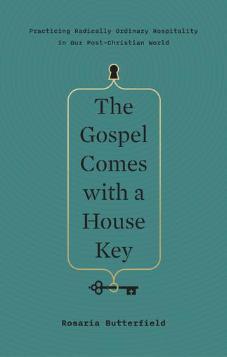
 Inspirational. Provocative. Enticing. Raw. These are some of the words that quickly come to mind as I reflect on Rosaria Butterfield’s new book, The Gospel Comes with a House Key. Let me confess, I didn’t read this book. I listened to Rosaria read it. She kept me captivated from the minute I left Canberra until I drove into my street in Bonny Hills. Eight hours of ‘radically ordinary hospitality’.
If you haven’t come across Rosaria Butterfield, let me introduce her briefly. She grew up in an atheist family and went to a Catholic school. She found herself attracted to the lesbian and homosexual communities at an early age, pursued studies in literature, and eventually became a professor in English and Women’s Studies at Syracuse University. Rosaria was a influential radical and a leader in LGBTQ rights. In an earlier book, The Secret Thoughts of an Unlikely Convert, Rosaria describes how she set out to write a book critiquing Christianity, and how in the process she became a Christian herself.
The Gospel Comes with a House Key is a book about the importance of hospitality. Not the hospitality of tea parties and lace tablecloths. This is a long distance from ‘entertaining’ others. This is radical and ordinary, and it is motivated and shaped by the Gospel of Jesus Christ. It’s about welcoming strangers and turning them into neighbours. It’s about welcoming neighbours and inviting them to become extended family.
Rosaria’s conversion came about over many months of dinners at the home of a Presbyterian minister and his wife. They demonstrated to her the deep difference between acceptance and approval. They accepted Rosaria for who she was. Her beliefs, lifestyle, aspirations, and politics were no barrier to real welcome, hospitality, acceptance, and friendship. Her experience of God’s grace through the hospitality of a Christian couple has radically shaped her desire to pass it forward. Together with her husband and family, they welcome anyone and everyone into their home, and they do it not occasionally, but on a daily basis. Their modest and functional home provides a safe haven for many in their community. They share meals, discuss current affairs, explore what it means to be a follower of Jesus, assist the needy, provide a refuge for discarded and abused, provide warmth, and model genuine love and friendship to others.
It’s a costly process. They give time and love in spades. Their food bill each week is double or triple what they would spend on themselves. Rosaria is making extra food literally every single day. When a family is in crisis, she is out delivering homemade meals. She makes regular offers on a social media app to the entire local community of 300 homes to assist the needy. All this on top of caring for her own family, supporting her husband in the ministry of their church, looking out for wider friends and family in need, studying the Scriptures, praying for many people, and even writing books. It’s a family lifestyle. The children consider it normal to reach out to others and invite people into their home. Her husband takes this attitude of hospitality to the jail, where he provides support for men who society has rejected and forgotten.
The Gospel Comes with a House Key is a gripping read because it is so real and raw. Rosaria tells story after story. We learn of her mother who absolutely hated Christianity and made life hell for the family. We meet the bloke across the street, his pit bull, and his drug addicted girl friend, and the account of the DEA raiding the house to dismantle his crystal meth lab. And we learn how God worked through the patience and love of Rosaria’s family to introduce these people and many more to the saving love of Jesus.
There is nothing showy about this hospitality. The regular menu revolves around rice and beans and the occasional chicken. Chairs are optional. Dogs are welcome. It’s barebones, rough, honest, and unpretentious. It’s attractive and daunting at the same time. Rosaria doesn’t have all the time and resources at her disposal, but she finds them and makes them. It’s costly and sacrificial.
There’s a warning too. Those who will find it most difficult to offer hospitality to the stranger, the sinner, the outcast, the unloved and unlovable will more than not be the rich—people like me, and maybe you. Those who have the most, fear they have the most to lose. They can’t risk their carpet, or their dining setting, or their polished reputation, or their safe, self-contained lifestyle. It’s hard following Jesus if you’re well off. Jesus had meals with ‘sinners’ and prostitutes. He met with lepers and social outcasts like the tax-collectors. He didn’t care about his reputation. He was willing to be waylaid and interrupted. He taught us what hospitality should really look like.
I asked myself a couple of questions after finishing this book:
- How much of my hospitality is merely catching up with friends, rather than reaching out to care for the needy or the alienated? How much of my hospitality is literally the philoxenia—love of strangers—that we find in the New Testament?
- We have a nice home, fairly new, matching furniture, close to the beach. Will I ensure that our home is for people? Will I care more for the welfare of those around us, than the welfare of our couches and coffee machine?
“Please God, help me to love others before myself. Help me to love people more than things. Help me to be generous with my time, gifts, possessions, and particularly our home. Teach me to become more and more hospitable. Teach me to delight in the love and care of those around me. Move me to share the great news of Jesus Christ with strangers and neighbours as you give me opportunity.”
 When we’re hit by the trials of life, we face the temptation to look immediately to our own resources. We’re taught to do this—to be resilient and strong and resourceful. We draw on our experience, our education, our networks, our finances. And we should. If a nail is sticking out of the wall, and we have a hammer, then we knock it in. Problem solved. If an unexpected bill arrives, and there’s money in the bank, then we pay it. If we lose your job, and we have the right qualifications and experience, then we look for another. We can overcome adversity, we’ve done it before, we’ll do it again, and it’s all good.
 It’s some time since I’ve been out in big surf. I don’t trust myself anymore. I’m certainly not as young or fit as I like to think I was. But there have been times in the past when I’ve been dumped by large waves, tossed and turned, struggling to find my way to the surface, desperate for air, wondering if I was going to drown.
 James, the brother of Jesus, opens the argument of his New Testament letter with these words…
 But at church this past weekend I was reminded of another kind of gracious living—the grace of giving generously. I had to pause and think. Do I really know what that means? Not just in theory, but in practice? Have I ever truly given generously? Or do I merely give out of my surplus, redistributing what I don’t need anyway?
 But what disturbed me in the video, was the laughter of the audience when Macarthur quoted Osteen. There was much hilarity and amusement. Now, I’m not suggesting that Macarthur was using Osteen to whip up his congregation, or making light of what he was teaching, but is laughter really the appropriate response? Is what Osteen teaches funny? If it’s false and destructive, then shouldn’t it lead us to tears?
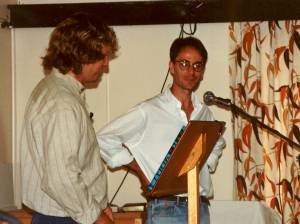 In 1996 we planted Crossroads in Canberra. It was among the earliest of the now FIEC churches. Its origins are found in Dickson Baptist Church and a growing university ministry at the ANU and UC. In the lead up, I had been working as an associate pastor at Dickson as well as working with the Australian Fellowship of Evangelical Students leading the campus ministries. Dean Ingham worked alongside me in the church and on the campus.
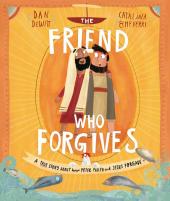 Now that I’m a grandpa, I’m on the look out for great kids’ books. We’ve still got a few at home that our kids haven’t taken with them, but we’re keen for some new ones for when the grandkids come to visit. So I was pleased when the The Good Book Company sent me a new children’s book to review. It’s The Friend who Forgives: A True Story about how Peter Failed and Jesus Forgave, written by Dan DeWitt and illustrated by Catalina Echeverri.
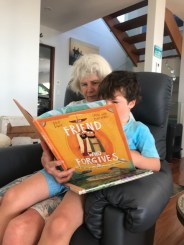 We tested the book yesterday with our nearly five year old grandson. He’s not reading yet so Nona read it to him. He listened intently, answering appropriately, and told me he enjoyed it at the end. We’ll read it to him again, next time he comes over.
 Who of us wouldn’t want our churches to be genuine communities of meaningful, caring relationships? Perhaps this is your experience already. People invest in each other, they look out for one another, they show genuine interest, they seek help, they ask what they can pray and then they pray. They do more than offer support to others, they show deep empathy, compassion, and practical care. Maybe this is a bit of overreach, but you see glimpses of it and you want it more and more. Right?
 Some of us have been on a date, a third date to be precise. It’s been a date of ‘fellowships’, or should that be ‘denominations’. The Fellowship of Independent Evangelical Churches has gone out with the Fellowship of Evangelical Churches of Australia. We had three leaders of each group meeting, listening, talking, exploring, wondering what it might be like to be in ministry together. Two of their leaders attended our national conference, then two of our leaders shared in their conference. We’ve begun to explore matters of unity in the gospel and what matters are non-negotiable when it comes to getting hitched. There has been much to thank God for and there is much more yet to be considered.
 Resilience and burnout are big issues in work and ministry at present. In the field of Christian ministry the statistics of burnout seem alarmingly high and the focus on building resilience is both urgent and important. Kirsten Burkett has provided a great service by sharing her research into these areas in her latest book Resilience: A Spiritual Project. This isn’t a popular level book. For a start it’s published by The Latimer Trust, as the 84th of their brief academic studies. While only being 46 pages in length, it includes another 9 pages of bibliography, comprising mainly of academic journal articles. But don’t let these things put you off. Resilience: A Spiritual Project is compact, yet thorough, and I found it engaging and easy to read. While much of her book is surveying and summarising findings in the literature, Dr Birkett draws us to practical conclusions with profound pastoral implications.
 A fortnight ago I boarded a plane for Sydney in order to speak at the Managers Conference for Koorong Books. They wanted me to speak devotionally and to share about Hope Beyond Cure. My plans had been to shut my eyes and add a little sleep after what had been a very busy fortnight in New Zealand. But it wasn’t to be.
 Yes, I’m trying to get my writing mojo back. People say the way to start writing is to start writing. People are profound sometimes! So back to reviewing a few of the books I’ve been reading. This book was recommended to me by a friend who suggested it might be helpful to leaders in our network around the country.
 I could never have imagined myself reading a book by a Nobel Prize-winning economist, but I have, and to my profit. Daniel Kahneman’s Thinking, Fast and Slow has helped me understand more about how I think, make decisions, communicate, and respond to the words and actions of others.
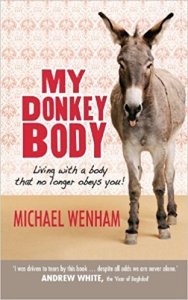 My Donkey Body recounts Michael Wenham’s journey with a rare form of Motor Neurone Disease (MND). If you’re unfamiliar with this disease, think Stephen Hawking. The motor neurones that transmit instructions from the brain to the muscles deteriorate and cannot replace themselves. The brain keeps working but it becomes unable to get messages to the muscles to do their work. The person becomes more and more debilitated and eventually the muscles that keep you alive stop working. MND is a terminal illness and there is currently no known cure.
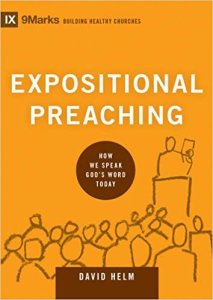 Coaching and playing don’t always require the same skill set. Not every player will make a good coach and not every successful coach will have been an elite player. Look at some of the men coaching gymnastics. It’s hard to believe they could have ever mastered the pommel horse or uneven bars for themselves, but they can be brilliant at training others. The successful coaches are somehow able to deconstruct each aspect of each move, and train their athletes to weave their brilliance in seamless performances.
 It’s been an anxious week as I’ve anticipated returning to the exact place and the same event where I first noticed the symptoms of my cancer. It was the Geneva Push church planting conference and I was speaking on leadership, church planting, and the vision to reach Australia with the good news of Jesus. It was the end of November in 2011 that I climbed the three flights of stairs at Scots Church in Melbourne, stopping on each landing, completely breathless, not knowing that within a few days I’d be in hospital fighting for my life.
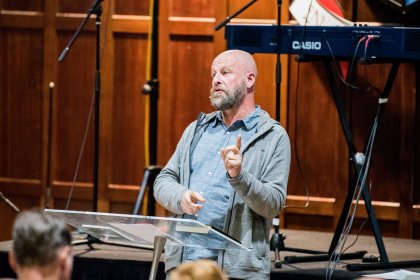 It’s a joy and honour to be able to gather with men and women, young and old, to spur each other on to reach Australia with the life transforming, eternally consequential message of Jesus. People are getting jaded by the endless cycle of meaninglessness promoted by our society. People are searching for meaning. Surely there has to be more that work, sleep, eat, over and over again. Or are we just caught up in an endless Groundhog Day?
 This morning I had an echocardiogram. Don’t know what that is? Neither did I until this morning. It’s basically an ultrasound of the heart. This is one of a number of health checks I’ve had in recent months. Since it’s six years since I was diagnosed with cancer, and two years since I’ve had chemo, and since we’re planning on moving cities, we thought it wise to book in for a major service or two. So far, I’ve had the cameras in both ends and seen some of the damage chemo has left behind. I’ve managed to take on another ‘C’ disease—well developed coeliac. So we’ve had a pantry purge and I’ve started to become one of those difficult people who is always asking what’s in the food I’ve been given. I’ve had lung function tests and discovered that despite the beating my lungs have taken I’m sitting on the low end of average for a bloke my age. My bone density has been checked and I’m osteopaenic. Don’t know that word either? Well, it’s much better than osteoporosis and osteopathetic. I’ve even spoken to my first specialist, a lung physician, who was willing to explore another ‘C’ word—cure. I liked the sound of that one, but we can’t ever know for sure.
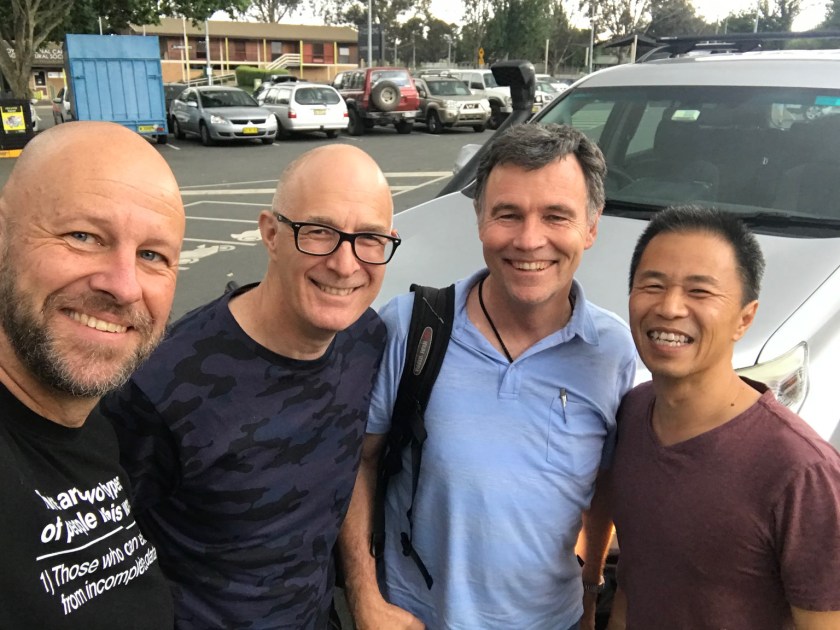 Yesterday I had the privilege of catching up with the same blokes who cared for me on that first day. As we have done every year, we drank coffee (or chai lattes and hot chocolates—we’re getting older), we shared stories, and we prayed for each other. Much has happened in this time. So much has changed. But the goodness of God remains. As I drove home, I found myself singing (yes, truly—and I believe I was even in tune!)
