Saving Eutychus

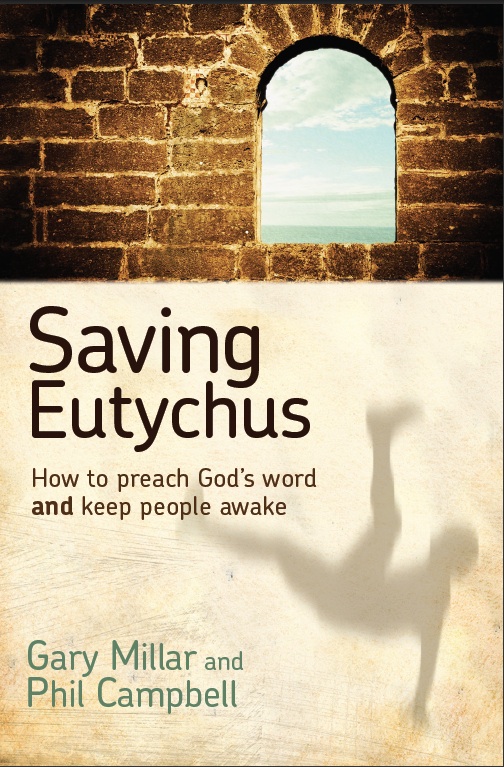
Saving_EutychesI should declare my hand on this book. I’ve only met the Irish author, Gary Millar, on one occasion as he and his family sat in front of me at Chappo’s memorial service. I’ve known the Aussie one for over 30 years. Phil and I met at uni, studied theology together, and have partnered together in ministry often over many years. Phil sent me an advanced copy of this book (pdf only – I’m waiting for my published copy!) and invited a review. Here’s a quote from Phil’s email …

If you like it, we’d love a review on macarisms. If you don’t like it, it would be good to just forget you ever saw it 😉

This might sound like a ‘suck up’, but I really did enjoy reading this book! It’s full of wisdom, tried and tested, Biblical, theological and practical. I don’t preach as much these days, but I’m pleased to have been given this book just prior to my next gig. As I prepare this week and next to preach on Matthew 9 and 10, I plan to filter my preparation through the advice of this book.

Saving Eutychus, by Gary Millar and Phil Campbell, grabs it’s title from a popular eclectic blog written by Nathan Campbell. Eutychus was the bloke in Acts 20 who fell asleep, toppled out of the window, and died during a very long sermon by the Apostle Paul. Without criticising Paul, this book is an OH & S workbook to keep sermon listeners alive.

Saving Eutychus doesn’t just mean keeping him awake. It also means doing our best to keep him fresh and alert so he can hear the truth and be saved.  (p15)

The chapter I most needed to read was the opening on prayer. I easily identified with Gary’s temptations to get up and get busy. No time for prayer – there’s too many urgent things to do… like check Facebook, twitter, read the sports results etc. Sad, I know! And I need constant reminding that talking to God about stuff is the most useful thing I could be doing. This chapter encourages us to pray for our preachers. It also encourages preachers to pray that God will work through our words to transform and change people. Even having been struck with cancer, I still have a temptation to self-reliance. I need continual reminding that I might sow, plant, water and weed, but only God gives the growth. These words spoke to my heart:

God doesn’t use people because they are gifted. He uses people (even preachers) because he is gracious. Do we actually believe that? If we do believe it, then we will pray – we will pray before we speak, and we will pray for others before they speak. It’s that simple.  (p21)

The authors want to help us preach faithfully without being boring. This means people being profoundly impacted by what they hear. We should expect to be changed as we hear God’s word preached. In recent times, I’ve heard two words too often when it comes to describing preaching – encouraged and challenged. Now, there’s nothing wrong with these two responses to preaching, but God’s word promises to do so much more. Gary writes: I want to be challenged, humbled, corrected, excited, moved, strengthened, overawed, corrected, shaped, stretched and propelled out into the world a different person. (p27) In short, we want preaching that changes people.

The key to heart-changing preaching is not about tricks of emotional manipulation. It’s about letting God’s message come clearly through the sermon. The Bible is the life-giving, transforming, re-creating word from God. So the preacher can do no better than to let God speak. It’s not up to us to come up with a message. We simply need to put in the hard work to grasp God’s message and then let him speak. Don’t get in the way of what God has to say. This is what expository preaching is all about.

Phil has been banging a drum for a long time now. Clarity, clarity, clarity! It’s so important. If there’s a bushfire approaching your home, then you want the warning to be clear. If you’re taking potent drugs for a serious illness, then you want the labelling to be clear. If you have a message of life for all eternity, then you want the preaching to be clear. It matters! Saving Eutychus gives us a top ten list for making our preaching clearer and it’s good stuff.

  1. The more you say, the less people will remember
  2. Make the ‘big idea’ shape everything you say
  3. Choose the shortest, most ordinary words you can
  4. Use shorter sentences
  5. Forget everything your English teacher taught you
  6. Am I repeating myself?
  7. Translate narratives into present tense
  8. The six-million-dollar secret of illustrating
  9. People love to hear about people
  10. Work towards your key text

Not all these headings are self-explanatory, but together they offer great tips on making things clearer. Many good communicators tend to do these things instinctively. They’re the building blocks of clarity, especially with the spoken word. If you’re starting out as a preacher, or if you suspect that you’re not keeping people’s attention during your talks, then take the time to work through each of these points.

I’d say the big idea of this book is discovering the big idea of the Bible passage. If you don’t understand what the passage is saying, then you’ll simply pass on your confusion and ignorance. Hard work is required. Interrogate the Bible text until you’re clear on the big idea. What does it mean? What’s it saying? What does this have to do with me? If we can’t answer these questions, then we have no right preaching… yet. There’s more work to be done.

big_ideaPhil is a high-tech computer geek, but when it comes to working out the big idea, he goes old school. Strictly pen and paper. Write out the text, work out the logic, create a visual map of the argument, note repetitions, connections, links, and jot down questions to be explored. This takes time, but its rewards are great. You get it in your head to mull over and over during the week. Visual learners are able to see what’s happening. This exercise goes a long way to uncovering the big idea. And once you’ve got that idea, then you can start working out how it applies in the light of the gospel. Application is the goal, but you need to get there via the text, and that takes time.

Both authors are concerned that we produce gospel-shaped sermons. Gary writes: Just about the worst thing that can happen when we finish preaching is that someone will walk out the door of the church buoyed by their own resolve to try harder. (p77) The preacher’s role is to be faithful to the Bible in pointing people to Jesus. This means reading backwards and forwards. Things happened to others in the past that have been recorded for us in the present. I read the Bible as a Gentile not a Jew. This has big implications for how I relate to the Old Testament. I’m also a human being (yes!) and that puts me on common ground with Adam and everyone after him. It’s all about reading the Scriptures with wisdom and care, seeing how things progress towards and climax in Jesus. This book offers some good advice on preaching in a way that is shaped by the big idea of the Bible.

Saving Eutychus also includes practical tips for delivery. Varying pace, volume and pitch helps keep the listeners awake and engaged. How do you know where to put the emphases? Again, the answer is the same. It needs to be shaped by the big idea. If you’re clear on what you want to communicate, then you’re much more likely to communicate clearly!

In the last couple of chapters and the appendix we get to read a couple of sermons by the authors. These are run of the mill Sunday sermons. Phil shares the what and the why of his preparation and we get to see him putting his ideas into practice. Gary and Phil both critique each other, offering helpful insights and feedback at different points. It’s useful to see this modelled and to be offered a framework for providing feedback. They provide a sermon feedback form that can be used to invite feedback on our sermons, or to train others in preaching. When it comes to feedback, I agree with the authors that feedforward is preferable. It’s better to be able to improve the talk before you go live, than to wish you’d changed it afterwards.

So… I want a real copy of this book! I’ll be recommending it to the preachers in our church and networks. I’ll be encouraging those training to give Bible talks to work carefully through this book. I’ll be suggesting they listen to some recordings of the authors to see how they model what they teach. I’ll be critiquing my own preparation and talks in the light of the wisdom here.

But just one question… in a book that says to choose the shortest, most ordinary words you can… what’s with the “illocutionary effect”? Really!!

The trellis and the vine

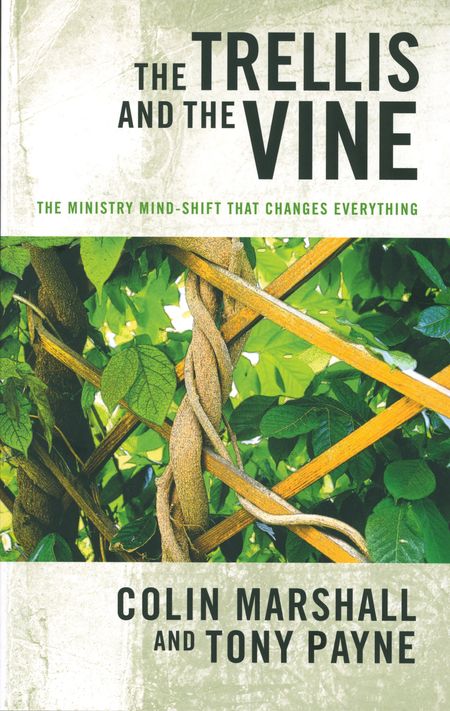
Trellis and the VineFor some reason I’ve kept putting off reading The Trellis and the Vine by Colin Marshall and Tony Payne. It might be the familiarity breeds… thing. After all, I did a ministry apprenticeship with Col nearly 30 years ago, and I overlapped with Tony doing the same thing a year behind me. It could be that I thought I’d heard it all before. And I pretty much had! But it’s for this reason, and the passion and commitment of the authors, and the quality of the book, that I’m now keen to recommend it to others. I intend to provide an overview of the material, highlighting what I see as some key issues, share some ideas of how we are seeking to grapple with these things, and make some suggestions.

The two images of the trellis and the vine are used to describe two aspects of Christian ministry.

The basic work of any Christian ministry is to preach the gospel of Jesus Christ in the power of God’s Spirit, and to see people converted, changed and grow to maturity in that gospel. That’s the work of planting, watering, fertilizing and tending the vine.

However, just as some sort of framework is needed to help the vine grow, so Christian ministries also need some structure and support. It might not be much, but at very least we need somewhere to meet, some Bibles to read from, and some basic structures of leadership within our group.  (p8)

The observation of the authors is that so often in our churches the trellis work takes over from the vine work. We get caught up in committees, structures, activities, fund raising, keeping the machinery ticking over, such that we lose site of the reason for the trellises – that is, to support the vine. Drawing on the great commission in Matthew 28, this book argues for vine-growing as disciple-making which should be the normal agenda and priority of every church and every Christian disciple (p13).

As churches move away from erecting and maintaining structures to growing disciple-making disciples, a radical mind-shift is required. These changes of outlook will include…

      1. Building people rather than running programs
      2. Training people rather than running events
      3. Growing people rather than using them
      4. Training new workers rather than filling gaps
      5. Helping people make progress rather than solving problems
      6. Developing teams rather than focusing all on ordained ministry
      7. Forging ministry partnerships rather than focusing on church polity
      8. Establishing local training rather than relying only on training institutions
      9. Looking at the long term picture rather than being constrained by immediate pressures
      10. Engaging in ministry with people rather than being consumed by management
      11. Prioritising gospel growth over specific church growth

Col and Tony ground their claim to the priority of the vine over the trellis in the Scriptures. They examine what God’s plan is for his world, what he has been doing, and what he is doing now after the finished work of Christ. God is saving souls through the Spirit-backed proclamation of the gospel and this has big implications. Our small ambitions need to be laid aside for the cause of Christ and his gospel. God is calling people to be born anew in Christ and to grow into maturity. And this growth happens by the power of God’s Spirit as he applies the word to people’s hearts. It’s evident that this has little to do with structures and organisations and much more to do with prayerful word ministry.

The Trellis and the Vine aims to show that every Christian is called to be a part of this vine work. Not everyone is gifted in the same way, but we are all called to the task of being and making disciples. The beauty of the body of Christ is we can support one another in this work. The common clergy-laity divide is broken down as leaders and congregations begin to work off the same game plan. Modelling and teaching from pastors, elders, teachers, group leaders and others is focused on God’s agenda of proclaiming Christ and calling people to follow him. We read, discuss, and prayerfully apply the Scriptures together at church, in groups, one-on-one, in formal and informal contexts, with the same aim of growing into maturity as followers of Jesus.

I especially appreciated the careful defining of ‘training’ in this book. They contrast our popular understanding of training as a focus on skills development and show from the New Testament that it should be more focused on Christian thinking and living.

Have nothing to do with irreverent, silly myths. Rather train yourself for godliness.  (1 Timothy 4:7)

All Scripture is breathed out by God and profitable for teaching, for reproof, for correction, and for training in righteousness, that the man of God may be complete, equipped for every good work.  (2 Timothy 3:16-17)

Though training is not simply the imparting of information, the faithful passing on of sound teaching is essential.

And the things you have heard me say in the presence of many witnesses entrust to reliable people who will also be qualified to teach others.  (2 Timothy 2:2)

Training is also modelling a way of life. It is caught as well as taught and we are called to set one another an example. The ultimate example is that of Jesus Christ himself.

Do not cause anyone to stumble, whether Jews, Greeks or the church of God —  even as I try to please everyone in every way. For I am not seeking my own good but the good of many, so that they may be saved.  Follow my example, as I follow the example of Christ.  (1 Corinthians 10:32-11:1)

Not that trainers will be perfect, but they are called to watch their lives and teaching carefully. They will impact others profoundly as their progress is seen.

Practice these things, immerse yourself in them, so that all may see your progress. Keep a close watch on yourself and on the teaching. Persist in this, for by so doing you will save both yourself and your hearers.  (1 Timothy 4:15-16)

This understanding from the Bible has led the authors to summarise the nature and goal of training by three Cs.

Through personal relationship, prayer, teaching, modelling and practical instruction, we want to see people grow in:

  • conviction – their knowledge of God and understanding of the Bible
  • character – the godly character and life that accords with sound doctrine
  • competency – the ability to prayerfully speak God’s word to others in a variety of ways.  (p78)

Following the lead and language of the Book of Acts, the authors describe training as more concerned with gospel growth than particular church growth. This happens in the lives of people, not structures. It means we should be generous and willing to send off many whom we train for the sake of God’s church elsewhere. It requires us to see people as people, and not just cogs in the wheel for our own projects. As more and more people are trained in godliness and a good understanding of the truth, then we will find churches as they should be – growing in numbers and maturity, with people serving one another, encouraging and setting an example to each other. In other words, a long way from the ‘professional minister with all of his clients approach’, which does little more than stifle gospel growth.

For churches to adopt this radical mindset, it requires pastors and leaders to grasp the essential importance of training. It’s not sufficient to be the preacher, clergyman, CEO, or business manager. Leaders need to encourage their churches to become centres of training where disciple-making disciples are nurtured, equipped, and encouraged. In this way the opportunities for outreach, teaching, modelling, service and care are shared among the body of the church. Churches can grow in health as well as numbers and more and more people are mobilised. We would do well to conduct an honest audit of our congregational programs, structures and and activities and see how we measure up against this picture.

Recruiting co-workers is key to promoting gospel growth, but there are mistakes to be avoided. Here are a few:

  • Don’t compromise on core beliefs and values.
  • Don’t be impressed by enthusiasm over substance.
  • Don’t ignore their track record.
  • Don’t choose people who aren’t good at relating to people.
  • Don’t recruit in desperation.
  • Don’t select unteachable co-workers.
  • Don’t simply choose ‘yes’ people.
  • Don’t just advertise for volunteers.

The best way to recruit co-workers according to convictions, character, and competence is to train them. Keep on the look out for people who might be suitable to share the load with you. Always be thinking about whom you could be training. Consider if there are one, two or more people that you could especially invest in. Make it happen. Share in their lives, work through the Scriptures together, pray with one another, open your heart to them, delight in their progress, be honest and speak the truth in love, as you encourage them to grow as a disciple-making disciple.

A chapter is devoted in this book to the Ministry Training Strategy. This isn’t surprising given that Col was one of the founders of this ministry and Tony was one of the early trainees. They have shaped and refined this ministry over three decades, and commend it as an excellent strategy for preparing new Christian leaders. It’s basically a two-year apprenticeship that gives people real opportunity to grow in gospel ministry, by doing ministry under the supervision and guidance of a suitable trainer. It’s often a precursor to more formal theological training and has the benefit of enabling a good assessment of a person’s suitability for ministry leadership before investing everything in 3 or 4 years at college. A good outcome is a wise and godly decision at the end of the apprenticeship. I’m an advocate for this training experience before formal theological training. I benefitted greatly from receiving it myself and have subsequently led more than 60 apprentices through a similar program.

So what have I learned from this book?

The big thing has been the reminder to see training as part of the DNA of a healthy church. Not simply skills development, but the making of disciple-making disciples in response to the commission of Jesus. As churches grow it is easy to be consumed by organisation, structure, vision setting, strategic planning, and the like. We can lose sight of the people. It’s been a good reminder that God is seeking people with him for eternity, not clever programs!

The Trellis and Vine has also encouraged me to be more purposeful in training workers for ministry throughout our church. Training is not simply for the ‘professionals’. It’s about being transformed into the likeness of Jesus, and that’s for all. We need to audit our Sunday meetings, growth groups, children’s and youth ministries, and ask the hard questions. Are we occupied with a gospel work that will make a difference for eternity? Are people genuinely seeking to follow Jesus? Are we making disciples of one another, or are we sitting back assuming it will just happen automatically somehow?

My current pastoral focus is particularly on ministry training and leadership development. I’ve begun to assess how we are travelling with equipping and supporting our growth group leaders. A quick analysis shows there are a number who would really appreciate some training. This book is a helpful resource as I seek to encourage the leaders to make growing disciple-making disciple a priority in their groups.

A couple of suggestions

Given that this book is called The Trellis and the Vine there is very little about trellises. The author’s main point is to get us focused on vine growing and not distracted by erecting and maintaining trellises. However, I would appreciate more on how to create helpful trellises for vine growing. A lack of trellis or the wrong type of trellis can become a serious impediment to vine growth. Disorganised strategies and structures can certainly prevent gospel growth in our churches, but the inverse can also be true. It seems to me that we need to find the right trellis that enables the vine to grow. More could be said on this.

However, and I’m not sure if this point is made explicitly in the book, The Trellis and the Vine is itself a helpful trellis! Here is a strategy with organisational advice to increase the disciple-making outcome in our churches. Chaos is affirmed in the book as an expected outcome when the focus is on vine growing, but sometimes the chaos is an indicator that some trellis work needs to be done to keep the vine growing healthily.

I also had a concern in the section on ‘people worth watching’. The call is to become ‘talent scouts’, looking for people with extraordinary gifts in leadership, communication and management; people with vision, energy, intelligence and entrepreneurial spirit; people who are good with people, and who can understand and articulate ideas persuasively. If these are also godly servants of Christ who long for his kingdom, then why not headhunt them for a life of ‘recognised gospel ministry’? (p140) My concern here is the order and emphasis. It’s too easy look on the surface, see the gifts and talents, and fail to look deeply at the life and character of the person. In a book that has highlighted this issue, it would have been more helpful to illustrate the things that might give evidence of godly character.

A similar concern is the limited mention of ‘love’ as a defining characteristic of the disciple and his or her life and ministry. Interestingly, the first FAQ in the appendix illustrates what makes a great sales person. The answer is love for the product and care for the people. When it comes to the gospel and Jesus and other people, this is so important. I think it’s a point that could have been much stronger and more up front in the book. 1 Corinthians 12-14 would have been an excellent starting point for a chapter on the importance of love in building the church and making disciples. I worry sometimes that our catch-cry of looking for FAT people (faithful, available, teachable) people is not enough. I used to add an S (self-starting or sacrificial), to make FAST people! Maybe we should add an L (loving) to make FLAT people instead!

Overall

This is a very helpful book. I commend it to pastors, ministry leaders, small group leaders and any Christian who is keen to make their life count for eternity.


Getting ready for Easter

easterThe department stores and supermarkets are always ready for Easter. I think once the Christmas stuff comes down, the Easter stuff goes up. There’s over-priced, over-packaged, hollow chocolate as far as the eye can see. I usually wait for the post-Easter sales and reductions on the broken eggs and rabbits. Churches don’t really need to advertise Easter because the shops do it for them!

But it does worry me that our shops are so focused on Easter, while many of our churches don’t seem to give it a lot of thought. We know it’s coming but we still seem to be ill-prepared and caught off guard when it arrives. The fact of the matter is that Easter is one of two occasions on the calendar when many people will visit church. I’m pleased that many take this step because I want them to hear and grasp why the Easter events are so absolutely crucial for all who follow Jesus.

Easter is a time where we remember a Galilean man of the first century who was executed by crucifixion under the Roman regime. It’s strange to celebrate this event two millennia later and stranger still to call it Good Friday. But this is the event that mends the broken relationship between God and us. That’s a whole lot better than good. And Easter Sunday demonstrates that this man is no longer dead. The empty tomb and the appearances of Jesus bear testimony to the efficacy of his sacrifice on the cross for us, and the fulfilment of his promises to die and rise again. Jesus is the risen Son of God, and we’re called to value him, turn to him, trust in him, honour him, and live for him. Resurrection beyond death is the hope of those who follow Jesus. Jesus’ death and resurrection has made this possible.

These are events of history that I’m keen for people to notice. There’s a fairly good chance they’ll get mentioned in churches over Easter (though no guarantee in some churches with little regard for the Bible) so I’d love my neighbours, workmates, teammates, relatives, occasional church-going mates, and anyone else to come along.

And if they’re going to be guests at our churches, then I want our churches to be ready. In the same way we prepare for guests at home – light up the barbie, organise food and drinks, welcome people, and seek to provide a good time – I want to prepare at church. I want people to feel especially welcome. I’d like them to feel comfortable with what’s going on. I’d love them to find us friendly, helpful and generous. I want the message of Easter to be so clear it can be repeated afterwards by one and all. I’m keen for people to get a window into how important it is, how much it means to people (like me) today. I’d like them to understand how they could find out more about Jesus, if they wanted to. And I’d love them to be pleasantly surprised about church, and want to come again… soon.

All this assumes people know it’s on, what’s happening, when and where to go. It requires advertising of some sort and people inviting others to join us. It would help if we could overcome a perception of ‘same old same old’ and ‘why would I bother coming cos I know what they’re going to do and say?’ Families would probably appreciate knowing what happens for kids and youth at church. We might want to check whether church is easy to find, whether their are clear signs directing the way. I reckon we should be offering top class refreshments to make it worth sticking around afterwards. And why not think about a gift that people could take home with them?

If you follow Jesus, let me ask have you and your church worked out what you’re doing at Easter yet? Now would be a good time to start if you haven’t already. Some churches have a season before Easter called Lent, so they’re probably ahead of the game. Our church doesn’t make much of lent, so we need to learn from the shops and get our act together.

If you don’t follow Jesus, but if you’re open-minded about Christianity and talking about God, then let me encourage you to check things out this Easter. If you know a Christian and you’re thinking of visiting their church, then I recommend you letting them know you want to get to the heart of message and not be distracted by religious fluff. Just saying!

And by the way, you probably shouldn’t buy me any Easter eggs. I’m supposed to be losing weight, lowering my blood-sugar levels, and reducing my blood pressure. Not fair!

Journey with cancer 17 Feb 2013 – chain reactions

I’m still rejoicing in Tuesday’s amazing news of my cancer shrinking. This has renewed my commitment to persevering with the chemo. Why else would I submit to being poisoned every three weeks, AND pay thousands each time for the privilege?

Digital Sphygmomanometer-500x500But Wednesday gave me a sober reminder that there are other costs. I stopped by a National Heart Foundation stall and let them take my blood pressure. I’m not sure who got the bigger shock – them or me? It was 180 over 106. This was off their charts and they told me I was high risk for a stroke or heart attack. Thanks guys! I checked it again at home. It wasn’t quite as bad, but still serious. I’ve been checking each day since and it’s not good.

I think it’s easy to explain. I don’t think it’s lifestyle or diet. It’s almost certainly the chemo, specifically the Avastin. So we may need to make a choice. Give up the Avastin or introduce new drugs to reduce the blood pressure. When the chemo is shrinking the cancer, I don’t feel like messing with the chemo cocktail. But I don’t want a stroke either, so I may have to take on another drug, and live with its side effects and repercussions.

There’s nothing simple about this cancer journey. If you pray, please ask God to grant us and the specialists wisdom to know how best to proceed. Please ask him to protect me from harm caused by high blood pressure. And please ask him to help me not be anxious, but to keep trusting him in all things.

Thanks,

Macca

Macca’s book

Macca

Wow! I have my own book. Last Sunday I was welcomed back onto the staff team at Crossroads and presented with a book. I was gobsmacked and completely humbled as I looked through it. In fact, it was hard to concentrate on the rest of church. Sunday afternoon was spent reading it from cover to cover.

The book is full of thank you messages from friends. It represents 23 years of relationships here in Canberra, and it’s a great encouragement to hear how people have been impacted by God over this time. Some share of how they became Christians as we examined together what the Bible reveals about Jesus. Others speak of the impact of church or the FOCUS ministry or various trips we made to be involved with other churches on the coast.

I don’t know for sure whose idea it was, but I understand that special thanks goes to Marcus and Kelly, as well as the super-crafty Sara Sparks. Let me also thank Derek and Anna, David and Jenny, Monica, Bernie, Cath and Jamie, Klaus and Jude, Matt and Carla, Matt and Annette, Bron and Con, Anthea, Revin, Matt, Mik, Snicko and Anita, Richard and Pinnucia, Cam and Sue, Anton and Kylie, Sarah, Micaiah, Michael and Trish, Michael and Julie, Tim and Kate, Dan and Emma, Rob and Jenny, Steve and Cathy, James and Ali, Jonty and Beth, Sonya, Cliff and Jen, Lexi, Janine and Chris, Phil and Laura, Michelle, Michael and Susan, Andrew and Tanuja, Kate and Hamish, Keith and Joyce, Rob and Arabelle, Grace and Jono (best photo!), Matt, Mark and Louise, Dan and Celine, Eben, Philip and Rosi, Jennifer and Adi, Dave and Kate, Jo and Stuart, Russell and Kiri, Kathleen, Pete and Kate, Kell, Anne and Ian, Jared and Angela, Dan and Simone, Sam, Kerryn and Nathan, Dave, Tom, Ben and Beth, Deb, Nicola and Harry, Tim and Tegan, Mark and Katherine, Tim and Alison, Graeme and Chris, Mike and Donna, Mal and Vicki, Tim and Louise, Roslyn, Shan and Paul, Dean and Jo, Anita and Dave, Ralph and Kylie, Dave and Elissa, Andrew and Wendy, and families, and anyone else too slow to get in it!

Please come over and check it out if you’d like to see it. I was very touched. Thank you 🙂

PS If you click on the image above you can view the contents of the book!

Retail therapy – a first world sin?

retail_therapyI don’t remember when I first came across the idea of ‘retail therapy’, but the idea has disturbed me for some time. For those who haven’t heard of it before, ‘retail therapy’ is a term to describe shopping when you need cheering up. If you’re feeling a bit down or depressed, then you go to the mall and make some ‘comfort buys’ to improve your mood.

According to Wikipedia, retail therapy was first used as a term in the 1980s with the first reference being this sentence in the Chicago Tribune of Christmas Eve 1986: “We’ve become a nation measuring out our lives in shopping bags and nursing our psychic ills through retail therapy.”

There’s now a website called ‘Retail Therapy’ hosting fashionable clothes for all shapes and sizes. Our local civic mall invites shoppers with these words: For those yearning for some retail therapy, Canberra’s City Centre offers an innovative retail experience at the Canberra Centre. It’s even a selling point for real estate near our city: The centre of Canberra is also a few minutes walk offering fabulous retail therapy , award winning dining experiences, vibrant funky cafes and…  The lists could go on, throughout our nation and in many wealthy countries around the world.

There’s something profoundly disturbing about thinking that buying more and more stuff will cheer us up. Are we really happier for having the latest, fastest, shiniest, brightest, hippest. Of course not. It’s out of fashion before it’s out of warranty! I came back from camping and got disturbed about all the clutter. I’d lived just fine without so many things in the tent, so why do I need more and more now! I got a little depressed about it, so what did I do? I bought another tarp and another tent! (Actually there are good reasons for this, but the point still stands.) More stuff does not equal more satisfaction.

I worry too that I can be quick to spend on myself, buying things that I don’t really need, to the neglect of those in great need. We support a number of families in Kenya and in India. They’re all living well below what we’d call the poverty line. For the most part I think they know genuine contentment, but I’m sure it wouldn’t cross their minds to earn money simply to spend it on trivia when they’re feeling down. Food, clothes, school – if they can cover these things then they’re doing well.

Yesterday I received an invitation from the Oaktree Foundation to Live Below the Lineliving on $2 a day, to tackle extreme poverty. I reckon if you’re feeling a little aimless, need a little cheering up, then living below the line will do a whole lot more for you and others, than some self-indulgent retail therapy. Or perhaps when the department stores are seducing you to part with your cash or go deeper into credit card debt, you could consider contacting TEAR or Compassion or World Vision or Médecins Sans Frontières or a similar group, and get into some generosity therapy instead.

Food for thought!

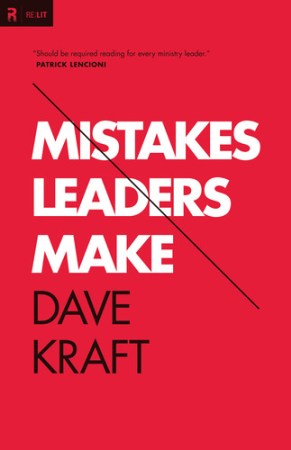
Mistakes leaders make

mistakes-leaders-makeDave Kraft has had plenty of time to make mistakes and to observe others doing the same. He’s been in Christian leadership for more than 43 years serving with Navigators and a variety of churches. In his recent book, Mistakes Leaders Make, he offers ten warnings of what not to do as a leader. This is an easy book to read. It took me less than a day, but I’d recommend taking it more slowly and working through the issues and questions he raises more carefully. It’s readability is increased by the style of writing. He follows the pattern of Lencioni in telling a story about a church and its various staff. While the church is fictional, the characters and issues are very real. Each chapter introduces a new character, and their mistakes, before teasing out some principles and practices.

Kraft recommends letting Psalm 139:23-24 be your prayer as you work through each chapter.

23 Search me, O God, and know my heart!
Try me and know my thoughts!
24 And see if there be any grievous way in me,
and lead me in the way everlasting!

The list of mistakes is very sobering. I have experienced temptation and failure in a number of these areas. Each one is worth considering carefully.

  1. 1. Allowing ministry to replace Jesus

The first mistake is very subtle and easy to deny. How could you possibly replace Jesus with ministry when ministry is about serving Jesus? You can and I have! It’s easy to be so caught up with the responsibilities of ministry that we neglect our relationship with our Lord. I don’t have time to talk to God because I’m too busy doing things for him. Successful ministry can become more important that honouring the one we serve. I think this area is a big trap for senior pastors and it has an awful ripple effect. Families, staff teams, and churches all suffer as this happens. The key to this mistake – indeed the solution to each of the mistakes in this book – is to keep Jesus at the centre of our lives and all we do.

2. Allowing comparing to replace contentment

Comparison versus contentment is another perennial fight for Christian leaders. Every denominational gathering, leadership conference, or ministry fraternal offers the temptation to pride or envy. How many on your team? Have you planted a new church this year? What’s your budget? How many people come each week? It’s a fools game. The solution is to be content with who you are, where you are, what you are doing, and what God is doing through you. (p33) Just remember you are God’s person, entrusted with God’s people, and God’s ministry. If you must compare, then ask yourself the question whether you are being all that you could be for God.

3. Allowing pride to replace humility

Kraft argues that pride is the root cause for the undoing and fall of most leaders. It’s so easy for the ministry to become all about us. He quotes Gary Thomas in his book, Thirsting for God:

Proud women and men relate everything back to themselves. They are all but incapable of seeing any situation except for how it affects them. Empathy is something they may read about but will never truly experience.  (p44)

Pride can be a particular issue for young, gifted leaders who experience success early in their ministry. It’s easy to be swept up in the praise, to believe we are the cause of our own success, and to lose sight of the contribution of others. Most significantly we can take our eyes of the Lord of the harvest altogether. I believe that this was a struggle of me at times. The solution is to refocus regularly on the cross of Jesus Christ and the extraordinary grace that we’ve been given from God.

4. Allowing pleasing people to replace pleasing God

People pleasing is a trap. If we spend our time worrying about what everyone else will think of what we do, then we will be torn this way and that and never lead effectively. Ultimately we play to an audience of one – God himself. He will judge our motives, words and actions. As Proverbs 29:25 says, The fear of man lays a snare, but whoever trusts in the Lord is safe.

5. Allowing busyness to replace visioning

Busyness is a great enemy of Christian leadership. Too few leaders spend time thinking, praying, dreaming, looking ahead, and planning. The urgent gets our attention and we fail to set clear vision for the future. This mistake leads to ineffective and overly busy ministries, burnout of people, and disillusionment with what we’re doing. Leaders must look to the future. We need to be concerned with what could be not simply with what is.  This is a hard lesson to learn because we are so often tyrannised by the urgent. Let’s make time in our calendars to think, pray, reflect, dream, plan – both on our own and with our teams.

6. Allowing financial frugality to replace fearless faith

The temptation is to think that this mistake is one that only church boards and parish councils make! This is not true. We began our ministry on a shoestring. We had to clear a substantial debt in the beginning and for a number of years I was paid 6-8 weeks late. Everything was done on the cheap, money was kept and saved rather than spent, and I became overly concerned with getting a bargain. We need to be financially wise, but also filled with faith. We should remember that God is our provider and he calls us to use his resources for the advancement of his work.

7. Allowing artificial harmony to replace difficult conflict

We are not to be so loving that we don’t speak the truth, or so truthful that we don’t speak with love; there is a fine balance between the two that is essential to all human relationships, especially among church staff and in a leadership role.  (p79)

Avoiding conflict can be a big problem among Christian leaders.  I’ve been in staff meetings where it’s obvious people aren’t on board, but they remain compliant or passively aggressive. It’s awful! We’re tempted to work around people rather than confront them. Sometimes people are unable to do their job and we’d rather compensate for them at great cost to the organisation, than confront them or move them on. Conflict can be very healthy for teams. And healthy conflict depends on trust and relationships. I recommend reading Patrick Lencioni for more on this.

8. Allowing perennially hurting people to replace potential hungry leaders

There are always hurting people in our midst and the compassionate leader can find him or herself overwhelmed with trying to care for them. Eventually the leader is unable to keep it up and goes on stress leave or resigns. The problem is we try and do it all ourselves. Leadership is about building teams of people to share the load. We need to take the time to get the right people onto the team bus with us and them help them to find the right seats according to their gifts, abilities and passions. Grow the team and we grow the capacity to care. Leaders must be team builders.

9. Allowing information to replace transformation

It’s not what you know, but what you do, in dependence on the Holy Spirit, with what you know that makes all the difference.  (p99)

It’s easy to be so consumed with preparing, teaching, and passing on information, that we lose sight of the purpose of seeing people transformed by God. If we are teaching and learning, but never changing, then we have a massive problem. As leaders we should be on our knees asking God to transform us and the people we lead.

10. Allowing control to replace trust

Stressed and busy leaders are high risk to be controlling rather than trusting. We might fear things going wrong or getting out of control. We might worry that someone else will stuff things up or not do them properly. We might be jealous of others and try to guard our reputation. Good leadership is about helping others to have a go, to grow, and contribute, and be the people God made them to be. After all, this is God’s church and God’s ministry, so let’s lighten up and trust God!

This is an insightful and practical book. It cuts deeply. I recommend it especially to young blokes coming out of theological college who are planning to conquer the world! It’s also a must read for senior pastors who know deep down that they keep running in the red zone on empty!

Journey with cancer 13 Feb 2013 – surprisingly good news

It’s been some time since I posted on the progress of the cancer. I guess there hasn’t been much to report. October was the last time I had a scan. The cancer had been stable. I’d been feeling fairly well. In fact, for two or three cycles, the chemo hadn’t knocked me round too badly and I’d only been bed-ridden for a day or two.

During the summer months I’d enjoyed some wonderful relaxing time with the family. We’d been camping at Burrill, enjoying the surf, catching some fish, chilling out in the hammocks, chatting round the campfire, learning to cook cakes in my ‘Shuttle Chef’. I stopped reading books for a while, slowed down on the blogging, played a bit of real life scrabble, and slept lots. We spent a couple of awesome weeks in Sydney house-sitting for friends. During this time I learned to ride a stand-up paddleboard (sort of), helped the kids to learn to wakeboard while I had heaps of fun driving the zodiac on Sydney Harbour. I didn’t even have to interrupt the Sydney holiday because we were able to arrange chemo in Sydney. Then, another week or so camping in Burrill. I had long walks on the beach, caught some salmon, flathead and whiting, cooked some more cakes, and even went out in the surf. For the first time in two years I went out on my bodyboard and caught some decent waves. It was exhilarating! Who would have thought a year ago?! Mind you, I suffered the next two days, as my ankles swelled up in such pain that I could barely walk. But, it was worth it!

Now I’m back at work. I’ve re-joined the team that I built, but in a new role, with new patterns, new responsibilities, and new challenges ahead. I will need to be disciplined in getting rest, taking time off, tuning out from the demands of ministry, saying ‘no’ to opportunities, and staying focused. But I’m excited at the possibilities.

marble-in-hand-cmykOn Monday I had a CT scan to check what was happening with the cancer. I must admit, that I’d been expecting this scan to show growth. It’s over a year now since I began chemo and it’s unusual for people with my cancer to show no progression for this long on this treatment. But, it’s not about statistics. Everyone is unique. And my results stunned everyone. Fiona rang for the results yesterday and we celebrated them over dinner. The tumour had shrunk again. After being stable for months, it had shrunk from 12mm to 7mm! Awesome! I’ve gone from having a marble inside me to having a pea!

peaThe oncologist this morning was smiling! In fact, he was pretty chirpy. They just don’t expect to see further shrinkage once things have plateaued on maintenance therapy. Plus, the neuropathy seems under control. So much to be thankful for.

A miracle? Yes, it is really. I’m not healed, but I’ve been healing in so many ways, and that is very encouraging. Why is this? The right drugs? It seems so. The combination of Alimta and Avastin isn’t that common, but in my case it’s proved to be very effective. It justifies the huge costs of the treatment. Is it good food, reasonable exercise, de-stressing and refocusing on life? I’m sure this has helped. And what about prayer? Can my improved condition be linked to the prayers of so many (I believe hundreds of people) praying regularly for me? I believe it can. I don’t know why, but it’s the mercy of God that I’m where I am today, and I thank him for listening to the pleas of so many. If you pray, please join me in praising God for his kindness and please keep asking him to shrink this cancer to oblivion!

Mixed up macarisms

Puzzle-300x182Looking back over the months, this blog has fulfilled a number of different purposes. I’ve been able to share what’s been going on with my cancer and treatment, and my physical, emotional, relational and spiritual responses to these things. I’ve reviewed a range of books – mainly Christian ministry and leadership material. I’ve shared my life as a Christian and invited others to seriously consider trusting in Jesus. I’ve written a few posts on leadership and I’ve even dabbled in a bit of poetry. It’s been pretty eclectic and nobody knows what I’ll write about next – not even me!

This has led to thoughts of starting another blog. Macarisms could remain the blog where I post on cancer and personal matters, and I could start another for leadership and ministry resources. In fact, these thoughts turned into action and I began a separate blog and started dividing the materials, creating new links, and so forth. But, I didn’t go live with the changes and I’ve since begun to think differently. I intend keeping the diversity on the one blog and I have, what I believe are, important reasons for doing so.

The internet is crowded with resources. Christian materials, blogs on leadership, people reviewing books, many selling their wares. We can view the resources, and maybe know the name of the author, but mostly we know absolutely nothing about the life of the people behind the words and ideas. Just lifeless, faceless men and women sprouting their wisdom via computers and phones.

I’m keen for macarisms to be different. I will write academic posts from time to time, but they will be placed alongside testimony and experience. I want people to understand how I do life as well as how I do theology. I hope to encourage, equip and inspire people from the Bible as I seek to live it out myself. In other words, I want to be someone who walks the talk.

The Bible teaches and models how important this is for Christian leaders…

Watch your life and doctrine closely.  (1 Timothy 4:16)

You know, brothers and sisters, that our visit to you was not without results. We had previously suffered and been treated outrageously in Philippi, as you know, but with the help of our God we dared to tell you his gospel in the face of strong opposition. For the appeal we make does not spring from error or impure motives, nor are we trying to trick you. On the contrary, we speak as those approved by God to be entrusted with the gospel. We are not trying to please people but God, who tests our hearts. You know we never used flattery, nor did we put on a mask to cover up greed—God is our witness. We were not looking for praise from people, not from you or anyone else, even though as apostles of Christ we could have asserted our authority. Instead, we were like young children among you. Just as a nursing mother cares for her children, so we cared for you. Because we loved you so much, we were delighted to share with you not only the gospel of God but our lives as well. Surely you remember, brothers and sisters, our toil and hardship; we worked night and day in order not to be a burden to anyonewhile we preached the gospel of God to you.
10 You are witnesses, and so is God, of how holy, righteous and blameless we were among you who believed. 11 For you know that we dealt with each of you as a father deals with his own children, 12 encouraging, comforting and urging you to live lives worthy of God, who calls you into his kingdom and glory.  (1 Thessalonians 2:1-12)

Integrity is priceless and absolutely essential for teachers. My aim is to live with integrity and so to speak and write with integrity also. For this reason I will offer a window or two into my life as I comment, teach and explore a range of different topics. I hope this works for you!

Leadersense

I’ve just taken on the role of developing leadership within the church I serve as a pastor. It’s a wide role and open-ended. What type of leaders – do you mean pastors and ministry apprentices? Will it include members of the congregation? Is this about growth group leaders? What about children’s and youth leaders? Aren’t they someone else’s responsibility? Will this involve women as well as men? Shouldn’t each area of ministry be doing this anyway? Will you be creating new opportunities for leadership? And these are just some of my questions! I’m sure you can think of dozens of others. The role is really about making sure we’re recruiting, training, equipping, supporting, and multiplying our leaders across the church. The answer to every question above is ‘yes’!

It’s easy for us to be very monochrome when it comes to thinking about leadership. We might limit our focus to paid staff for example and say that they’re our leaders. We could think of the governing body of the church as the leaders. Or we might limit our thinking to all the people who have the title of ‘leader’, such as our growth group leaders, kingdom kids (Sunday School) leaders, youth leaders, service leaders, and so on. If we think role as well as title, then we have leaders (or at least we need leaders) in all kinds of places. Every ministry team needs a leader. The growth of a church requires a corresponding growth in the numbers and calibre of leaders. Leaders need to understand God’s agenda for church, the church’s vision for ministry, the needs of the people they lead, and the importance of continually replacing and reproducing themselves.

This may seem like common sense – and it is! But, as someone once said, good sense isn’t that common! It’s easy to assume that leadership will arise naturally, that people will automatically understand what’s expected of them, that they’ll step up to the plate, do a great job, and all will go well. In the real world, leadership needs to be taught and caught. It needs to be encouraged, supported, resourced, and held accountable. We have to develop pathways to move the right people into leadership, and equip them so that they’ll lead people in the right way.

The Scriptures are the foundation for understanding leadership. God made people. He knows us inside out. He knows how we tick psychologically and engage relationally. Jesus, Paul, Peter, Moses, Joshua, David, and others, show us and teach us God’s purposes for leading his people – why to lead them, where to lead them, how to lead them, who should lead them. My plan is to draw on the riches of God’s word to build and inspire leaders in our midst. And, more importantly, for each of our leaders and yet-to-be leaders to dig deeply into the Bible, to shape and equip their leadership.

large_einsteinAnd yet, I don’t subscribe to the view that says “If you can’t find it in the Bible then it’s not worth knowing.” The Book of Proverbs shows how much can be learned by astute observation of this world we live in. God has created sharp minds who have much to teach us in many areas including ‘leadership’. We can learn from great leaders throughout history. We will be warned to avoid the mistakes of the past and inspired to reproduce the wisdom that worked. Bookshops abound in leadership books and, while many aren’t worth the paper they’re printed on, there are some real gems out there. Leadership happens in all areas of life and organisation and we can draw on our experiences in other contexts and the experiences of others in similar situations. All this must be firmly bracketed by the understanding that leadership in church should be fundamentally about leading people in their relationship with God, through Jesus Christ, in the strength of God’s Spirit. No Harvard Business Review best-seller will take you there.

olddogI’ve been in this leadership game for years and years, but I’ve still got so much to learn and apply. My hope is that this old dog can learn a few new ‘tricks’! My goal and prayer when it comes to leadership is to develop God-informed and worldly-wise, practical and principled, organisational and personal, uncommon and common sense.

I’m keen to grow in my ‘leadersense’.

Leadership and followership

For the past 20 years I’ve been the leader: Director of the FOCUS ministry on campus; Senior Pastor of Crossroads Church; making the decisions; setting the vision; recruiting the staff; leading the team; critiquing, evaluating, shaping and encouraging. It’s been my responsibility.

Now things have changed. I’m entering new territory this year. The Senior Pastor has now become the Associate Pastor! Now I report to Marcus – the same Marcus whom I recruited, mentored and employed. To be honest, I like the idea. It’s exciting to be able to change positions. It’s a privilege to have the opportunity to serve in this way.

I don’t have the same authority or responsibility that I had in the past. And that’s probably a good thing. I’ll need to be more flexible, less time-constrained, and more careful about what I do and don’t do. Some days I might be highly productive and other days I might be stuck in bed. Things that need to happen every day, week, or month – without fail – probably won’t be the best fit for me. My prayer is that there will be less adrenaline, stress, late nights, and compromised days off in the new regime!

My new job description will take a while to bed down, but we’ve got the big things worked out. I’ll be focusing on ministry training and leadership development across the church, as well as contributing to the preaching program. I’m also planning to write. God-willing, I hope to produce some resources for ministry training, that can be used at Crossroads and more widely. There are also a couple of books I’m keen to have a crack at! But one step at a time!

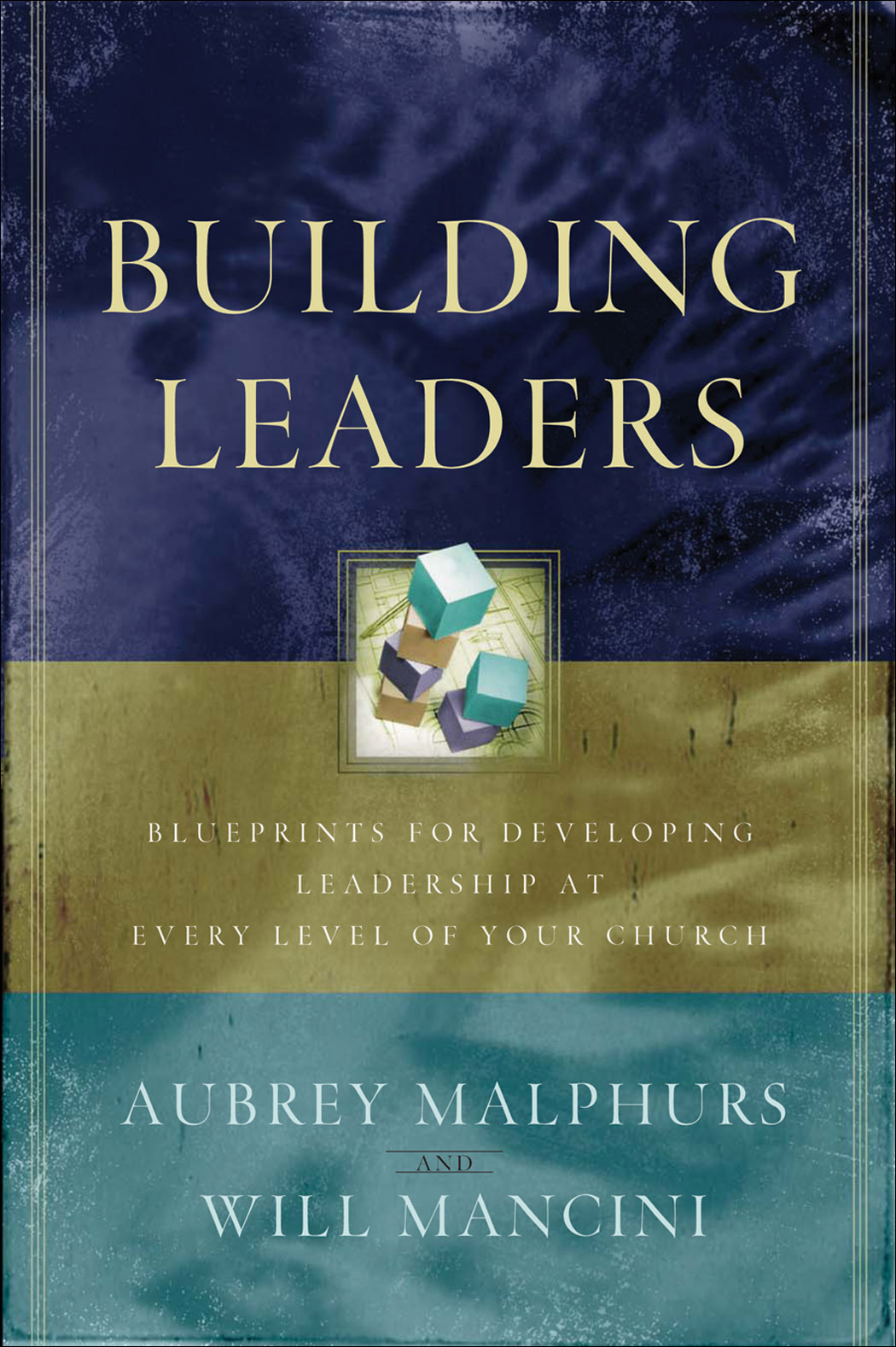
I’ve begun to work on material and ideas for leadership development. Currently, I’m reading through Malphurs and Mancini’s book, Building Leaders. They remind us that in order to be good leaders, we must first be good followers. In fact, I would say if we can’t follow, then we must not lead. Good leadership is not about getting our own way or the wielding of power over others. It’s about service and giving our lives for the benefit of others.

In response to a power struggle among his followers, Jesus taught these things to them:

42 Jesus called them together and said, “You know that those who are regarded as rulers of the Gentiles lord it over them, and their high officials exercise authority over them. 43 Not so with you. Instead, whoever wants to become great among you must be your servant, 44 and whoever wants to be first must be slave of all. 45 For even the Son of Man did not come to be served, but to serve, and to give his life as a ransom for many.”  (Mark 10:42-45)

Christian leadership is primarily about influencing people to follow Jesus, and to do this in every area of their lives. Leaders should teach these things, but they also need to model them. This means that leaders must first be followers. It goes with the job description.

The challenge to me as I enter a new form of leadership this year, is to keep working on my ‘followership’. Firstly, as a follower of Jesus Christ, and secondly as a newly positioned member of the pastoral team following the leadership of my Senior Pastor.

Signs of life

photoIt’s been roughly a month since I posted on this blog. Sometime around new year I decided that I needed a break from reading and writing… so everything stopped. What I hadn’t appreciated, was that some people were counting on my regular updates to know that I was still alive. The words alleviated their fears. The posts prompted them to pray. I received a number of emails and calls just checking I was still okay. It is nice to be missed!

Well, I’m still here! I’ve outlived my earliest prognosis. And I plan to continue fighting this cancer. My prayer is that God in his kindness will give me many more days, months and years. I want to treasure this life he’s given me, without holding on too tightly. I desire to make an impact for eternity with my choices, my words and my actions.

I don’t know exactly what’s in store for 2013, but yesterday I was to be welcomed back onto the Crossroads staff team at church. The only problem was I didn’t turn up! I couldn’t get out of bed. The impact of chemo, with the fatigue, nausea, aches, constipation, and a whole bunch more, left me unable to do much at all. So my first public day of ministry was a sickie! God has his ways of encouraging humility!

The wind and the waves

As many throughout Australia battle fires and soaring temperatures, I’m privileged to be staying on Sydney Harbour. The sea breeze is soothing, the harbour waters are cooling, and the views are amazing. Yesterday I went for a paddle on a surf ski, joined by a little dog called Maliki. She’s one of three dogs here at the moment (including our Bonnie) and the only one who managed to clamber onto the slippery ski without falling off.

IMG_5021We headed out against the breeze towards Middle Harbour Yacht Club. After a while the winds built up, gusting around 30-40 kph. I figured we should turn back. We made the turn and, while side on to the waves, Maliki slipped off and started swimming away. I reached for her and promptly fell off also. Dog one way, ski the other way, and the current was strong. I let go of the paddle, reached Maliki and then had to swim to the ski and recover the paddle. Not that easy in high winds. Eventually, I got hold of all three, put Maliki back on the ski, and hung on gasping for breath. The lungs aren’t what they used to be.

IMG_5020Meanwhile, the ski kept floating away in the wind and the waves, with me in the water clinging on, until it bumped into a luxury boat anchored in the harbour. A man poked his head over the side and asked if I was okay. I replied that I was, but I wouldn’t mind a rest! So we tethered the ski and climbed on board. Maliki and I shared a drink with the three couples on board! These people were very hospitable, doted on Maliki, and wanted to know all about where we’d come from. They could see I was pretty breathless and encouraged me to stay a while, until all was well. I explained that I had lung cancer and that I was struggling a bit. They probably thought I was stupid to be paddling on the harbour in these winds, because they mentioned more than once that it would be better to go out in the mornings before the winds got up. Yes, I know! I know!

IMG_5015After the winds had died down somewhat, we made our way back to shore. Interesting afternoon! It didn’t seem that big a deal, but it’s a reminder not to take the sea or my abilities for granted. Sometimes little things can quickly grow into big things. I’d proven the day before how easily I could fall off a stand-up paddle board, especially when two or three dogs try to get in on the action. Next time I’ll take a son, or daughter, or wife to rescue me!

I’ve been involved in rescuing people from the ocean before. And I’ve also enjoyed the help from others when caught in a rip and strong seas. It can be pretty scary. The important thing is to recognise when you’re in trouble and not to be too proud to seek help. Better to look stupid and be rescued, than to drown trying to do it all yourself.

It’s like this when it comes to relating to God. We need to be rescued and God is offering help. We need to drop our pride, our self righteousness, our hostility, and our apathy toward God. He’s reaching out his hand. He’s asking if we need help. He’s offering to take us on board his boat. He’s promising to get us safely to shore. He simply calls us to turn and put our faith in Jesus.

My experience yesterday brings to mind an extraordinary event in the life of Jesus – an incident that shows Jesus’ power to rescue.

35 That day when evening came, he said to his disciples, “Let us go over to the other side.” 36 Leaving the crowd behind, they took him along, just as he was, in the boat. There were also other boats with him. 37 A furious squall came up, and the waves broke over the boat, so that it was nearly swamped. 38 Jesus was in the stern, sleeping on a cushion. The disciples woke him and said to him, “Teacher, don’t you care if we drown?”

39 He got up, rebuked the wind and said to the waves, “Quiet! Be still!” Then the wind died down and it was completely calm.

40 He said to his disciples, “Why are you so afraid? Do you still have no faith?”

41 They were terrified and asked each other, “Who is this? Even the wind and the waves obey him!” (Mark 4:35-41)

To be honest, I didn’t think to cry out to God yesterday. But some years ago I did cry out, and he heard my cry, and he rescued me from something far more serious than the wind and the waves. He rescued me from the consequences of my sin and his judgement. God delights in rescuing people and I’m eternally grateful.

Learning from the Mayan mistake

mayanDecember 21 came and went without so much as a ripple. 21/12/12 had been forecasted as cataclysmic end to the world, based on a particular understanding of the Mayan Calendar. A handful of people escaped to various ‘safe zones’ throughout the world – though I’m not sure how that helps if the earth gets destroyed. Others were stockpiling food and wine – but I don’t know if they planned a feast before or after the world’s end! There was a bit of noise, some media hype, a few fanatics, and then disappointment – or should that be relief? December 21 was followed by 22, then 23, then 24, then Christmas… and now we’re well into 2013. What do we make of this? Ignore it? Joke about it?

I recommend learning from it. But what’s there to learn? Don’t listen to doomsday prophecies? Filter all media beat-ups? Be skeptical of all mystical explanations of the cosmos? Maybe, but I suggest something more concrete and personal:

It may not be possible to predict the end of the world,
but you can certainly predict the end of your world.

You probably won’t know the day or the month or even the year, but you can be absolutely certain that it will happen. Death is one of life’s certainties. We are finite beings. We grow old, get sick, and die. Sometimes this comes quickly, sometimes it’s delayed, but it always happens. Moses got right to the point when he wrote long ago:

Our days may come to seventy years,
or eighty, if our strength endures;
yet the best of them are but trouble and sorrow,
for they quickly pass, and we fly away.  (Psalm 90:10)

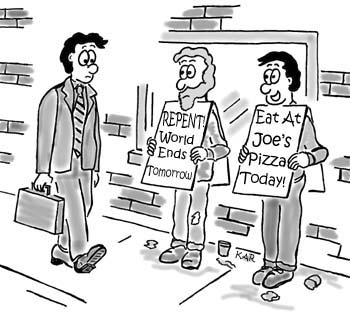
RepentThe Bible also teaches that this world will come to an end. It’s tied up with Jesus Christ. Just as Jesus entered this world once to bring salvation, so he will come again to judge the living and the dead. Jesus promises that this day will mean judgement for all who reject him, and life for all who submit to him and trust him. It’s common to ridicule and caricature the Bible’s teaching on the end of the world, but we’d do well to take Jesus at his word. He will come again.

So whether it’s the return of Jesus that marks the end, or whether it’s our mortality that guarantees our end, it makes sense to be prepared. There’s no point stockpiling things because they won’t help you and you can’t take them with you. There’s no ‘safe zone’ in this world you can flee to. But there is a way to prepare. Flee to Jesus and find refuge in him. He died and rose again to rescue you from the judgement to come. He’s offering you fulness of life now and forever. Do it now so that you don’t get caught out. Do it now so that you don’t miss out on the joy of relationship with Jesus in all the time you have left. Do it now because the more you practise putting things off, the better you’ll get at doing it. Do it now because the God who gave you this life wants you to enjoy life with him forever.

Surf

DSC_0917

The sea was sparkling,
the water was cool,
the surf was a good size.

I took off on a wave,
felt it pushing me forward,
and rode it to the beach.

My lungs were working hard,
sucking in every breath,
it was exhilarating!

Ride after ride,
heaving hard,
gasping for every breath.

Two years since I’d caught a wave,
last year I barely got wet,
and now I’m body surfing!

Simple things,
swimming and surfing,
smiling with joy.

I felt like I’d been given my life back.

Thank you God!

Christmas at Burrill

20121225-164927.jpg

Christmas is different here at the beach
Nature’s chorus has so much to teach
For God made it all for every and each
To showcase his glorious ways

The ocean is rolling in with a roar
Waves are crashing onto the shore
God’s power and strength we were made to adore
As we celebrate Christmas day

Rosellas screech and call and sing
Kookaburras laughing at everything
They’re caroling praises to the King
To the God who became a boy

The wind dances over the trees
Branches gently sway in the breeze
Dappled light sneaks through the limbs and the leaves
Christmas, God’s gift to enjoy

Merry Christmas

20121223-180522.jpgHere’s the Times Square Christmas message from the American Atheists. And I agree! The only problem is they put the captions with the wrong pictures.

The crucifixion of Jesus is no myth. It’s well attested in biblical and non-biblical historical sources. The baby born at Christmas grew up and gave his life to bring us good news of great joy – that bad people can receive God’s amazing gift of forgiveness. That’s the truly merry news of Christmas.

On the other hand, the Santa story grows more powerful every year. Maybe once upon a time there was a Saint Nick. I don’t know? But I do know that today there are millions. No shopping mall can be without one. And they all perpetuate the same myth – be good and you get presents. Trouble is we’re not. But why spoil a good myth for the sake of truth and real joy at Christmas?

Diagnosing James chapter 5

James5Over the past 12 months I’ve been pointed numerous times to a passage in James chapter 5. This is an important and puzzling part of the Bible. It seems to make bold promises and yet, so often, doesn’t seem to deliver upon them. Is this because we’ve misunderstood the text? Is it because we’ve misapplied the text?

This part of the Bible has had me curious for many years. I’m not sure I’ve ever been completely satisfied with any of the commentary explanations. Is it a prescription for healing today? Should we follow the advice to apply oil, call the elders, confess sins and pray for healing? Should we have the faith that the sick person will be healed? Is this a promise of healing to the person who has repented of their sin?

My cancer has given me cause to reflect more seriously on these words of God. Over the years I’ve been called on a few times to pray for a seriously ill Christian and anoint them with oil. Earlier this year some of our pastors and elders prayed over me and anointed me with oil. Does this mean that I should expect to be healed from my cancer? Others have had similar experiences and haven’t been healed. What do we make of this?

A pastor friend took me to this passage while I was still in hospital last year and asked me to consider if there might be any sin that is causing my sickness. The truth is I can think of so many sins! But how would I know what sins might be serious enough to lead to serious sickness. And I trust God that he has accepted payment for all my sin in Christ. And I don’t think there is anything for which I remain unrepentant.

But it’s also the exegesis of this passage that puzzles me. So many commentaries see little or no links in the immediate and wider context, and this bothers me because it seems unlikely that James would drop a new and unrelated exhortation at the end of his letter. I wish to explore the meaning of these verses further and to ask whether it is possible to see a coherent argument from 5:7-20. So here are some of my thoughts for consideration.

The ESV translation of James 5:14-15 is as follows:

14 Is anyone among you sick? Let him call for the elders of the church, and let them pray over him, anointing him with oil in the name of the Lord. 15 And the prayer of faith will save the one who is sick, and the Lord will raise him up. And if he has committed sins, he will be forgiven. 

In these verses, one English word ‘sick’ is used to translate two different Greek words: astheneo (5:14) and kamnonta (5:15).

While astheneo in its various forms throughout the gospels seems to always refer to sickness, it is used more widely in the letters of the New Testament to mean weakness. Weakness can include physical sickness, or be caused by physical sickness, but it can also include a broader range of issues, such as the ill-informed conscience, spiritual struggle, and more. Hebrews 4:15 gives a good example of spiritual struggle:

For we do not have a high priest who is unable to sympathize with our weaknesses, but one who in every respect has been tempted as we are, yet was without sin.

The second word translated as sick (5:15) is kamnonta. This word is more easily pinned down. Its only other appearance is in Hebrews 12:3:

Consider him who endured from sinners such hostility against himself, so that you may not grow weary or fainthearted.

The same word appears in Revelation 2:3 in the Textus Receptus, where it also carries the meaning of weary in a similar context. The word kamnonta is also used in Job 10:1 (LXX) where Job is weary in his soul. This is particularly interesting, given the mention of Job in James 5:11. If kamnonta in James is being used in a similar way to its use in Hebrews 12, then it seems reasonable to adopt the broader translation of astheneo as ‘weak’ in verse 14. On this understanding, we could offer the following translation:

14 Is anyone among you weak? Let him call for the elders of the church, and let them pray over him, anointing him with oil in the name of the Lord. 15 And the prayer of faith will save the one who is weary, and the Lord will raise him up. And if he has committed sins, he will be forgiven.

Of course, there are other issues to be determined in these verses. How is ‘save’ (Gk. sozo in 5:15) being used? The NIV translates this word as ‘make well’, whereas the ESV translates as ‘save’. Does it refer to salvation from illness and death? Or is it speaking of salvation from God’s judgement? James uses this word on four other occasions and each time it refers to spiritual salvation.

Therefore put away all filthiness and rampant wickedness and receive with meekness the implanted word, which is able to save your souls.  (1:21)

What good is it, my brothers, if someone says he has faith but does not have works? Can that faith save him?  (2:14)

There is only one lawgiver and judge, he who is able to save and to destroy. But who are you to judge your neighbour?  (4:14)

…let him know that whoever brings back a sinner from his wandering will save his soul from death and will cover a multitude of sins.  (5:20)

Most telling, is the proximity of 5:20, which I would argue is a continuation of the same discussion by James. Thus, James could be saying that the prayer will restore the weak and weary person so that they will be saved from the judgement of God.

The reference to healing (Gk. iaomai in 5:16) could then be understood to be functioning metaphorically, as it does in Isaiah 53:5.

Therefore, confess your sins to one another and pray for one another, that you may be healed. The prayer of a righteous person has great power as it is working.  (5:16)

That is, the person is healed from their sin. Interestingly, in Hebrews 12:13 this word is used for ‘the healing of drooping hands and weak knees’. This is a picture of restoring the person who has grown weary and faint-hearted (Hebrews 12:3) in their struggle against sin. The same idea could well be on view in James 5.

This interpretation fits well with the context and helps us to see the development of James’ argument. In 5:7-11 James writes about the attitude his brothers and sisters should have toward suffering. They are exhorted to be patient and to persevere. They are to find encouragement in the example of the prophets (Job is noted) and the merciful character of God. This has an eschatological focus in the return of Christ and the final judgment.

Be patient, therefore, brothers, until the coming of the Lord. See how the farmer waits for the precious fruit of the earth, being patient about it, until it receives the early and the late rains. You also, be patientEstablish your hearts, for the coming of the Lord is at hand. Do not grumble against one another, brothers, so that you may not be judged; behold, the Judge is standing at the door. 10 As an example of suffering and patience, brothers, take the prophets who spoke in the name of the Lord. 11 Behold, we consider those blessed who remained steadfast. You have heard of the steadfastness of Job, and you have seen the purpose of the Lord, how the Lord is compassionate and merciful.

James 5:12 is harder to understand in the flow of James’ argument and is usually explained as an isolated saying. However, it’s possible that James is returning to his warnings about double-mindedness and his encouragement to his brothers and sisters to remain steadfast.

But above all, my brothers, do not swear, either by heaven or by earth or by any other oath, but let your “yes” be yes and your “no” be no, so that you may not fall under condemnation.  (5:12)

5:13 continues the matter of remaining godward in the face of suffering and trials, by encouraging the suffering person to pray. If the praise is also godward, then he encourages people to speak with God in good and bad circumstances.

Is anyone among you suffering? Let him pray. Is anyone cheerful? Let him sing praise.  (5:13)

But what of the weak person, the spiritually weary, the one who may be unable to pray in faith? Let him call the elders to pray so that he may be restored. Indeed, prayer is not limited to the elders. Prayer is something we should offer for one another, especially when they need help in overcoming sin. This whole argument is nicely concluded and summarised in 5:19-20 where we see that the heart of the matter is saving the sinner from his sin that leads to the death of his soul.

19 My brothers, if anyone among you wanders from the truth and someone brings him back, 20 let him know that whoever brings back a sinner from his wandering will save his soul from death and will cover a multitude of sins.

But what of Elijah in the midst of all this?

17 Elijah was a man with a nature like ours, and he prayed fervently that it might not rain, and for three years and six months it did not rain on the earth. 18 Then he prayed again, and heaven gave rain, and the earth bore its fruit.  (5:17-18)

Again, the reference to Elijah points to the continuity of argument, because the example of the prophets has already been raised in 5:10. Elijah serves as an example of a righteous pray-er. His ministry occurs during the time of drought and he is introduced in these terms in 1 Kings 17:1. For three and a half years the people have to wait, and the cause of the crisis is the sinfulness of the people of God. In particular, it is their double-mindedness as they flirt with other gods and fail to trust God’s covenant promises. This fits well with the introduction to this section of James, where in verse 7 the farmer waits for the rains, which are the coming of the Lord. 1 and 2 Kings reveals that Elijah was a man who prayed, but the prayers recorded are interesting. He prays for a little boy to be saved from death to life – and he was. A powerful prayer for healing, but James does not mention this. So, I understand the connection to be humble faith in God, as we wait patiently for him to bring the rain, or in the case of James – the return of Jesus.

This still leaves the puzzling reference to ‘anointing with oil’. The New Testament only mentions the practice of anointing with oil in relation to healing the sick in Mark 6:13. (There is also the reference to pouring oil and wine on the bandages of the good Samaritan in Luke 10:34.) So, it could be that a connection with healing prompts the mention of anointing with oil. This, on my view, could be a symbolic demonstration of God’s spiritual healing of the individual.

This ‘restoration of the weak and weary’ view fits well with the overall message of James. People become weak and weary when they fail to submit humbly to God’s word. Rather than strengthening their hearts (5:8), they become faint-hearted and weary of struggling against sin. They become double-minded, being tempted by the world’s ways rather than patiently trusting in the goodness of God.

James began his letter by calling upon people to remain steadfast under trial. They are to persevere patiently because God has promised a crown of life. James concludes his letter by returning to where he started. His big concern is that people live out their faith and not fall by the way, distracted by the pretence of the world. They are to keep trusting in God, come what may, and if anyone starts to stray, then their brothers and sisters should pray and do all they can to bring them back.

I recognise that this interpretation is not watertight and there have been various arguments against it. Commentators point to the calling of the elders as indicating the incapacity of the sick person to go themselves to the elders. The strong connections with Jesus’ teaching are seen as a pointer to the sickness/healing/saving theme of the gospels being repeated here. Further, the place of anointing with oil in a context other than healing is hard to explain.

I have weighed these arguments (and will continue to do so) and it seems to me that in the context of James’ letter ‘restoring the weary’ is a more likely interpretation than healing the sick. If I am wrong, then it is still likely that James explores a link between the weakness/sickness of individuals and the potential of sin having brought this about. Thus the prayer and concern for the sick person will be concerned with more than their physical healing. It will be concerned with the forgiveness and salvation made possible through Christ.

My recent experience of serious sickness has reminded me of the strong connections that can exist between physical sickness and spiritual struggle. Someone who is very ill and facing their own mortality may experience doubt and a struggle to maintain their faith in Christ. In such circumstances the prayers of the elders and encouragement of God’s people will be particularly important.

In all of this, I continue to pray fervently for others to be healed of their sicknesses and that God will strengthen their faith in him for salvation. I deeply appreciate the thousands of prayers that people have offered for my healing. Please don’t stop! Let’s pray to God, let’s pray for one another, especially for the sick and weary and weak and struggling, that God will raise them up. When things are especially tough, the prayers of our brothers and sisters are so important.

These reflections are a work in progress. I have grappled with this text over a number of years (preceding my illness) and recent events have pushed me to explore their application again. My prayer is that we will read them humbly and faithfully, leading us to trust God in whatever circumstances we are facing. I welcome your thoughts and prayers!

Simple schoolies alternative

Over recent months I’ve been meeting with other parents from church, to pray for our teenagers. The adolescent years can be pretty volatile. Kids are turning into adults. Hormones are kicking in. Once delightful compliant children can morph into something from the Twilight series. Key among these changes are issues of faith. Do I believe what mum and dad believe, and do mum and dad really believe it any way? Have I just been swept along by the expectations of my church or youth group? What is real?

Burrill2As I was talking (and later praying) with another dad from church a few weeks back, I got the idea of offering to take a bunch of graduating year 12 boys/young men away for a couple of days to focus on life after school from God’s perspective. I invited 10 guys in our church and ended up having 6 come away with me, and my son, Luke, and our youth director, Steve, for the weekend. We headed to the coast and set up camp for the weekend. Some time was spent in the surf, playing various games, or just chilling around the campsite. The main game was to open the Bible and to talk together about stuff that mattered – and we did!

Here is a simple summary of what we looked at:

Saturday morning
Getting to the guts of the gospel. I shared my experiences as a teenager of constantly failing God, wondering if I was really a Christian, wondering if it was true, not being able to turn over a new leaf, hoping a change from Canberra to Sydney would change everything, and more. During 1st year uni I came to understand Romans 5:6-11 and this changed everything. God wasn’t waiting for me to make myself good enough for him. He was reaching out to me as a rebel, forgiving all of my sin in Jesus, and having guaranteed my current standing with him as not-guilty, I had nothing to fear from God, and was freed up to serve him with joy.

6 You see, at just the right time, when we were still powerless, Christ died for the ungodly. 7 Very rarely will anyone die for a righteous person, though for a good person someone might possibly dare to die. 8 But God demonstrates his own love for us in this: While we were still sinners, Christ died for us. 9 Since we have now been justified by his blood, how much more shall we be saved from God’s wrath through him! 10 For if, while we were God’s enemies, we were reconciled to him through the death of his Son, how much more, having been reconciled, shall we be saved through his life! 11 Not only is this so, but we also boast in God through our Lord Jesus Christ, through whom we have now received reconciliation. (Romans 5:6-11)

Saturday afternoon
Beginning with the end in mind. We talked about how the shortness of time clarifies what’s important. If 80 minutes has passed in a game of rugby and your team is 4 points behind, then you hang on to the ball for phase after phase, aiming for that 5 point try. If you have an exam tomorrow, then it makes sense to start studying. If your life is short, then it’s important to know what is worthwhile doing. I shared how my cancer diagnosis has sharpened my focus of what matters in life.

I got all the boys to share their plans for the year ahead and beyond. Some were looking at gap years, others heading to uni or tech, some leaving home, others staying with family. We looked together at Psalm 90 and saw how the eternal God has numbered our days and called us to live for him and find our satisfaction in him. In particular we brainstormed what this verse would look like for each of us in our contexts.

Teach us to number our days aright,
that we may gain a heart of wisdom. (Psalm 90:12)

We also looked at the typical Aussie dream and how chasing affluence, influence, pleasure and security are the messages we hear every day. Jesus critiques these ideas and shows how the brevity of life and the certainty of death make a mockery of a life spent chasing this stuff.

15 Then he (Jesus) said to them, “Watch out! Be on your guard against all kinds of greed; a man’s life does not consist in the abundance of his possessions.”

16 And he told them this parable: “The ground of a certain rich man produced a good crop. 17 He thought to himself, ‘What shall I do? I have no place to store my crops.’ 18 “Then he said, ‘This is what I’ll do. I will tear down my barns and build bigger ones, and there I will store all my grain and my goods. 19 And I’ll say to myself, “You have plenty of good things laid up for many years. Take life easy; eat, drink and be merry.”’

20 “But God said to him, ‘You fool! This very night your life will be demanded from you. Then who will get what you have prepared for yourself?’

21 “This is how it will be with anyone who stores up things for himself but is not rich toward God.” (Luke 12:15-21)

This bloke made 3 fatal mistakes. He thought riches would guarantee him security. He thought he had all the time in the world. And ultimately he thought only of himself, leaving God right out of the picture. That night his life was demanded of him. I urged the boys not to fall into the same foolish and fatal mistakes.

Saturday night
Q and A. We built a raging campfire and sat around with the boys asking me questions. We covered a lot of ground with different topics. These included relationships, marriage and sex; life in residential colleges; helping people grapple with issues such as the horrors done in the name of Christianity, or what happens to people who’ve never had a chance to hear about Christianity; what to do when you’re struggling; and more.

Sunday morning
Don’t sell out for a bowl of soup. We looked at how temptations can be so appealing and seem to offer so much, and yet how easy it is to get everything out of perspective. Everyone agreed that we wouldn’t swap an inheritance from our parents for a meal, and yet this is the risk when it comes to inheritance from God. We can be tempted to look at people not following Jesus and think we’d be better off if we were like them. Perhaps it’s their perceived sexual freedom, or their power or wealth, or maybe it’s that our inheritance from God seems so intangible or remote. We checked out these verses from Hebrews:

24 By faith Moses, when he had grown up, refused to be known as the son of Pharaoh’s daughter. 25 He chose to be mistreated along with the people of God rather than to enjoy the pleasures of sin for a short time. 26 He regarded disgrace for the sake of Christ as of greater value than the treasures of Egypt, because he was looking ahead to his reward. (Hebrews 11:24-26)

15 See to it that no one misses the grace of God and that no bitter root grows up to cause trouble and defile many. 16 See that no one is sexually immoral, or is godless like Esau, who for a single meal sold his inheritance rights as the oldest son. (Hebrews 12:15-16)

We talked together about how being Christian is for the long haul and God wants us to encourage each other to persevere and live our lives for him. These verses show how we can invest in the lives of one another.

23 Let us hold unswervingly to the hope we profess, for he who promised is faithful. 24 And let us consider how we may spur one another on toward love and good deeds. 25 Let us not give up meeting together, as some are in the habit of doing, but let us encourage one another—and all the more as you see the Day approaching. (Hebrews 10:23-25)

God doesn’t expect us to be Robinson Crusoe Christians. The boys shared how they thought they could encourage each other. There were some great ideas that focused around being genuine, getting past trivia, and caring about how each is going with God. This was important, given they were heading in different directions, with different challenges ahead.

Finally, we discussed how we would all stuff up and why it was so important to remember the grace of God. Rather than hiding from God when we feel that we don’t measure up, or when we know we are guilty of not living for him, this is the time to draw near and rely on his grace. Jesus knows what we’re going through. He was tempted as we are. He was challenged to give up his inheritance for a ‘bowl of soup’ too. But he drew near to God and trusted him, even to death.

14 Therefore, since we have a great high priest who has gone through the heavens, Jesus the Son of God, let us hold firmly to the faith we profess. 15 For we do not have a high priest who is unable to sympathize with our weaknesses, but we have one who has been tempted in every way, just as we are—yet was without sin. 16 Let us then approach the throne of grace with confidence, so that we may receive mercy and find grace to help us in our time of need. (Hebrews 4:14-16)

BurrillI think this was a good weekend. The boys told me so! One shared how it had encouraged him as he struggled with his faith. My prayer is that it will help these guys to remember the gospel, and live it out as they face massive changes in the year ahead.

It wasn’t hard to pull off a weekend like this. It’s a simple schoolies alternative, or add-on. It was fun, relaxed, and at its heart it was a serious time together. Maybe next time we’ll do it for 3 or 4 days. Perhaps you could consider this with year 12s from your church or network. I focused on boys so as to keep things simple, but there would be opportunities with girls too. God-willing, we might try to do both separately next year. If you’d like to know more about how it worked or to talk through possibilities for something similar, please get in touch.

Smoking – because I care!

smokersEarlier today I visited the local chemist to pick up some scripts for drugs I’m taking. Pretty normal really. But the conversations I had out on the street, while I was waiting, weren’t! I spoke with four different guys, each of them were smoking, and the conversations went something like this…

Me… Hey mate, there’s a good chance you’ll get lung cancer if you keep smoking.

Him… (Smiles at me and keeps smoking)

Me… It’s true you know

Him… Yeah, I know

Me… I’ve got lung cancer and I can tell you it’s not much fun

Him… Yeah?

Me… You don’t know whether to believe me, do you?

Him… (Shrugs)

Me… It’s true. You want to see my scars?

Him… (Shrugs)

Me… (I lift up my shirt on the left side to reveal 3 rather ugly scars around my ribs) They had to stick tubes in me to drain out all the litres of fluid from round my lungs. You know, it’s a good idea to give up.

Him… Yeah, I know.

Me… I know it’s hard, but you should try. Start now, it’s worth it.

Him… Did you give up smoking?

Me… Mate, I didn’t smoke and I still got lung cancer!

Him… Yeah?! Have you got rid of it?

Me… Mate, I might never get rid of it. They can’t cut it out, and I’ve got to keep on chemo.

Him… Yeah?!

Me… So give it a shot, eh? It’s worth trying to give up now.

Him… Yeah, thanks mate. And hey, good luck eh!

Then, back in the chemist, picking up my scripts, I say “I understand you guys help people to quit smoking.” To which the pharmacist replies, “Yeah, that’s right.” And I say, “Well, there’s three guys outside smoking right now. You could help them!”