The Power of I Am

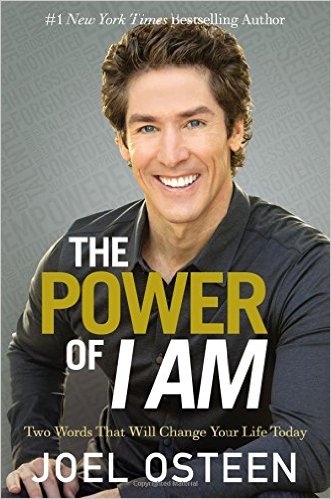
iamI am grieved. I am angry. I am appalled. I am not going to buy this book. I am calling people to stay clear of this false gospel. There—I’ve said it. This is fundamentally false teaching. Some might say this is blasphemy. I’d say it’s ignorant and dangerous at best. It’s popular. It sells. And it’s toxic. This is not what our world needs. This is not what our God is offering. This is graceless, hopeless, truth less, and fruitless. If this is indicative of what this man teaches, then keep your distance.

Why the rant? Because I just visited my local Christian bookshop and found this volume prominently displayed in the new release section. I stayed a while and skim read the book. I arrived home, gathered my mail, and found this same book on the recommended Christmas reading list of a Christian bookshop catalogue. So, woe to me if I do not speak. If a blind man prepared to step off the edge of a cliff, I would take hold of him tightly. If my grandson picked a toadstool believing it to be a mushroom, I would snatch it from his mouth. So I say, beware this book. It might look real, it might look healthy, it might even reference the Bible again and again, but it will leave you unwell.

Pardon my naivety, but I opened this book expecting to read of the wonder and power of Yahweh—the one true God, the great I AM or maybe to be reminded of the wondrous I AM sayings of Jesus in John’s Gospel. Instead I read the narcissistic promises of a ‘name it and claim it’ speech-faith preacher. Rather than hearing the call to humble myself before the God of all the earth, I am told to banish all negative thoughts and place ‘me’ at the centre. I am told to be positive or be quiet. No!

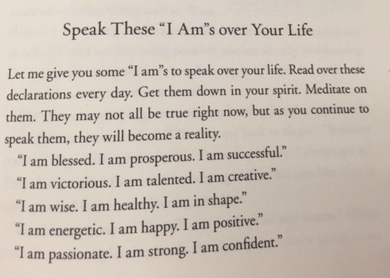
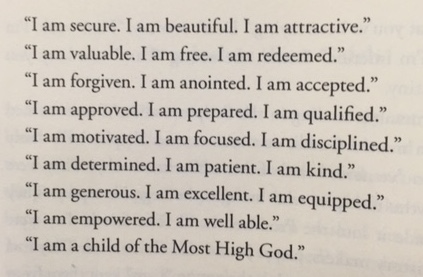
Osteen calls his readers to Speak These “I Am”s over Your Life

IMG_1527  IMG_1528

Please, whatever happened to I am undeserving, I am weak, I am a slave, I am rejoicing in suffering, I am being poured out like a drink offering? Where is the call to lose our lives for Christ’s sake? Why has the glory of God been replaced with the glory of self?

Joel Osteen, follow the example of Volkswagen, and recall your fraudulent books.

R U OK?

IMG_1281Today is ‘Keep a low profile’ day. Well, I expect it will be for many. It’s actually R U OK day – a day to remind us all that it’s important to look out for one another. The trouble is that many will cringe if the only time people care for them is on a designated day. Every day is a good day to ask R U OK. So let’s slow down sufficiently to keep an eye out for each other.

I know a good number of my friends aren’t OK. Life sucks sometimes, and sometimes often. I get this. Sometimes life feels like the walls are closing in on me and I need help to see the big picture.

So if you’re not OK, please reach out.

Beyond Blue  1300 224 636

Lifeline  13 11 14

(Original artwork by Liam)

Worth reading

NIV_blueWe’re not all natural readers, but my experience is that reading brings great reward. I struggle to read the great novels or works of fiction. But I’m a fan of sports biographies, and works on leadership, people, organisations, and new ways of thinking and doing. But hands down the most instructive, life-changing, and liberating book I’ve ever read—and continue to read is the Bible.

Apparently it takes less time to read than Game of Thrones and not all that much more than Lord of the Rings or Harry Potter. And while these are great stories, the Bible is so much more. If you’ve never really dipped into the Bible, can I recommend you give it a shot. Grab a modern translation—replace the old King James with a New International Version or the Holman Christian Standard Bible—and give it a read. Maybe start in the second part, the New Testament, and discover the extraordinary account of Jesus. It’s a book of life and hope and, contrary to popular opinion, extraordinary relevance and applicability to life now.

If you’d like to read the Bible with someone else, this can make it easier and more fun. Let me know and I will see if I can arrange a reading buddy or even a reading group.

For those of you who have read the Bible—’have’ being the operative word—and want to dip into it again, here are a few suggested approaches to get you restarted.

  1. Read the whole Bible through in one year. A good option is to get a Bible reading plan and follow it. Such plans are available on line or on smart phone Bible apps.
  2. Listen to the Bible on your mp3 player as you travel to and from work, go on holidays, or exercise.
  3. Use some Bible study guide, such as those produced by Matthias Media, which help you through an entire book of the Bible. These provide some commentary and ask questions to assist your understanding and application of the passage.
  4. Get into a routine Monday to Friday that fits with work and other regularities. Don’t worry if the weekend doesn’t fit the routine – do something different on weekends.
  5. If you know another language then, after you have looked at the passage in English, read through it again in the other language. This with help you give more attention to the meaning.
  6. Read with a friend and discuss what you have learned. Or both of you read on your own and then make contact to discuss it together.
  7. Read the Bible out loud to yourself.
  8. Use Search the Scriptures – a three year Bible reading program. You can take this at whatever pace you desire. Maximum benefit is gained if you take the time to write your answers to the questions.
  9. Follow Don Carson’s For the Love of God to read the Bible over one to four years. Excellent commentary by Carson. Available free on the Gospel Coalition website.
  10. Keep a journal of what you have learned and intend to apply from your reading.
  11. Prepare for sermons and Bible studies by reading over the passages beforehand.
  12. Read a passage with a view to giving a very brief talk which explains it, illustrates it and applies it. Then you can talk to me about finding an opportunity to give it!
  13. Try the S.O.A.P. approach. Read or write out the passage of Scripture. Note your observations and questions of the text. Decide how you are going to apply what you’ve learned. Pray that God will give you understanding and enable you to put it into practice.
  14.  ‘Manuscript Discovery’ is a term given to the study of the text of the Bible without chapters, verses, paragraphs or headings included. This means you have to do more work, with the result that you learn more. You can do this yourself simply by printing out the text of the Bible from Bible Gateway and removing all added numbers and headings.
  15. Commit verses to memory.
  16. Type out the entire Bible.
  17. Come up with your own ideas… share them with others

The morality of God in the Old Testament

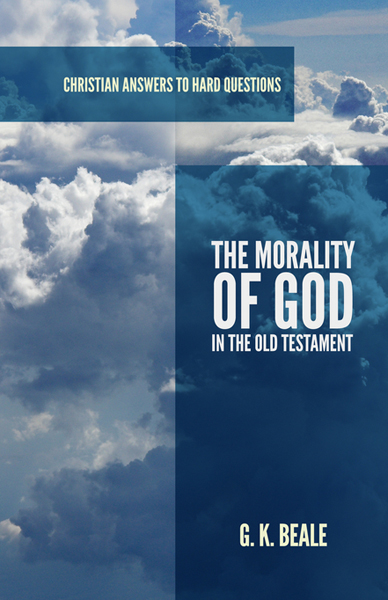
Layout_GenesisHow are we to understand the Israelites being commanded to wipe out all the Canaanites in Deuteronomy and Joshua? What do we make of the various Psalms that call down curses on the enemies of the writers and God? Perhaps, like me you are troubled by these things (and others) in the Bible. Atheists, such as Richard Dawkins, Daniel Dennett, Christopher Hitchens, and Sam Harris, point to these things as evidence for the moral corruption of God (who they believe is really a fiction). Christians come under attack for their beliefs in a God, whom some describe as a moral monster. Some would say how can Christians criticise the recent actions of the IS in Iraq or Syria, when the Old Testament provides evidence of God’s people doing similar things, and at the behest of God?

Let me say that this isn’t really the atheist’s problem—this is a problem that the Jews and the Christians need to deal with. For the atheist, the problem is not with God, for he/she/it doesn’t actually exist, but with the people who claim to believe in God. Their criticism is fundamentally toward religious people justifying their immoral behaviours in the name of an imaginary divine being. However, for the Christian who believes that God is real, that he has revealed himself to people, and that he is involved in human history—there are real issues to consider when it comes to trusting that God is morally pure. This is an issue that I’m keen to explore further.

In considering this matter, I’ve recently read a brief book by G.K. Beale, called The morality of God in the Old Testament. The book focuses on the commands of God to destroy every man, woman and child of the Canaanites (e.g.. Deuteronomy 20:10-18) and also on the imprecatory Psalms (e.g.. Psalms 7; 35; 55; 58; 68; 79; 109; 137) which call upon God to judge and destroy his enemies.

Beale explores various proposed solutions to deal with the difficulties raised by these passages. First, he describes how people argue that wartime ethics differ from peacetime ethics. While this may be true, it doesn’t account for the commands to kill non-combatants. Secondly, he explores the suggestion that the command to kill women and children is not meant to be taken literally, but is a metaphoric way of describing a total victory over the Canaanites. Beale demonstrates that while there may be something in both these suggestions, neither adequately explain the texts.

Instead Beale offers a fivefold approach to engaging with these issues. His approach gives important nuance and perspective to interacting with the difficult moral issues of the Old Testament.

  1. God’s wiping out the wicked Canaanites as a demonstration of his justice;
  2. God’s extermination of the Canaanites as a purifying of uncleanness of the Promised Land as an Edenic sanctuary;
  3. God’s self-sufficiency and independence from creation;
  4. suspension of ethical obligation by typology and intrusion of final judgment;
  5. suspension of the law of neighbour love. (p33)

Beale argues that we need to recognise the uniqueness of the Canaan episode. It does not offer a paradigm for continued activity in the Old Testament, let alone the New Testament. Instead, it should be seen as a once-only, historic actioning of God’s redemption of Israel, as the nation enters into the land of promise. This salvation/judgment event is also to be understood as a type of what is to happen through Christ’s first and second coming.

There is more to his argument than this, but he demonstrates how it is important to allow Scripture to be understood in it’s full biblical context. The critiques of Dawkins and others show absolutely no understanding of the overall shape of the Bible or the saving purposes of God in the Old and New Testaments.

I still find the matters being described troubling, but no more so than the reality of death and the promise of eternal judgment for all who dismiss God. As a Christian I need to grapple with why God allows any suffering, evil or death, and especially with the moral rightness of God judging people for eternity. It’s sobering to remember how much my own moral failings corrupt my ability to recognise what is right and true and perfect. It’s totally presumptuous (and deluded) to think that I can stand morally superior to God, and judge him for his actions. This becomes clearest to me when I am reminded that God loved the world so much, that he sent his only Son, Jesus, to die in our place, so that all who trust in him will not perish but have everlasting life. Such is the moral character of God.

How can I be sure?

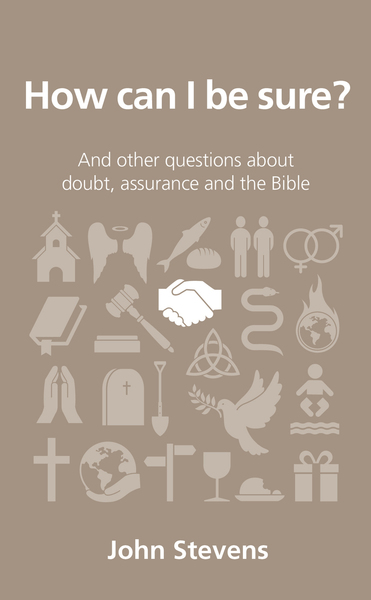
sureJohn Stevens’ little book, How can I be sure? And other questions about doubt, assurance and the Bible is definitely one that I will be recommending to others. It’s clear and simple, without being simplistic; it’s empathic and it uses the Bible well. The author understands that doubt is a complex beast, displayed in a variety of forms, and arising from many different causes. I personally found the book to be inspiring and reassuring. It resonated at times with my experiences of doubt, and some of the causes; and it took me to the places where I’ve found reassurance. While recognising that everyone’s circumstances are different, my prayer is that it will do the same for others. All in all, this compact book is one of the better books on doubt and assurance I’ve read.

If I’m going to engage with a book dealing with these topics, I want to know that the author has a firsthand personal understanding of the matter—and Stevens does. He writes about the impact that his father dying of lung cancer had on his faith. It rocked his world, not simply as an intellectual challenge to the goodness and sovereignty of God, but with personal pain and experience. He took some years to recover from the anguish of this time. Stevens has also explored these issues with many in his church over the past twenty years. This has helped him to grasp the different forms that doubt can take in people’s lives, and to apply his thinking to how the Bible helps each one. The book engages the reader by presenting a mix of personal stories of doubt. People have trouble believing due to their struggles with personal sin, unanswered prayers, the challenge of other religions, relationships with people who have different belief systems, God seemingly remote or out of touch with this modern world, feeling overwhelmed by all around who don’t hold the same beliefs, or questioning whether their ‘conversion experience’ was real. Recognising this complexity is so helpful, and many more scenarios could be added, because doubt is not a one-size-fits-all phenomenon. Doubt could mean a lack of certainty about the future, or a questioning of what we believe, or a lack of assurance, or unbelief. The first three types of doubt will likely be common experience for all Christians and if they are unchecked they can lead to the more dangerous position of unbelief. This book helps us to engage with our doubts as part of the normal experience of living as a Christian.

So if you are reading this book because you are struggling with a problem of doubt at the moment, be encouraged! The fact that you doubt does not mean that you can’t be a Christian. “Doubt” is not the same as “unbelief”. However, you can’t afford to ignore your doubt, treating it complacently or just hoping that it will go away. You must deal with it so that it does not develop into unbelief, and use it as an opportunity to develop a more confident, resilient and mature faith. (p18-19)

Stevens answers the important question “How can I be sure that I’m really a Christian?” by pointing not to us, but to God’s love for us in Jesus. There are dangers in becoming too introspective about this issue. We can end up placing confidence, or lack of, in ourselves rather than the gospel. If we base our assurance on a response we previously made at church, or at a Simply Christianity course, or on a university camp, or an outreach event, this can lead to a misplaced and false assurance. We are not made right with God because of our response, but because of God’s gracious work in Jesus’ death and resurrection on our behalf. For me, who had made decision after decision to become a Christian (again) in my teens, it was realising the truth of Romans 5:8-9 — that Jesus had paid for my sins past, present and future — that led to my assurance before God. While this book generally leads us away from introspection, it does call us to examine the evidence for our lives being changed. The Bible pushes us to look for evidence that our faith is real and we should expect to see our lives changed by the Spirit of God at work within us. On three occasions, Stevens recommends that we keep a spiritual journal to chronicle the evidence of God working in us and changing us. I must admit that I worry a little about this strategy. It’s not that I’m opposed to journalling, it’s more that documenting our experiences will always provide fickle evidence at best. I’d recommend that if we’re going to journal, we spend even more time documenting the promises of God that we discover in  the Bible. God’s promises remain trustworthy, whereas my experiences lead me here and there. If I want clear evidence that God loves me, then I need to look at the cross, not what happened in my life last week or last year. As Martyn Lloyd-Jones describes in his book Spiritual Depression, after looking at Psalm 42-43, we need to spend more time speaking to ourselves (about God), than listening to ourselves (about why God is absent or doesn’t care). The chapter on overcoming doubt is practical and helpful. Stevens recommends the following strategy:

  1. Admit that you are struggling with doubt and seek help.
  2. Come to Jesus for help with your doubt.
  3. Seek the help of mature believers with your doubt.
  4. Identify the root causes of your doubt
    1. Doubt rooted in our bodies: Physical causes of doubt.
    2. Doubt rooted in our minds: Intellectual causes of doubt.
    3. Doubt rooted in our hearts: Experiential and emotional causes of doubt.
    4. Doubt rooted in our spirits: Spiritual causes of doubt.
  5. Addressing the causes of doubt.

In the end, the Christian faith stands or falls on whether Jesus really was the Divine Son of God who took on human flesh, was crucified and rose again after three days. If this really happened, then we can be sure that God exists. We can know what God is like because Jesus fully reveals him to us. We can be sure that the Bible, both Old and New Testament, is true because Jesus tells us so. We can be confident that God is love, and that he will accomplish his good purposes for his people. We can trust that our sufferings are part of his good plan for us, even though we may not understand how, because we can see that Jesus entered into glorious new life after suffering on the cross. We can trust that Jesus will return to bring true justice and remake our broken world. If we can be confident about Jesus, then this is the basis from which we can address all our doubts. (p71-72)

This book will point you to Jesus as the basis of your assurance and the antidote to your doubts. Any book that does this is worth a read, I reckon.

Decluttering the inbox

No Junk Mail copyI’ve spent much of the past couple of days in bed due to my three weekly chemo malaise and I feel like I’ve achieved something worthwhile—I’ve decluttered my inbox. More than simply getting hundreds of emails down to a small handful, I’ve systematically unsubscribed to dozens of regular newsletters, blogs, advertisements, and junk that fill my box every day. I have no idea how I ended up collecting many of these emails. Some were an impulse click. Some were a good idea at the time, but are no longer relevant. One or two I’ve changed the frequency from daily to weekly or monthly. People keep telling us that too much information—which often corresponds to too many emails—can’t be be doing us any good. I’m looking forward to a simpler eLife!

Is God anti-gay?

gayChristians have bad press when it comes to homosexuality. This hasn’t been helped by the bigotry and hatred of the Westboro Baptists in the United States and their appalling website godhatesfagsdotcom. The assumption by many is that all Christians are homophobic and therefore God must be anti-gay. The reality is the opposite—John 3:16 famously declares…

For God so loved the world that he gave his one and only Son, that whoever believes in him shall not perish but have eternal life.

By extension, this also means…

For God so loved gay people that he gave his one and only Son, that whoever believes in him shall not perish but have eternal life.

Sam Allberry’s little book, Is God anti-gay? And other questions about homosexuality, the Bible and same-sex attraction is an excellent guide to this issue. It’s not shaped by politics, sensationalism, or right-wing ideologies. It’s not seeking to ride the trends of culture or church opinion. This book is an attempt to seek the mind of God honestly and sensitively from the Bible.

Allberry writes with sympathy for the matters at hand. He discloses to his readers that his own sexual orientation is homosexual. However, he does not presume to speak for everyone for whom homosexuality is an issue. As a Christian, and minister of a church, this has caused him to grapple seriously both with Scripture and it’s application in his life. He prefers not to describe himself as ‘gay’ but rather as ‘someone who experiences same-sex attraction’. He writes:

But describing myself like this is a way for me to recognise that the kind of sexual attractions I experience are not fundamental to my identity. They are part of what I feel but they are not who I am in a fundamental sense. I am far more than my sexuality. (p8-9)

Allberry explains that the way to understand homosexuality is to view it against the backdrop of God’s good purposes for gender and sexuality. We need to understand what it means to be made in God’s image, to understand one-flesh union in marriage, and to explore God’s reasons for the gift of sex. We must also recognise that in our fallen world there will be many temptations to live alternatively to God’s ways. Some of these pressures come from the outside, others come from within us. We will all face trials and temptations of different kinds—this doesn’t mean we blame our DNA or upbringing or culture, but that we seek God’s help to trust and follow him.

While acknowledging that God’s design for sex as outlined in the Bible is heterosexual, within a loving and faithful marriage relationship, this doesn’t mean that God is anti-gay. It is, however, a significant call to trust God when our preferences and passions don’t align with his. Allbery reminds Christians who are attracted to persons of the same sex, that they should take the opportunity to talk to God about it—about our confusion or distress, our temptations, or our failings and sins. He reminds us that particular feelings do not disqualify or define us as Christians. All Christians struggle with a multitude of feelings and temptations. What matters is how we respond to these things. We are also reminded that Christians need to be willing to support one another in these matters.

Sadly, many churches do not engage well with matters of sexuality, and especially with homosexuality. Many people with same sex attraction have felt deep rejection at the hands of Christians. There is much for our churches to change in how we engage with people whom God clearly loves.

Allbery offers helpful advice to Christians in engaging with people who are homosexual in orientation. He prefers to start at the centre and work outwards, rather than start at the edge and work in. The matter of sexuality is not of first importance. Jesus’ death and resurrection take centre stage. This is where God is most fully revealed. It shows his heart towards all people.

This is what I most want people to know—for people to be bowled over by the God of the cross and resurrection. And, once gripped by this, to help them think through what trusting in this God will involve—what will need to be given over to him, including our messed up sexuality.

But I want the conversation to take place in the context of the gospel, rather than start with their sexuality and try to get from there to the gospel … So when a gay couple start coming to my church, my priority for them is the same as for anyone else: to hear the gospel and to experience the welcome of a Christian community. (p63-64)

I found this book to be very helpful in understanding issues of same-sex attraction from the perspective of the Bible. It is written with warmth, insight and compassion. It upholds the dignity of all people, and it demonstrates the depths of God’s love for all, regardless of sexual orientation or anything else. I commend it especially to Christian people wanting to understand the mind and heart of God in todays cultural climate.

How will the world end?

world_endThe beauty of a couple of interstate bus trips and a return flight to Brisbane over the past couple of weeks, is that I’ve been able to find time to do some more reading. And the brief books from the Questions Christians Ask series have been ideal travel reading—far better than most stuff you pick up at the airport bookstores!

How will the world end? And other questions about the last things and the second coming of Christ by Jeramie Rinne takes us into some hotly debated topics among Christians. We are very good at dividing over millennial positions, the meaning of world events, identification of the anti-Christ, when the end will happen, and more. Careful reading of the Bible is paramount to understand God’s intentions in these matters.

The book starts by affirming that the end of the world will arrive according to God’s design and purpose. It won’t be the result of arbitrary forces of the universe, nor the inescapable consequence of human failure to care for our planet.

The problem facing the human race is not that it’s on a collision course with an asteroid. Our problem is far worse: we are on a collision course with a holy God who is coming to judge a sinful world. (p13)

God has promised to address our sin and rebellion and to bring us to account. In fact, we could not describe God as ‘good’ if he was to ignore sin and tolerate evil forever. His judgment reveals that he cares about this world that he has made and the people within it. Though we don’t know when, God promises that he has set a day when he will judge this world through his Son. This is the day when Jesus will return.

Rinne discusses what will happen before this day when Jesus returns to judge the world. He does so with special reference to Matthew 24. We are warned that there will be false messiahs; many who oppose Jesus; wars and disasters; persecution of Jesus’ followers; wickedness and evil; growth in the gospel. These things are not the end—but they are signs that the end is on the way. The overwhelming testimony of the New Testament is that we are in the Last Days now. Not because we live in 2014 when there is evidence of these things all around us—this has been true of every age since Jesus first spoken these words. Jesus came to inaugurate the last days and he will bring them to an end when he returns.

A chapter of this book is devoted to helping Christians understand and navigate the various millennial perspectives that arise from Revelation 20. This provides a clear and helpful introduction to people’s thoughts on this matter. He concludes the chapter saying:

It’s probably all too much to hope that this chapter would clear up all the questions. But I hope that it did at least three things:

  1. I trust this chapter lifted you above the trees to see the forest.
  2. I pray this section increased your humility and patience toward others with different views.
  3. I hope this chapter increased your appetite to learn more about God’s word.

As your mind works to make sense of the details, may your heart swell with excitement that our Lord is returning! (p65)

How will the world end? draws heavily on the book of Revelation to make it’s case. However, I am always a little cautious about going to Revelation as the primary place to build my theological understanding. My rule of thumb tends to be ‘check my theology of Revelation with what I can verify clearly from the rest of Scripture’. Having said this, I do believe that Rinne handles Revelation faithfully and clearly.

From Revelation 20 we’re reminded that when Jesus returns to judge there will be ‘the books’ and the ‘book’. The ‘books’ will contain a record of our thoughts, words, and deeds. These will provide the incontrovertible evidence that God’s judgment is fully-informed, just and true. There is no hope for anyone in these books. It is the ‘book’ that offers hope. This is the Lamb’s book of life—what matters is whether our names are recorded in this book. The book of life reveals all who have trusted not in our deeds, but only in the sacrificial death of Jesus in our place. Is your name in this book?

For those not listed in the Lamb’s book of life the future is very grim. Images of hell and judgment speak of an everlasting judgment on all who reject God’s offer of rescue through Jesus. It is impossible for us to appreciate the magnitude, or indeed the rightness, of God’s judgment because we don’t have any sense of the gravity of our crime. (p76).

The closing chapter explores how we should live as we wait for Jesus’ return. He starts with the basics—because Jesus is returning to judge, we need to turn from our sins and put our trust in Jesus now. As we trust in Jesus, he doesn’t merely save us from our sins, but his grace transforms us and teaches us to live godly, Christ-like lives while we wait (Titus 2:11-14). We are urged to pray (1 Peter 4:7) and encourage one another to pray. We’re to remember our calling to take the good news of Jesus to all nations. As this world is passing we should not be too attached to stuff (1 Corinthians 7:29-31). We should remember that whatever trials and suffering we will face in this life, they are not worth comparing to the glory that will be revealed in us (Romans 8:18).

It is far too easy for us to live our lives stuck in the moment, to assume this life is all we’ve got, to lose sight of the end that is coming. This book is an important corrective.

Who on earth is the Holy Spirit?

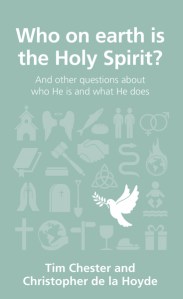
holy_spiritWho on earth is the Holy Spirit? by Tim Chester and Christopher de la Hoyde is written to reassure believers about the experience of the Spirit in their lives. It’s also written to help believers become more aware of the work of the Spirit. The writers want to raise people’s expectations…

When you pray, we want you to expect the Spirit to work miracles. When you talk about Jesus, we want you to expect the Spirit to create faith in people’s hearts. When you read God’s word, we want you to expect the Spirit to create intimacy with the Father. When you’re tempted, we want you to expect the Spirit to give you alternative desires.

In your daily life, we want you to expect the Spirit to show you how you can serve others in love. We want you to be able to appeal to the experience of the Spirit as Paul does in Galatians 3 v 2-5.  (p8-9)

These are wonderful aims for the book, and filled me with great anticipation as I set about reading another book in the Questions Christians Ask series. The book begins by demonstrating the fundamental role of the Spirit in giving us spiritual life. Without the Spirit’s work we are unable to recognise the beauty of Jesus and the power of his work, or to turn to him and trust him. The Spirit gives us new birth or ‘regeneration’. The life-giving work of the Spirit reveals that salvation is God’s work from beginning to end. It is entirely a work of grace—even our faith is a gift from God. Put simply, if we don’t have the Spirit then we cannot be Christian.

If anyone does not have the Spirit of Christ, he does not belong to Christ. (Romans 8:9)

God was at work through his Spirit in the work of creation, bringing order out of disorder. The work of the Spirit continues to sustain and renew the creation. The Spirit is God’s seal upon his people, rather like God’s name tag, stating clearly that we belong to him. And the Spirit gives us a foretaste of life in the new creation. He’s the first instalment of the new creation, given to us as a guarantee that it really is coming. This is more than an a divine engagement ring, given as a pledge of the marriage to come—it’s more like a lover’s kiss, given as a foretaste of what is to be experienced.

Chester and de la Hoyde show us from the Scriptures how the Spirit is at work in us, making Christ present in and among believers. He dwells in the church and individual believers, and works in us to transform us into Christ’s likeness. We are reminded of the wonderful promise that if we live by the Spirit, we won’t gratify the desires of our sinful natures. (Galatians 5:16).

I appreciated the chapter entitled The Spirit of love where we are reminded that throughout all eternity God has been a Trinity of persons-in-relationship, an eternal family, a community of love. (p40) God has existed forever in a relationship of love between Father, Son and Spirit. Thus God can be known simply as being ‘love’. He always has been—it’s part of his essential being. The extraordinary thing is that we can be drawn into this family of love by the Spirit. God adopts us into his family and he wants us to know that we belong to him and are loved by him. (Galatians 4:4-7)

However, I also found some of the author’s comments about our relationship to the Spirit ambiguous and potentially unhelpful…

But it’s possible to grow less aware or sensitive to the Spirit’s prompting in our hearts. It’s possible to find ourselves acting more like God’s employees than his children. That’s what’s happened to the Galatians. They’ve lost their joy (4 v 15) Why? Because they’ve been duped into thinking they can earn their relationship with God. They’re going back to the law (4 v 8-11). They’ve become deaf to the Spirit. (p51)

I agree that the Galatians are being drawn back to reliance on the law, thinking they can earn their way to God. This is not the way of the Spirit. They began with the Spirit in reliance on Christ alone, and they are called to continue in the same fashion. I understand that this is, in fact, becoming deaf to the Spirit. However, describing this as growing less aware or sensitive to the Spirit’s promptings opens the way to confusion and misunderstanding. I don’t believe that the Galatians’ problem was one of failing to tune into ‘promptings’, but that of being drawn away from the true gospel of grace to a self-righteous gospel of works of the law.

The language of ‘being sensitive to the promptings of the Spirit’ (eg. p64) is used by the authors on a number of occasions in this book and I’m not persuaded it’s helpful. Don’t get me wrong—I believe whole-heartedly that the Spirit can prompt people, and that he has prompted me on many occasions. Yet, the authors seem to me to go beyond the promises of Scripture on this matter. They seem to be greater advocates of the freedom of God than the explicit promises of God. We need to be careful about ‘tuning into promptings’ and be encouraged to weigh up carefully the ideas of others, our inner hunches, the desires of our hearts, the circumstantial evidence, the feelings that these things must be from God. We also need to be careful not dismiss what is of God. Thus, we will do well to follow the advice of Paul to the Thessalonians:

Do not quench the Spirit. Do not treat prophecies with contempt but test them all; hold on to what is good, reject every kind of evil. (1 Thessalonians 5:19-22)

I had a couple of other minor complaints about this book, such as the author’s unwillingness to state clearly that the baptism in the Spirit in 1 Corinthians 12:13 refers to the conversion experience of being united with Christ, rather than a second experience of the Spirit after becoming Christian. I am persuaded that to understand Paul to be speaking of an experience subsequent to conversion, is to undo his argument in this passage altogether. The authors may agree with me, but they leave it ambiguous. Perhaps, they do not want to make an issue of this point thereby making their book more accessible to a broader readership.

Despite my reservations, this book has much to commend it. It’s anchored in Scripture and it warmly invites the reader to embrace the work of God’s Spirit in our lives. We have nothing to fear in doing this. Rather, we enter more deeply into the blessings of God for his beloved children.


What happens when I die?

dieWhat happens when I die? And other questions about heaven, hell and the life to come by Marcus Nodder is another little book in the Questions Christians Ask series by the Good Book Company. Firstly, let me commend Nodder for being willing to share his life with the reader. This is not an academic book, written in ignorance of the pain of death. It’s a book that integrates the promises of God with the experience of death. He begins by reflecting on the death of his dad, and I immediately warmed to the author as one who would empathise with people’s experiences. I am convinced that this should be a vital component of any book that deals with sensitive and painful matters of life and suffering.

Nodder identifies the reality that death is not part of popular conversation and in the developed world we’ve become very adept at avoiding the issue altogether. Yet death intrudes on each of us, and the reality of death confronts us with some uncomfortable truths. I could identify with these words:

If you’ve been diagnosed with a terminal illness, you will need no convincing of this, but for the rest of us Sigmund Freud was onto something when he once wrote: “No-one really believes in his own death”. (p6)

This book takes us to Jesus who knows what lies beyond the grave and, not only that, provides the solution to the problem of death. Jesus broke the power that death holds over people, so that in turning to him and trusting him, we can look forward to life with God beyond death.

The basis for our hope for life beyond death lies in the evidence for the resurrection of Jesus from the dead. The empty tomb; the appearances to various people at various times; the eye-witness testimonies; the circumstantial (even embarrassing ) evidence for the resurrection recorded in the New Testament; the transformation of his followers, many of whom would give their lives rather than change their testimonies; all points to good reasons for trusting God on this matter.

If anyone at any time after the resurrection of Christ had been able to produce Jesus’ body —his corpse—Christianity would have sunk without a trace and that would have been the end of it. But there was no corpse because the body had been raised to life. The empty tomb is a powerful piece of evidence. You can go to the Red Square in Moscow and see Lenin’s embalmed body on public display. Followers of Bruce Lee go to visit his grace in Seattle’s Lake View Cemetery, where the remains of his super-fit body are interred. Followers of Mohammed go on a pilgrimage to the Mosque of the Prophet in Medina, where the the prophet is buried. But followers of Jesus Christ going to the Garden Tomb in Jerusalem find just an empty grace. (p39-40)

Many important practical and pastoral concerns are addressed in this book’s 94 pages. The author addresses such matters as What will happen to my body?; What will it be like to die?; How do we cope with bereavement?; and What will life be like in eternity? There are also brief answers to questions relating to prayers for the dead, ghosts, cremation versus burial, soul sleep, rewards in heaven, recognising loved ones, what is a soul or spirit, and even whether our pets will join us in the new creation! There is much to consider in this book, and each matter is addressed with appropriate sensitivity.

Nodder writes also of his grandmother dying of cancer. She was in her seventies and ready to go home to be with her Lord. However, she was bothered by well-meaning Christians who couldn’t accept the place of death. The reality is that one day we will all die. It may be tragic and sudden, or it may be slow and peaceful. There will be a day when our organs will cease to function, when there is no more healing to be found in this life. This is God’s will for each of us—for since the fall we are no longer equipped to live forever in this life, and God has something far greater in store for all who trust him. Sadly, there are some Christians doing much damage by their unwillingness to accept this.

Some people by their obsession with healing seem to me to rob Christian souls of their privilege and opportunity to glorify God in the way they die. Instead of a triumphant acceptance of death, as simply one more step in the purposes of God for them, we find instead an hysterical search for healing as if it were quite impossible that it should be God’s will for a Christian to die. Instead of courageous testimony, we find an attitude to death that resembles in many ways the conspiracy of silence and the double-think that we find in the world. It ought not to be so. (p59)

I notice ads on the TV for life insurance, funeral insurance, and leaving a will, a lot more often since I’ve been diagnosed with a terminal cancer. They’ve probably all ways been on TV and I haven’t noticed. Perhaps I just watch more TV now! The ads are correct in highlighting the need to make decisions about these matters while we can; but they almost suggest that once these choices are made, we can go back to just getting on with life. It’s not sufficient to consider our death—we need to make plans and preparations beyond death, and this means we need to go to the Bible.

The philosopher, Cicero, said that “to study philosophy is nothing but to prepare ourselves to die.” God says the only way to prepare ourselves is to put our trust in Jesus as our Rescuer and Ruler before we meet him as our Judge. (p61)

Is forgiveness really free?

forgivenessIs forgiveness really free: And other questions about grace, the law and being saved by Michael Jensen is definitely worth a read. I must admit, however, that I came to the book with a different set of questions and expectations that all had to do with the intricacies of forgiveness—particularly our forgiveness of one another. Fundamentally, this is a book about God’s forgiveness of us. It’s about ‘grace’ and grace is something we all need to be reminded of all the time. Maybe ‘grace’ should have appeared in the title and ‘forgiveness’ dropped to the subtitle. Anyway, I don’t want to be a pedant.

Michael’s aim in writing this book is to help you plunge into a deeper and richer experience of God’s grace, so that it may make a huge difference in your life. (p7) I read this book at the same time as viewing the recent movie Freedom. This is a story about rescuing American slaves to freedom in Canada. There is also a back story throughout of John Newton and the writing of his powerful hymn Amazing Grace. Both the movie and the book warmed my heart.

Some of the book describes my transformation to becoming a believer. For years I was confused and lacked assurance of my standing before God. I needed to focus on the death of Jesus to so as to reject the following erroneous ideas:

God’s grace to us in Christ is not conditional on our performance in any way, or upon taking part in certain rituals, or on our having confessed in precise detail everything we can think of we have done wrong. Those false views of grace only lead to a life filled with guilt, uncertainty and a lack of assurance. (p15)

I loved Michael’s section on Jesus’ crazy economicsIt’s so helpful to be reminded that God’s economy is the economy not of the wage but of the gift. (p24) God gives to those who haven’t earned or deserved anything from him. It comes entirely from the generosity of his heart, not because of any debt or obligation to us for services rendered. But we are also carefully reminded that while the grace of God is free, it is not cheap. The cost is to the giver, not the receiver. It comes at great price—through the death of Jesus Christ for our sins.

Michael includes a pastoral word for those with a tender conscience who are scared that they, or others might fall away and separate themselves from God’s grace. He writes:

The confidence that Hebrews speaks about is not a confidence that we are saved because of some past decision or prayer of commitment; but rather a confidence in God, that also means a right fear of him.

Can grace be taken away? The right answer is not “yes” or “no”, but: God is faithful: cling onto him with all your might. (p46)

Is forgiveness really free? goes on to describe the relationship of the Old Testament law to grace and Christian living; to debunk the challenge that grace is simply a license to sin; to show how grace transforms our lives to make us more like Jesus; and to challenge to our pride that we should need such grace in the first place.

I found this book pointed me back to the important truths of grace from the Scriptures and reminded me that “but for the grace of God go I” goes far beyond a cliche. It’s the foundation of a life lived in the transforming power of God.

Will you be my Facebook friend?

facebookSome books are long. Others are short. Don’t judge the value of a book by its size. Will you be my Facebook friend? Social Media and the Gospel is only 48 pages short. The font size is large and the lines are well spaced, but the message is profoundly important. Tim Chester asks us to carefully consider both the benefits and the pitfalls of social media. This isn’t a tirade against the internet, but rather a plea to use it wisely. Social media has the capacity to radically distort reality, and we need to be wise to the dangers. Chester doesn’t leave us with a call to be more self-disciplined, which will lead only to pride or despair. Rather, he reminds us how the gospel reorients our lives and puts them back in real perspective—God’s perspective.

Here are a few words to consider…

The genius of Facebook is that all your friends come to you and all your friends come to them. So we simultaneously all inhabit our own little worlds, each with me at the centre. (p20)

Is your Facebook self more attractive or successful than your real-world self? (p26)

Am I using Facebook to enhance real-world relationships, or to replace them? (p39)

Remember the medium is the message, and Facebook was designed by a teenage nerd. (p42)

The Facebook comments wither and the tweets fall, but the word of our God stands forever. (p46)

If you or your kids are into Facebook, Twitter, Tumblr, Pinterest, spend hours in front of the TV, surf the net, scour blog sites, or the like—then do yourself a favour, turn off the computer, the TV, the X-Box, or whatever else, make yourself a coffee and read this book. It might take two cups of coffee, but I think you’ll find it worthwhile!

Covering over sin

coversinLove covers over a multitude of sins. Love doesn’t hold a grudge against the perpetrator. But neither does love ignore sin or sweep it under the carpet. Love forgives. Love bears the cost of letting go. Love doesn’t seek revenge or retribution. Love fights the growing seduction of bitterness. Love leaves justice in the hands of the righteous God. Love looks to the cross where the price for sin is paid, so that mercy can be offered.

Thank you God for love.

My new babysitting job

bikeI have the privilege of babysitting a friend’s Honda ST1300 for the next couple of weeks. Yes, I understand that babysitting is a big responsibility—after all, babies are precious and they need to be looked after with care and attention. So I will aim it give it what it likes to drink—98 octane premium. I will take it outside for rides and show it a bit of the countryside. I will introduce it to my wife—in fact, she can help me with the babysitting—and to a few friends. Who knows, we might even take it on a cruise with a few other babies.

By the way, if you know of any other babies who need sitting, then I’m only too happy to help. If your baby is called Harley or Duke or Trumpy, then I’m prepared to set aside some extra time to look after it. Not a problem, it’s the least I can do!

A time to read

20-minVarious studies and websites have demonstrated the importance and value of encouraging children to read for 20 minutes every day. It doesn’t seem like much, certainly when compared to average times spend watching television, playing on computers, and the like. However, the reality for many children is that it simply doesn’t happen.

Forgetting about children for a minute—what would be the value to adults if we spent 20 minutes a day reading? Let’s look at some stats…

People estimate we could read 1,800,000 words per year.
This is the equivalent of 28 average size books.
We could finish a book every two weeks.
We could cover a broad range of topics and interests.

Given that the Bible contains approximately 1,200,000 words, we could read it 3 times over 2 years.
Or we could read the Old Testament once, and the New Testament and Psalms twice each year.
Or we could read the whole Bible and more than 9 Christian books every year.
Or—if we read the Bible for an additional 15 minutes—then we could read the whole Bible each year, and at least one Christian book and one general book every month, and still have time for this blog!

Yes, I do know you can make stats say whatever you want, but even with a large measure of miscalculation and exaggeration, you can begin to see what just 20 minutes a day reading could achieve.

So why not take the 20 minute challenge?

God’s not trying to tell you anything

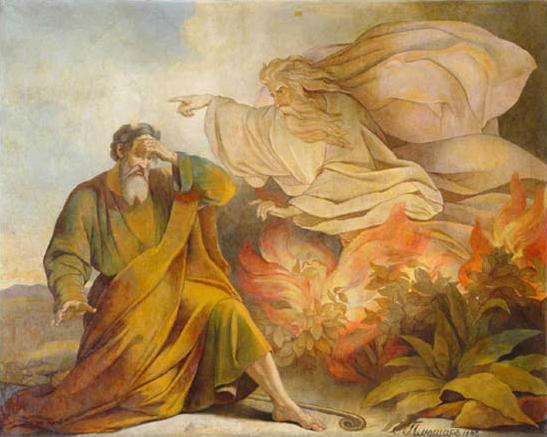
Moses_PluchartHe was trying to make sense of his circumstances. Why were these things happening to him? Surely there had to be some greater purpose? Maybe God was trying to tell him something?

I often hear people say these words and I always find them jarring. These words are really quite ridiculous, and very disrespectful to God.

It’s not that God doesn’t tell us things. He does. In fact, he always has. But he doesn’t have to try to do it. He’s more than capable. As if God has to try to communicate. If God wants to tell us something, he will—simple as that.

He’s not up there somewhere trying to find a way to get our attention, planning a new and improved media strategy, hoping he can finally make a connection. God doesn’t waste words. He’s not in the business of talking to himself.

When God speaks, things really happen. Big things.

God speaks and the creation comes into existence.

By the word of the Lord the heavens were made,
their starry host by the breath of his mouth.
(Psalm 33:6)  

God speaks and people are born again into a new and enduring relationship with God.

…you have been born again, not of perishable seed, but of imperishable, through the living and enduring word of God.
(1 Peter 1:23)

God’s word is not an ancient, dusty document.

For the word of God is alive and active. Sharper than any double-edged sword, it penetrates even to dividing soul and spirit, joints and marrow; it judges the thoughts and attitudes of the heart.
(Hebrews 4:12)

God’s word has the power to change people’s lives for the better.

All Scripture is God-breathed and is useful for teaching, rebuking, correcting and training in righteousness, so that the servant of God may be thoroughly equipped for every good work.
(2 Timothy 3:16-17)

God doesn’t waste a single word.

As the rain and the snow
come down from heaven,
and do not return to it
without watering the earth
and making it bud and flourish,
so that it yields seed for the sower
and bread for the eater,
so is my word that goes out from my mouth:
it will not return to me empty,
but will accomplish what I desire
and achieve the purpose for which I sent it.
(Isaiah 55:10-11)

God doesn’t try to tell us anything. He speaks, and when he does, we’d be wise to listen.

I am a church member

I Am a Church MemberI am a Church Member by Thom Rainer is a heart-warming and encouraging little book. It gently urges the Christian reader to understand and fulfil their role as an active participant in the church. Rainer contrasts the church with the image of a country club. In the club a member is one who pays their annual subscription and then feels entitled to receive certain perks and to be served by others. People come to the country club with expectations and demands. Membership of the church is more integral and organic. If we belong to Jesus, then we are already essential members of the church body, and we each have an important part to play. We are called to serve one another rather than seek to be served.

The commendations for this book run for many pages and read like a ‘who’s who’ of contemporary church leaders. But this doesn’t guarantee the merits of the book. It’s strength lies in it’s biblical foundations. Ultimately church membership is viewed as a gift from God. It comes through God’s grace in salvation through the death and resurrection of Jesus Christ. It’s a privilege, not a burden, or a set of rules to be followed.

I appreciated the way that prominence is given to love as the centrepiece of Christian relationships. The church is called to express itself in love for one another (1 Corinthians 12-14) and love is to be the hallmark of true Christians (John 13:35). Sadly, churches are easily damaged by a lack of love, disunity, gossip, and a lack of forgiveness. We are called to remember how we have been treated by Jesus Christ. He forgave the unlovely, and we are called to the same attitude.

Rainer reminds us that the word servant occurs 57 times in the New Testament and the word serve 58 times. Jesus modelled this and he called his followers to do the same. Church is not the place to have our personal preferences satisfied by others. It’s the context for putting the wellbeing and needs of others before our own.

The book finishes with the reminder that church is the fruit of the gospel. Rainer outlines how the sacrifice of Jesus Christ calls us into relationship with God. It’s the joy of salvation, rather than legalistic obligation, that will draw us into loving one another as part of God’s church.

I appreciated this book because it is short and simple (only 79 small pages). In many ways it would be a good book to offer newcomers to our churches, at the close of a welcome or orientation program, or as they are welcomed into some kind of formal membership. It is also an important book for old-comers or occasional-comers to our churches, because it urges us to look afresh at what church is really all about.

Interestingly, each of the six chapters in I am a Church Member finishes with a pledge for the reader to sign. This seemed rather counter-cultural to me. Perhaps, it’s more of an American thing, or typical of other church traditions. Whatever, the intent is clear—Rainer wants to encourage the reader to act on what he has written; to make a difference in our churches. And so we should!

Life’s for the living

Recently I’ve been listening to a fair bit of Passenger. I love the music and the poetry of the lyrics. One song goes:

Don’t you cry for the lost
Smile for the living
Get what you need and give what you’re given
Life’s for the living so live it
Or you’re better of dead

Life is for living, and I feel so privileged to have spent a few days camping by the ocean. There’s something about being outside, under the trees, by the sand and the sea, to make you feel alive. I thank God that I’m alive and for the treats He’s given me over the past few days:

Time with my son away from the TV.
Swimming in the glassy ocean, hiding from the hot northerly winds.
Watching a young seal playfully skimming through the waves.
Learning to catch bream and spending forever cleaning, filleting, barbecuing, and eating them.
Rocking gently in the hammock to the sound of the wind in the trees and the surf on the beach.
Soaking up the sunsets.
Sitting by the campfire, shifting my gaze from the flames to the moon and the stars.
Talking to my Father in heaven and thanking him for life.

fire sunset burrillsunset bream

Let’s stop going to church

CrowdGoing to church

Is it like…

Going to school
Going to hospital
Going to the beach

Going to the movies
Going to the markets
Or going to the football

No

Church is not a building
Church is not an institution
Church is not a spectator sport
Church is not a compulsory ritual
Church is not a task to be completed
Church is a gathering of people who belong to God

Let’s stop going to church and start being the church

They don’t just come around

weddingA good friend once said that wedding anniversaries were more significant than birthdays. He made a good point that I’ve since repeated to others. Birthdays just come around year after year. You don’t need to do anything. Whereas wedding anniversaries take work. You need to keep investing in the marriage or you might not get to your next anniversary.

Yesterday was my birthday and I received many wonderful greetings—mainly via Facebook, the new greeting card! Many of the comments were very similar and they made me stop and think about whether he was entirely right. Let me share a few:

Happy birthday Macca! Praise God for another year. Hope you have a great day!

have a great day… thanking the Lord you’re still here with us and for your ongoing ministry…

Happy Birthday Dave! It is wonderful to celebrate another year!!!

Happy, happy birthday! Thanking God for the gift of the last 365 days and all that has happened since your last trip around the sun. Lotsa love

Happy birthday Dave! Thanks to God for another one!

Happy birthday cus! Glad you’re here to see another one.

Happy Birthday! May God bless you! And give you many more!

What thankfulness that you can celebrate another birthday! Have a great one!

Happy birthday Dave! Thanks to God for another one!

Happy birthday Macca! Glad God gave you another one.

I don’t expect everyone receives birthday greetings like these. I’d describe them as joyful and thankful, with significant undertones of sobriety. They are a reminder that birthdays don’t just come around. There were no guarantees last year that I’d celebrate another this year. Mind you—there aren’t ever any guarantees, for me or for you. I see the last year as a gift from God. It’s his grace that has preserved me for another year.

And I’m praying that his grace will sustain me for many more birthdays—and wedding anniversaries—for years to come.

Thanks for all your greetings!