Recommended reading (May 13)

readingWhy these 66 books? by Nathan Busenitz is a simple and clear introduction to understanding the canon of Scripture. This article helpfully anchors the basis of defining the biblical canon, not in church councils or decisions, but in Jesus Christ himself.

On the path to the cancer ward by Jean Williams instantly grabbed my attention. Not simply because I know this scenario well, but because I am always encouraged and occasionally rebuked as I read Jean’s sympathetic reflections on suffering in the light of God’s Word.

How to shut down gossip by Erik Raymond tackles the perennial problem of gossip among God’s people. I suspect gossip is one of the respectable sins that we either consider to awkward to address, or don’t want to tackle because we enjoy it too much. If you are wondering, I think ‘RPG’ stands for rocket propelled grenade!

Making Meetings Effective is something we all want to do. I keep hearing people in all walks of life, including and especially churches, lamenting the frustrations of unproductive meetings. Craig Schafer reminds us of the importance of two often neglected tools.

Recommended reading (April 28)

readingFrom time to time I plan to link to some helpful articles and ideas that I’ve been reading, This is my first instalment…

Contentment (1) At a time like this by Jean Williams is the first in a 10 part series on Christian contentment. Jean writes will clarity and a deep understanding of the implications and joys found in trusting Jesus.

Five pieces of advice for young men by Con Campbell is sage advice for men of all ages who are seeking to grow in the likeness of Jesus.

Six myths of discipleship by Col Marshall helps us to see that discipleship is the essence of being Christian, rather than a particular process for a select few.

Seven Basics for Better Staff Meetings by Eric Geiger offers helpful tips for improving those meetings we all love to hate.

Terminally optimistic

What wonderful words…

terminally optimistic

So much better than terminally ill. This is how Linnea Duff describes herself. Linnea was diagnosed with lung cancer in 2005, they discovered her ALK mutation in 2008, and she has been on a succession of clinical trials and targeted therapies since then. This year marks 10 years of living with cancer. So encouraging!

Rejoicing in lament

Todd Stern’s review of Rejoicing in Lament by J. Todd Billings. This review first appeared on The Gospel Coalition website on 18 March 2015.

rejoicingWhen Christians are confronted with significant tragedy, we are often reminded of Paul’s words to the church at Philippi: “Do not be anxious about anything. . . . [There is] a peace that passes all understanding. . . . I can do all things through Christ who strengthens me” (Phil. 4:6, 7, 13). While all this is wonderfully true, less often do we hear the line that immediately follows: “It was good of you to share in my troubles” (Phil. 4:14).

Dealing with our own troubles and sharing in those of others are among the most challenging aspects of the Christian life. It isn’t always easy to weep with those who weep (Rom. 12:15). Foolish and insensitive things get said by well-meaning folks. J. Todd Billings’s excellent new book, Rejoicing in Lament: Wrestling with Incurable Cancer and Life in Christ, will go a long way in equipping us to endure and to minister to one another in more theologically grounded and helpful ways.

How does Billings, professor of Reformed theology at Western Theological Seminary in Holland, Michigan, accomplish this task?

Writing from the Cauldron

If you’ve ever heard the harrowing words, “You have cancer,” you will quickly realize that Billings has “street cred.” He isn’t writing from a position of dispassionate analysis but rather from the cauldron, speaking openly and honestly of his experience of being diagnosed at age 39 with Myeloma, a rare and incurable cancer. Throughout Rejoicing in Lament he references his CarePages, an online journal for sharing with others the progression in his own thinking as he moves from the immediate upheaval surrounding the initial diagnosis to dealing with the “new normal.”

It is instructive how well reasoned even his early entries are. Even though Billings may have been surprised by the diagnosis, he was already well versed in truth, which enabled him to find solace and comfort in the only place it can truly be found—at the foot of the cross and in the pages of the Bible. Don’t wait for a crisis to read this book—strengthen your faith now, even in a peaceful season, by building these truths into your soul.

Praying the Psalms

Billings provides excellent instruction on praying the Psalms—particularly the psalms of lament—with all the honesty, struggle, and emotion of the Spirit-breathed writers themselves. He deals with these in detail throughout the book, teaching us how to fight our fears with faith and the language of Scripture. This discipline frees us to be honest and calls us to reflect on God’s wonderful promises, even when we can’t fully understand all that’s happening to us.

Billings helpfully explains that, as with Job, God does not owe us an explanation for why he allows severe trials. There is mystery here, yet we can rely on the truth that only he fully understands our suffering. We waste precious energy when we seek answers that only reside in the secret places of the Most High (Deut. 29:29).

Helping the Church

Billings also offers practical instruction for the church in chapters 6 and 7, “Death in the Story of God and in the Church” and “Praying for Healing and Praying for the Kingdom.” These chapters are particularly accessible and illuminating. The church is the place to run to rather than avoid when experiencing suffering. Sometimes we want to “grieve in private” or don’t want others to “see our pain,” but that can be profoundly counterproductive.

I hadn’t considered Billings’s point that the church is the one place where we celebrate birth, baptism, marriage, and death—a point that reinforced to me the importance of faithful perseverance in the church from cradle to grave.

Two Small Cautions

Lay readers (like me) should know in advance that Billings is an accomplished theologian and academician. As a result, some of the book’s language may be less accessible to the typical person wrestling with a trial of this magnitude. I’d counsel readers to stick with it, however, because there’s much gold to be mined in these pages.

A challenge in writing a book so tightly interwoven with the author’s experience is that he can share what he experienced and how he handled it, yet the reader’s experience may differ. While there may be certain commonalities in all Christian suffering, changing just one variable in a trial can make a world of difference experientially. Therefore, there cannot be a “one size fits all” approach. Questions that surface for some won’t rise for others. New and different questions may demand fresh and distinct responses.

I, too, have been diagnosed with incurable cancer. Even as I write this review, my chemo regimen is changing after 34 rounds because the tumors are continuing to grow. Additionally, today is the six-month anniversary of my wife’s death from her incurable cancer. I don’t have exactly the same struggles or questions as Billings: the “why” question hasn’t bothered me as deeply; I haven’t really experienced anger at God; and I find peace in the certain knowledge that he’s promised to “never leave us or forsake us” (Deut. 31:6, 8; Heb. 13:5). Billings implies at times that this sort of response is dangerously close to blind stoicism—but it might just be how God has prepared me to endure this trial. We all experience and respond to affliction in slightly different ways, and that’s okay.

Caught Up into His Story

All Christians can agree with Billings when he writes:

Even when we feel left in the dark, even when suffering and death seem senseless, we are empowered by the Spirit to groan, lament, and yet rejoice. God’s promise is trustworthy, and this same Spirit has united us to Christ, through whom we are able to call out to the Father as adopted children. We rejoice, we lament. In all of this, our own stories are not preserved in a pristine way; we are displaced (“I am not my own”) and incorporated into a much larger story—God’s story in Christ. (p170)

That message of truth needs to be heard loud and clear throughout the church, and Billings brings it home in a brilliant and powerful way. Whether you are walking with someone who is suffering, you are suffering yourself, or you want to be prepared to suffer, Billings can lead and guide you to do so in a God-honoring way.

Leaders eat last

leaderseatlastLeaders eat last: Why some teams pull together and others don’t by Simon Sinek is a thoughtful analysis of many of the problems created and experienced by leaders and organisations in today’s world. It contains case studies, research, and biological and anthropological explanations for why successful organisations are those that create strong and safe communities. While this book is longer than it needs to be, and possibly over reaches in its biological and evolutionary claims, there is much to learn and relearn in this analysis of human interaction. Leaders of all types, whether in families, business, churches, government or other organisations, will do well to review their leadership in the light of Leaders eat last. I’ve personally found many points for reflection as I’ve be pushed to evaluate my leadership and the organisation (church) that I lead.

While the title is a metaphor for selflessness, it resonates literally with me. In 2002, as I became the team chaplain for the Brumbies Super 12 Rugby Team, I met the assistant team manager, Garry Quinlivan. ‘Quinzo’ is a retired customs officer who devotes his time to serving the Brumbies players and staff. He works without pay, spending long hours preparing, cleaning, checking up on, and sacrificially caring for everyone. Many things stand out about Quinzo, but one thing has struck me over the entire time I have watched him at work—he always eats last! Whether it’s a social BBQ, a drinks break, team lunch, or celebrating after a win—Quinzo always eats last. He gives everything for the team. And, in turn, people love Quinzo—they would do anything for this man.

Leaders eat last has constructive advice to leaders who preside over toxic work places. Watch how you lead—you may be the problem! Though of course, many selfish leaders would never consider themselves at fault. They don’t pause to reflect on the climate they are creating. The push for profits, the obsession with numbers, and the focus on short-term results mask the damage many leaders are doing to people. And then they wonder why their outcomes and results are so poor.

Sinek makes much of the importance of creating a circle of safety in the organisation. This idea is taken from Aesop’s Fable:

A lion used to prowl about a field in which four oxen used to dwell. Many a time he tried to attack them; but whenever he came near they turned their tails to one another, so that whichever way he approached them he was met by the horns of one of them. At last, however, they fell a-quarrelling among themselves, and each went off to pasture alone in a separate corner of the field. Then the Lion attacked them one by one and soon made an end of all four. (p20)

When we are part of a strong circle of safety, we naturally share ideas, burdens, successes, and we build a culture of collaboration, trust, and innovation. Good relationships are key to people surviving, let alone flourishing. A healthy organisation will be built on good relationships between colleagues. People grow in their trust for one another and become willing to do more for each other and the organisation. By contrast, organisations characterised by suspicion, fear, and distrusting micromanagement, are destined for decline and failure.

Sinek suggests a number of strategies that leaders can adopt to build a healthy, positive, relational culture in their organisations:

Rule 1: Keep it real—bring people together. Efficiency doesn’t always equal effectiveness. Emails, intranets, and on-line people management systems won’t necessarily build deep, trusting relationships. Trust is not formed through a screen, it is formed across the table. It takes a handshake to bind humans … and no technology yet can replace that. There is no such thing as virtual trust. (p111)

Rule 2: Keep it manageable—obey Dunbar’s Number. Anthropologist Robin Dunbar has found that people are not able to maintain close relationships with more than 150 people at a time. Traditional societies around the world tend to be organized in groups of 100 to 150. Larger groups require clear lines of organisation and specialist care to encourage cooperation and healthy relationships to develop. I suspect it is no accident that many churches seem to get stuck, never growing much beyond 150 people.

Rule 3: Meet the people you help. Fund-raising workers who have personal contact with the people they help have far more success. We work harder and better when we can see our potential impact. If we are focused purely on names and numbers, then morale drops and the organisation suffers.

Rule 4: Give them time, not just money. Research has shown that we place a higher value on time than money. Giving time, attention, and energy builds relationship, fosters community, creates trust, and encourages loyalty.

Rule 5: Be patient—obey the rule of seven days and seven years. Building relationships of trust takes time. Gauging someone’s fit in an organisation or in a relationship takes longer than the time that we typically give it: ‘more than seven days, but less than seven years’.

Sinek teaches that becoming a leader involves the key ingredients of love and trust. Leaders must model and grow organisations shaped and characterised by care and strong relationships. They should work to provide safe environments for their workers to enjoy being productive.

It’s not hard to see the relevance of this book to many workplaces and community organisations. Many of us have experienced difficult work environments where the CEO or the boss is a large part of the problem. The drive for profits often leaves a wake of departures and problems for the organisation.

As a pastor, I see a number of lessons for myself and my colleagues. If churches focus on growing numbers, budgets, buildings and the like, then we can forget that we should be primarily about the love of God and a love for people. I’m called to put others before myself—to be a leader who eats last. Jesus is the great example of the one who did not come to be served, but to serve, and to give his life as a ransom for many (Mark 10:45). In a sense, I don’t need the wisdom of Sinek—I need the vision and example of Jesus. However, it doesn’t hurt to be reminded by whatever means. If God can teach people through an ass, then he can certainly challenge me through a popular leadership book!

The sad reality is that there are too many people who’ve been hurt by their churches. I regularly meet people who feel they have been neglected, rejected, abused, or betrayed by their church or their leaders. This many be a one-sided analysis (it’s much easier to see how we’ve been hurt, than how we might have hurt others) but it’s a reminder to stay in touch with what the church is intended to be—the body of Christ, shaped by his love.

Leaders eat last has encouraged me to do some self-reflection. Is my leadership offering care and protection to those entrusted to me? Are we building a church community where it is safe to be weak and vulnerable? Are people more important than processes? Is maturity more valued than money? Where are my blind spots as a leader? What do I need to change or work at?

Christians get depressed too

depressedtooLast week I attended a half day seminar on mental illness. It was aimed especially at Christian workers, offering an introduction to the prevalence and complexity of depression in particular. It sparked my interest to refresh my understanding and delve a little deeper into this troubling matter. ‘Depression’ can be a polarising issue among people in general, and there are particular dividing lines among Christians. There are different schools of thought about what it looks like, how and why people become depressed, and what should be done to help people with depression. Christians get depressed too by David Murray is a short book (112 pages) that is well worth reading. It shows a good understanding of the complexity of this issue and argues for a decrease in dogmatism and an increase in humility.

Murray urges us to avoid simplistic extremes when considering the cause of depression. He demonstrates how Christian analysis has fallen into three camps: the cause is all physical; the cause is all psychological; or the cause is all spiritual. The problem with these positions is the word ‘all’. We are complex beings and it is unlikely that one factor alone can be found that explains the cause of depression. In the case of spiritual factors, Murray argues that spiritual problems are more likely to be the result rather than the cause of depression. This is not to rule out spiritual factors sometimes being the cause of depression. But we are urged not to jump to this conclusion any more than we would assume spiritual factors to have caused headaches, cancer or asthma. The second chapter of this book offers some helpful analysis of the approach and writings of Jay Adams and also the modern Biblical Counselling Movement.

This book seems especially aimed at helping the person who believes that having depression is incompatible with being a Christian. Murray shows how this is not the case, and provides biblical evidence for depression and faith in God coexisting in the one person. The book of Psalms illustrates this, with approximately one third of the Psalms demonstrating depressed thoughts and feelings.

Many factors can be involved in depression: life circumstances; unhelpful thought patterns; negative emotions and feelings; bodily symptoms; and changes to behaviour and activity. Acknowledging the complexity of causes and the variety of symptoms, alerts us to the benefits of a multifaceted approach to helping a depressed person. Murray suggests making helpful adjustments to our lifestyles in the areas of routine, relaxation, recreation, sleep, diet, and the like. He recommends addressing our thought processes and assessing our feelings. If making these adjustments doesn’t fix things, then he recommends seeking out trained medical help and possible medication. He also urges us to correct spiritual consequences and, where appropriate, spiritual causes of the depression.

The last chapter gives some good advice to non-professional caregivers. We are urged to learn more about the nature of depression, and there are some useful recommendations for further reading. Murray calls for sympathy for the person suffering depression. However , in my opinion, what he describes might be better described as empathy. We don’t all need to experience depression ourselves to be able to help those who do. Secrecy and stigma are among the problems to overcome in caring for a depressed person. There’s helpful list of things not to say to someone who is depressed. And there is an important section on helping someone who may become suicidal.

There are no easy answers and no quick fixes when it comes to depression. Ongoing support and understanding are required to be helpful and this book is a useful tool for becoming better equipped at both.

10-10-10

10-10-1010-10-10 by Suzy Welsh is a very simple and very practical decision making tool. It revolves around asking three simple questions: When faced with a dilemma, stop and ask, “What will the consequences of my options be in 10 minutes, 10 months, and 10 years?”

This approach helps broaden the variables in complex decision making. It enables us to tap into our values and focus on our goals as we face the immediate crisis of making a decision. Some choices have long ranging consequences and other do not. 10-10-10 helps us weigh the different consequences of our decisions.

10-10-10’s applicability is wide ranging. “From college students to busy mothers to senior business executives, from artists to government administrators to entrepreneurs, 10-10-10 has shown its effectiveness in decisions large and small, routine and radical, changing lives for the better at home, in love, at work, and in friendship.”

While I appreciate the power of this decision making tool and recommend it to others, it doesn’t go far enough. And I mean more than extending it to 50-50-50, to enable decisions to be made with ‘whole of life’ implications considered.

As a Christian, I believe that we all make decisions with eternal consequences. Choices made today and tomorrow will have implications for more than this life alone. If I choose to shut God out of my life for the next 10 minutes, and the next 10 months, and the next 10 years, then I run the risk of distancing myself from God for all eternity. My choice is to trust God with the complexity of day to day, month to month, year to year decisions. I believe that God has secured my eternity through Jesus Christ and that every decision I make should reflect this reality.

The words of John Newton, in his famous song Amazing Grace, come to mind:

When we’ve been there 10,000 years
Bright shining as the sun
We’ve no less days to sing God’s praise
Than when we first begun

Let’s make our decisions by weighing up the consequences for 10 minutes time, 10 months time, 10 years time, and 10 thousand years into eternity. I’d love to cooperate with Suzy Welch in a Revised Edition called 10-10-10-10!

Comms are back

My computer just gave me a message…

Welcome back Macarisms!

Obviously a smart aleck Macbook Pro making the comment. But the truth is, I’ve written just three posts on this site since October 2014. So here comes a change.

My plan, God-willing, is to return to spending a bit more time reading, reflecting, and writing. Much of my bookwork in 2015 has been focused around planning, preparing, and preaching at Stromlo where I’m a pastor. Meanwhile, the pile of ‘unread good stuff’ gets higher and higher, and the space where I cram all the ‘I must write something about thats’ gets messier and messier.

My plan is also to repent of a personal pride—the pride of only allowing Macca’s stuff on macarisms.com. To be honest, I’ve found much value in the links, posts, and tweets of others. And much of the best stuff I’ve found gets passed on by a friend of a friend of a friend. So I plan to relax and pass on a few gems from time to time.

A picture seeing as it’s Seniors Week!

welcomeback

Ministry on holidays

I know I’m on holidays, and I didn’t plan it this way, but the beginning of 2015 has offered a number of opportunities for ministry. On Sunday 4th January I had the opportunity to preach on Hebrews 10:19-25 at South Coast Presbyterian Church and warn people of the dangers of making new year’s resolutions that focus on personal achievement. Typically on new year’s eve we decide how we’re going to work harder, but God is calling us instead to rely deeply and continuously on the completed work of Jesus. That night I was also interviewed on 2CH about Hope Beyond Cure.

During the following week I was interviewed by a leader of the Next Gen conference who drove down to the South Coast to ask me questions about suffering and hope in the gospel. I sat in front of my tent and answered questions for about an hour, so that he could edit the material into three 5 minute segments to use at the conference this week. Someone sent me a tweet saying they were at the conference and were encouraged by the interviews.

On Saturday we travelled to the Central Coast to celebrate my mother’s 80th birthday. It was a joyous occasion and good to see family again and meet my new niece, Annabelle. We stayed with Jim and Lesley Ramsay and as usual found them a great encouragement. On the return trip we dropped Marcus at the airport so that he could head to the Gold Coast to catch up with friends he made at the CMS MMM camp this year. He’s been preparing Bible studies to do with his friends during this time.

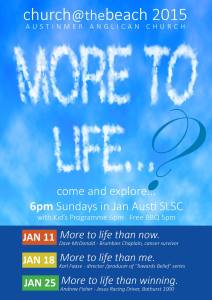
moretolifeOn the Sunday I spoke at the first of the Church@theBeach events for Austi Anglican. I had the opportunity to share something of my journey with cancer and to speak of my hope in the resurrection to come. Afterwards I met a woman who had just discovered she had metastatic cancer and had recognised her need to work out the big issues of life, death, God, and the life to come. I will be praying for her.

Next weekend we are looking forward to our son, Marcus, getting baptised here at Burrill. If you are down near Burrill at 3pm on Sunday you’d be very welcome to join us.

Our 31st anniversary present

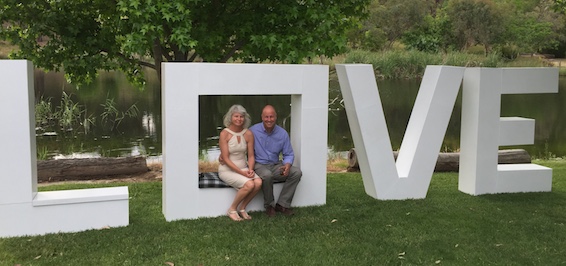
loveWe received a wonderful wedding anniversary present this morning—yesterday’s CT scan showed that I’m still NED! There is no evidence of cancer in my body. I don’t know why things have been going so well for me, especially when cancer destroys the lives of so many, but I’m very thankful to God. It is now over 18 months that I’ve been NED.

Do I have to continue with the chemo? Yes. Can I take a break? Yes. My oncologist was happy with the idea of me skipping two treatments over the summer. That could mean I get eight weeks in a row without the awful side effects of chemo. Awesome 🙂 We’ll need to make a decision about exactly what to do, but I’m looking forward to a bit of a break.

It’s fair to say that I have a bit of a spring in my step today. I am so appreciative to God for his loving kindness.

Marking a milestone

threeToday marks a significant milestone for me. Three years ago I was admitted to hospital with cancer and, within days, a year seemed like an eternity. Now three years, two operations, 50 cycles of chemotherapy, God’s kindness, and a lot of love from a lot of people, and I’m still here—thank God!

And thank you! For your prayers, your visits, your emails, your phone calls, your messages, your meals, your financial help, our walks, the words with friends, the motorbikes, the holidays, your feedback, your encouragement, your wisdom, your nursing, your doctoring, your acupuncture, your physio, the rugby, the camping, the fishing, the reading, the playing…

I thank God for my life! And I thank him for the solid hope of life to come!

The value of a life

I’ve written recently about our desire to see Crizotnib on the Pharmaceutical Benefits Scheme (PBS) in Australia as soon as possible. This decision must be made by the Pharmaceutical Benefits Advisory Committee (PBAC) who meet three times each year, in March, July, and November.

The PBAC is an independent expert body appointed by the Australian Government. Members include doctors, health professionals, health economists and consumer representatives. Its primary role is to recommend new medicines for listing on the PBS. No new medicine can be listed unless the committee makes a positive recommendation. When recommending a medicine for listing, the PBAC takes into account the medical conditions for which the medicine was registered for use in Australia, its clinical effectiveness, safety and cost-effectiveness (‘value for money’) compared with other treatments.

There are real difficulties knowing how to measure cost-effectiveness. The temptation is that a an expensive drug that helps a small number of patients, which is not guaranteed to be curative, will quickly be considered non-cost effective. However, when you factor in that the person or the government might be spending similar sums on other treatment; that the targeted therapy may have better medical outcomes; that it may introduce a much improved quality of life; that it may enable the patient to return to work and not experience the financial and personal costs of joblessness; and more… the equation is not simple.

And another important factor, and I do not know if this is considered by the PBAC or not—if a drug enables the person to live an extra six months, or six years, or whatever, with their family, friends, and community, isn’t this worth something. I know it is to me, and my wife, and my children, and my grandchild, and my friends, and my church, and a bunch of others.

I’ve recently met up with people from Rare Cancers Australia. They are doing a great work of helping to support people who cannot afford the treatments they need. This month they have launched a campaign called Sick or Treat. Please take a look and see if you might be able to help.

anitaPlease also watch this clip from the Today Show. Anita has the same cancer and mutation as me, and it is excellent that this is getting publicity. If you feel like lobbying the PBAC, please do. If you pray, please ask God that they will approve this drug and many others like it.

The morality of God in the Old Testament

Layout_GenesisHow are we to understand the Israelites being commanded to wipe out all the Canaanites in Deuteronomy and Joshua? What do we make of the various Psalms that call down curses on the enemies of the writers and God? Perhaps, like me you are troubled by these things (and others) in the Bible. Atheists, such as Richard Dawkins, Daniel Dennett, Christopher Hitchens, and Sam Harris, point to these things as evidence for the moral corruption of God (who they believe is really a fiction). Christians come under attack for their beliefs in a God, whom some describe as a moral monster. Some would say how can Christians criticise the recent actions of the IS in Iraq or Syria, when the Old Testament provides evidence of God’s people doing similar things, and at the behest of God?

Let me say that this isn’t really the atheist’s problem—this is a problem that the Jews and the Christians need to deal with. For the atheist, the problem is not with God, for he/she/it doesn’t actually exist, but with the people who claim to believe in God. Their criticism is fundamentally toward religious people justifying their immoral behaviours in the name of an imaginary divine being. However, for the Christian who believes that God is real, that he has revealed himself to people, and that he is involved in human history—there are real issues to consider when it comes to trusting that God is morally pure. This is an issue that I’m keen to explore further.

In considering this matter, I’ve recently read a brief book by G.K. Beale, called The morality of God in the Old Testament. The book focuses on the commands of God to destroy every man, woman and child of the Canaanites (e.g.. Deuteronomy 20:10-18) and also on the imprecatory Psalms (e.g.. Psalms 7; 35; 55; 58; 68; 79; 109; 137) which call upon God to judge and destroy his enemies.

Beale explores various proposed solutions to deal with the difficulties raised by these passages. First, he describes how people argue that wartime ethics differ from peacetime ethics. While this may be true, it doesn’t account for the commands to kill non-combatants. Secondly, he explores the suggestion that the command to kill women and children is not meant to be taken literally, but is a metaphoric way of describing a total victory over the Canaanites. Beale demonstrates that while there may be something in both these suggestions, neither adequately explain the texts.

Instead Beale offers a fivefold approach to engaging with these issues. His approach gives important nuance and perspective to interacting with the difficult moral issues of the Old Testament.

  1. God’s wiping out the wicked Canaanites as a demonstration of his justice;
  2. God’s extermination of the Canaanites as a purifying of uncleanness of the Promised Land as an Edenic sanctuary;
  3. God’s self-sufficiency and independence from creation;
  4. suspension of ethical obligation by typology and intrusion of final judgment;
  5. suspension of the law of neighbour love. (p33)

Beale argues that we need to recognise the uniqueness of the Canaan episode. It does not offer a paradigm for continued activity in the Old Testament, let alone the New Testament. Instead, it should be seen as a once-only, historic actioning of God’s redemption of Israel, as the nation enters into the land of promise. This salvation/judgment event is also to be understood as a type of what is to happen through Christ’s first and second coming.

There is more to his argument than this, but he demonstrates how it is important to allow Scripture to be understood in it’s full biblical context. The critiques of Dawkins and others show absolutely no understanding of the overall shape of the Bible or the saving purposes of God in the Old and New Testaments.

I still find the matters being described troubling, but no more so than the reality of death and the promise of eternal judgment for all who dismiss God. As a Christian I need to grapple with why God allows any suffering, evil or death, and especially with the moral rightness of God judging people for eternity. It’s sobering to remember how much my own moral failings corrupt my ability to recognise what is right and true and perfect. It’s totally presumptuous (and deluded) to think that I can stand morally superior to God, and judge him for his actions. This becomes clearest to me when I am reminded that God loved the world so much, that he sent his only Son, Jesus, to die in our place, so that all who trust in him will not perish but have everlasting life. Such is the moral character of God.

How can I be sure?

sureJohn Stevens’ little book, How can I be sure? And other questions about doubt, assurance and the Bible is definitely one that I will be recommending to others. It’s clear and simple, without being simplistic; it’s empathic and it uses the Bible well. The author understands that doubt is a complex beast, displayed in a variety of forms, and arising from many different causes. I personally found the book to be inspiring and reassuring. It resonated at times with my experiences of doubt, and some of the causes; and it took me to the places where I’ve found reassurance. While recognising that everyone’s circumstances are different, my prayer is that it will do the same for others. All in all, this compact book is one of the better books on doubt and assurance I’ve read.

If I’m going to engage with a book dealing with these topics, I want to know that the author has a firsthand personal understanding of the matter—and Stevens does. He writes about the impact that his father dying of lung cancer had on his faith. It rocked his world, not simply as an intellectual challenge to the goodness and sovereignty of God, but with personal pain and experience. He took some years to recover from the anguish of this time. Stevens has also explored these issues with many in his church over the past twenty years. This has helped him to grasp the different forms that doubt can take in people’s lives, and to apply his thinking to how the Bible helps each one. The book engages the reader by presenting a mix of personal stories of doubt. People have trouble believing due to their struggles with personal sin, unanswered prayers, the challenge of other religions, relationships with people who have different belief systems, God seemingly remote or out of touch with this modern world, feeling overwhelmed by all around who don’t hold the same beliefs, or questioning whether their ‘conversion experience’ was real. Recognising this complexity is so helpful, and many more scenarios could be added, because doubt is not a one-size-fits-all phenomenon. Doubt could mean a lack of certainty about the future, or a questioning of what we believe, or a lack of assurance, or unbelief. The first three types of doubt will likely be common experience for all Christians and if they are unchecked they can lead to the more dangerous position of unbelief. This book helps us to engage with our doubts as part of the normal experience of living as a Christian.

So if you are reading this book because you are struggling with a problem of doubt at the moment, be encouraged! The fact that you doubt does not mean that you can’t be a Christian. “Doubt” is not the same as “unbelief”. However, you can’t afford to ignore your doubt, treating it complacently or just hoping that it will go away. You must deal with it so that it does not develop into unbelief, and use it as an opportunity to develop a more confident, resilient and mature faith. (p18-19)

Stevens answers the important question “How can I be sure that I’m really a Christian?” by pointing not to us, but to God’s love for us in Jesus. There are dangers in becoming too introspective about this issue. We can end up placing confidence, or lack of, in ourselves rather than the gospel. If we base our assurance on a response we previously made at church, or at a Simply Christianity course, or on a university camp, or an outreach event, this can lead to a misplaced and false assurance. We are not made right with God because of our response, but because of God’s gracious work in Jesus’ death and resurrection on our behalf. For me, who had made decision after decision to become a Christian (again) in my teens, it was realising the truth of Romans 5:8-9 — that Jesus had paid for my sins past, present and future — that led to my assurance before God. While this book generally leads us away from introspection, it does call us to examine the evidence for our lives being changed. The Bible pushes us to look for evidence that our faith is real and we should expect to see our lives changed by the Spirit of God at work within us. On three occasions, Stevens recommends that we keep a spiritual journal to chronicle the evidence of God working in us and changing us. I must admit that I worry a little about this strategy. It’s not that I’m opposed to journalling, it’s more that documenting our experiences will always provide fickle evidence at best. I’d recommend that if we’re going to journal, we spend even more time documenting the promises of God that we discover in  the Bible. God’s promises remain trustworthy, whereas my experiences lead me here and there. If I want clear evidence that God loves me, then I need to look at the cross, not what happened in my life last week or last year. As Martyn Lloyd-Jones describes in his book Spiritual Depression, after looking at Psalm 42-43, we need to spend more time speaking to ourselves (about God), than listening to ourselves (about why God is absent or doesn’t care). The chapter on overcoming doubt is practical and helpful. Stevens recommends the following strategy:

  1. Admit that you are struggling with doubt and seek help.
  2. Come to Jesus for help with your doubt.
  3. Seek the help of mature believers with your doubt.
  4. Identify the root causes of your doubt
    1. Doubt rooted in our bodies: Physical causes of doubt.
    2. Doubt rooted in our minds: Intellectual causes of doubt.
    3. Doubt rooted in our hearts: Experiential and emotional causes of doubt.
    4. Doubt rooted in our spirits: Spiritual causes of doubt.
  5. Addressing the causes of doubt.

In the end, the Christian faith stands or falls on whether Jesus really was the Divine Son of God who took on human flesh, was crucified and rose again after three days. If this really happened, then we can be sure that God exists. We can know what God is like because Jesus fully reveals him to us. We can be sure that the Bible, both Old and New Testament, is true because Jesus tells us so. We can be confident that God is love, and that he will accomplish his good purposes for his people. We can trust that our sufferings are part of his good plan for us, even though we may not understand how, because we can see that Jesus entered into glorious new life after suffering on the cross. We can trust that Jesus will return to bring true justice and remake our broken world. If we can be confident about Jesus, then this is the basis from which we can address all our doubts. (p71-72)

This book will point you to Jesus as the basis of your assurance and the antidote to your doubts. Any book that does this is worth a read, I reckon.

Be the best bad presenter ever

I’m a regular preacher (again) and I’ve preached my fair share of dud sermons. Mind you, I’ve also listened to plenty of dud talks from others. What gets me most is when there’s a disconnect between the message and the medium, or the message and the messenger. It’s difficult to listen to an important message that completely lacks passion. It’s frustrating to have to fight to understand where the talk is going, when there doesn’t seem to be any logic or coherence to the message. It’s deadening to listen to the speaker drone on and on without changing pitch or tone or volume or speed.

badpresenterBe the best bad presenter ever: break the rules, make mistakes, and win them over by Karen Hough caught my attention. It sounded like a book that might have something useful to say to preachers and presenters alike… and it does. Hough critiques 14 rules that are commonly given to public speakers and shows how they can actually get in the way of good communication. She speaks of the respected rules for speaking and why you should break them—mercilessly. This book is built on the conviction that you are part of the message. People want to connect with you, not a proxy of you. If they know you care deeply about your message then they will forgive your clumsiness and mistakes. Passion overrides technique.

I will list the rules Hough says to break, and follow each with the alternative:

  1. Your purpose is to give a good presentation
    “Good” is to a presentation like “fine” is to a compliment. Your purpose is to make something happen!
    What purpose does your presentation serve? Having a searingly clear purpose will filter out all the silt from your presentation. Think of the purpose as the destination—the outcome of your presentation. What do you want to have happen? What change will come from you taking the time to talk to these people? (p15)
  2. Give informational presentations
    That’s about as exciting as watching grass grow. Take action!
    Remove inform from your list of acceptable actions. Replace it with words such as motivate, convince, teach, inspire, anger, entertain, invigorate.
  3. Practice in front of a mirror
    Mirrors are just a one person show. Practice often, out loud, and on your feet.
    Why would you want to submit your audience, and that critical speech, to your first unpleasant dry run?” (p32-33)
  4. Picture the audience in the underwear
    Stupid visuals distance you. Connect with your audience. Who really wants to visualise Bob from accounting in his underwear?
    You’re not there to impress your audience with how remarkable you are; you’re there to communicate with them. Become more “audience involved” and less “me involved”. Self-consciousness results from too much attention to yourself, which puts others—your audience—in the background and you in the front. (p42)
  5. Open with your introduction and close with questions
    Like a dreaded college lecturer. Bookends will hook your audience and send them out singing.
    People form opinions of others within the first seven to thirty seconds, so a hook must grab people’s attention right away. Give people a reason to listen. Use the power of repetition to teach your main points. Finish with what you want your audience to take away. The risk of finishing with questions is they can take the audience anywhere and completely away from your talk. If you take questions have a closer afterwards.
  6. You either have confidence or you don’t
    That’s bogus. You can teach your body confidence. And your body is your most powerful tool.
    Hough comments on research that shows how by changing our bodies we control chemicals that affect our confidence. Body language and tone of voice are both critical features of good communication. (By the way, this is why email is such a poor communication tool for influencing others. It has neither body language or tone of voice.)
  7. What you say is most important
    It’s how you say it that matters.
    I don’t agree with this contrast. It’s a ‘both/and’ rather than an ‘either/or’. Truth matters, but so does how we communicate truth. Hough talks about the tools of articulation, volume, pitch, timbre, speed, connection to breath, and silence.
  8. Scan the back wall to simulate eye contact
    Scanning is fake.
    Far better to plant a friend in the audience and make regular contact with them—especially if they agree to smile at you regularly!
  9. Stand behind the podium
    Podiums are really, really awful.
    Body language is important. People want to see you, not a piece of furniture, so step aside and feel free to move around.
  10. Explain each topic
    Tell stories! Stories are the most powerful way to share information.
    Why does this remind me of my good friend Chappo! He was the master story teller, and as he did he explained his topics better than most. People like to hear about people rather than concepts. When it comes to preaching, stories are an excellent way of showing how it all works.
  11. Have all your bullets on PowerPoint slides
    Bullets are so called because they kill good presentations. PowerPoint numbs the brain. You are the presentation.
    Personally, I loved this chapter! I’m over PowerPoint. PowerPoint is a scourge—on our ability to communicate effectively and keep an audience awake. Worse yet, it has become a substitute for us. (p97) PowerPoint is a lot like email: it’s a perfectly good tool that should make our lives easier, but it’s become a time-sucking, efficiency-mauling monster. (p98)
    If we are going to use PowerPoint, Hough recommends three simple suggestions:
    10/24 Only ten words per slide, and never smaller than 24pt font
    Don’t read your slides. Your audience is quite capable. Use them to illustrate.
    Prefer pictures to words. They will stick in people’s minds.
  12. If something goes wrong, act like nothing happened
    Everyone knows what happened, and ignoring it is weird. Acknowledge it, deal with it, and move on.
  13. Ignore your nerves, and they will go away
    Only zombies never get nervous. Nerves are good—breathe and embrace them.
    The truth is, nerves are a great bad thing! They are the body’s way of telling you that you care, that this is important. (p115) A helpful strategy for coming our nerves was developed by Dr Andrew Weir: breathe in through your nose for 4 seconds; hold that breath for 7 seconds; release the breath through your month with a whooshing noise for 8 seconds. This technique is used to help your body calm down.
  14. Control you emotions at all times
    Passion and emotion are okay.
    Emotional intelligence is a key concept in managing yourself as a presenter. (p121) Don’t fake it, and don’t be controlled by it, but expressing your true self appropriately to the context is important.

If you’ve been presenting or preaching for a while, and you have a feeling that you’re not really connecting as you should; if people complain you’re a bit hard to understand; if you don’t seem to be motivating change in people; if you think your talks could do with a tune up; then I recommend taking a look at this book.

Please put Crizotnib on the PBS. Please!

This an edited version of a letter my wife, Fiona, sent to support an application to the Therapeutic Goods Association (TGA) to ask them to please put Crizotnib (Xalkori) on the Pharmaceutical Benefits Scheme (PBS). This drug has proven results and yet is virtually unaffordable to all, at $7400 per month.

I understand you are collecting letters of support for Crizotinib being accepted on PBS. I’m not sure if TGA read submissions from individuals, but here goes…

This is not a scientific submission, but more a letter from one family suffering through a family member having ALK+ lung cancer. Whilst the TGA doesn’t court letters of submission from patients, this is an attempt to explain how TGA decisions affect individual families.

My perfectly well husband presented with a pleural effusion in Dec 11, being diagnosed with ALK+ lung cancer. He missed getting on the Crizotinib trial, because by the time we got the result, he had already received his first cycle of carboplatinum, alimta, and avastin, thus making him ineligible for the trial.
I chose this combination over what was being offered by the PBS (and our oncologist) at the time—Carbo/Docetaxel—because international research seemed to suggest it was more effective and had less severe side effects for general lung cancers.

My understanding when I spoke to the TGA a couple of years ago, was that the testing for ALK had to be passed by MSAC, with Crizotinib going before PBAC at the same time, before the TGA could consider putting Crizotinib on the PBS. My understanding is that both MSAC and PBAC have again deferred decisions as of Nov 2013. At that point they were struggling to understand who to allow ALK testing for.

As a carer for her non-smoking 49 year old Aussie husband it was pretty obvious to me, especially when he came back EGFR negative, that we should ask for and pay for the ALK test.

Looking through the ‘ALK+ roll call’ discussions on http://www.inspire.com it’s still obvious to me who should get tested for ALK. They are all younger non-smokers, who present late with stage 4 metastatic symptoms, because the original is on the periphery, not in the bronchi like standard smoking cancers. There are also histological features which are more suggestive of ALK—signet ring or acinar histology.

Our pathologist noted these on David’s histology, alerting the thoracic surgeon that this was unusual for standard lung cancer, and that maybe there was something else going on.

Surely it’s not too hard to offer ALK testing as a priority to patients in this category.

I’ve also heard that there’s new testing becoming available, which will be much cheaper, quicker, and give more of an idea as to whom to send for the more expensive testing. Hopefully, this will be commonplace soon.

In 2014, about 11550 Australians are expected to be diagnosed with lung cancer. Approximately 15-20%, or roughly 2000 people, will be non-smokers with a genetic mutation. Of these approximately 3-4 %, or 35 people, will be ALK+.

The Inspire roll call only found about 10, but obviously not everyone reads or visits http://www.inspire.com, and nor is everyone connected via a clinical trial.

We do not know of any other ALK+ patients in Canberra, but then oncologists don’t share patient information. There hasn’t been anyone else with this mutation coming to the lung cancer support group at Canberra Hospital.

But then again, how many are being tested, or not tested because of financial reasons?

I’ve just referred a younger,  unusual, possible lung cancer patient to Canberra Hospital in this last week, and I’ll be willing to find money for him through my workplace or the Eden-Monaro Cancer Support Group, if need be, because he couldn’t necessarily afford the money for testing.

As stated earlier, my understanding was that PBS approval for Crizotnib was again deferred in Nov 2013. This seemed more due to semantics than actual proof that Crizotinib did or didn’t work, or the cost-benefits of approval.

Even for intelligent people in the medical profession, it is difficult to read and understand the documents deferring approval. To read that PFS has shown ‘statistical improvement’ is hugely exciting. But to read ‘that OS hasn’t been demonstrated’—how does one prove that, except by time and death?

As a carer it’s also hard to read the statistics of overall survival and progression free survival without taking it personally. These statistics are talking about the future of my husband. He can’t read them without being overwhelmed, even though he’s been outside the statistics thus far.

It shouldn’t be up  to the patients and carers to have to trawl through these statistics to prove to the government that life is worth living, that some good quality of life is better than life cut short for lack of funding for medication that works, even if just for a limited time.

My husband has responded miraculously to an Alimta/Avastin combo for over 40 cycles, being NED for nearly a year and a half now. These treatments have cost us very large sums of money. Avastin isn’t on the standard guidelines treatment plan and the study on the benefits of adding Avastin to Alimta has not yet been released. Given that this combination has worked for my husband, he continues to endure the physical impact and financial costs until there is definitive proof that it doesn’t help.

But, we still need Crizotinib to be placed on the PBS list. Please consider the following…

1. The demand of  3 weekly cycles is hard. It’s hard for my husband to psyche himself to go to the hospital every 3 weeks to pump poison into his veins, knowing that its going to make him sick for the next week, often spending 3 or 4 days in bed. Not that the following 2 weeks till the next cycle are easy, with fatigue, headache, GIT upset, mouth/tongue ulceration, pain, acne, skin rash, itch, and more.

From early on he’s had to add in Cymbalta for peripheral neuropathy, increasing amounts of antihypertensive, pain relief, antinauseants, dexamethasone, folic acid, Vitamin B12 injections, etc.

Do they consider the cost effectiveness of paying for medications to deal with the side effects of ‘standard chemo treatment’? There is also the cost of the private chemo ward every 3 weeks.
Because Alimta or Avastin weren’t on PBS when he started, all treatment had to be done through a private hospital.

How much simpler it would be—physically, mentally, emotionally, financially—if my husband had been able to simply take a Crizotnib tablet twice a day.

2. Unfortunately chemo brain is a real phenomenon too (as is carer’s brain). His memory isn’t as good as it was, and nor is mine. The 3 weekly cycles take a toll on all our family, including the kids.

3. Furthermore, no one can tell us how long one can continue on maintenance therapy. When my husband was diagnosed, it was still being debated as to whether patients shoud go on maintenance therapy, whether it added anything. Fortunately that debate has been won and put to rest.

There are some in the USA, in the Inspire network, who’ve been on maintenance for longer than my husband (I think about 5-6 years is the longest). But how long can one continue to use non-targetted therapy, continually killing ordinary, healthy cells every 3 weeks, without doing some permanent harm, perhaps even causing further cancer. There is no answer to that question yet.

4. He’s worked part time since mid 2012, returning to full time work this year. He’s continued to pay taxes since his diagnosis, using sick leave and long service leave until returning to work, paying his taxes at the same rate as prediagnosis.

I’ve had to work more, to pay for the chemo, so now I pay even more tax. We have never applied for Centrelink help, or been able to because of our income. I understand that even the Centrelink payments are being tightened up, it has to be proven that you’ll die within 2 years, when all you really want to do is prove them wrong and keep living. Having not asked the government for help with living, are we also to be denied the cost of medication by the same government as we continue both to live and pay for medication, and pay taxes?

Has the cost benefit analysis been done on how I and my 4 children would have coped with me as a widow and them fatherless?

I’ve been willing to pay the cost of initial chemo and maintenance chemo, as opposed to what the PBS would have given us for free, because I think the cost benefit analysis of having a husband who’s alive has been worth it. But not everyone is as fortunate financially or with such generous friends or workplaces, who’ve supported us through the financial impact.

5. We’ve always been told he could go to Crizotinib once the Alimta/Avastin failed. It’s always been his next step. But it’s extraordinarily expensive, at $7400 month, now it’s off the special access scheme. Suddenly our next step is unsure.

6. Access to trials isn’t a certainty, as we’ve already experienced.
Nor is it without cost, as ALK+ Australian patients have moved cities to be able to access the trials in the few major centres that are offering them. Had we gained access to the initial phase 3 Crizotinib trial, we would have had to travel to either Melbourne or Sydney.

7. Highly regarded world class experts in the field of ALK+ Adenocarcinoma, including an Australian, recommend first line Crizotinib. The latest “Up to Date”, does so: http://www.uptodate.com/contents/anaplastic-lymphoma-kinase-alk-fusion-oncogene-positive-non-small-cell-lung-cancer
How can doctors follow recommended international guidelines, if the Australian PBS is still years behind?

It’s quite distressing to me to have to be writing this submission in support of Crizotinib, when I wrote a very similar submission (a begging letter really) almost two years ago. Nothing has changed in Australia, in those years. Except more friends, colleagues, patients have died of lung cancer.

Lung cancer continues to be one of Australia’s biggest killer. Crizotinib has been approved as first or second line therapy in so many countries throughout the world. It is normal in other countries, but for some reason we continue to drag the chain on best-practice care.

In the USA the FDA has now approved the second generation targetted therapies for ALK+ patients, both as initial and as second line treatments. We haven’t even got the first generation treatment approved as yet.

It is so frustrating that Australia is lagging so far behind. Bureaucracy seems to be holding us back unnecessarily. The irony is that Australians have been been benefitting from Crizotinib, at least since the phase 3 trial initiated in 2011.
Pfizer have been generously supplying both patients on the trials, and allowing patients to access the medication via the special access scheme until 30/6/14, when such access ceased.

Since that date, there have been at least two patients who’ve signed up to the Inspire Australian roll call for ALK+ patients who are struggling to how they can possibly afford $7, 400 per month. We should not be a country that only provides quality health care to the wealthy.

It’s enough being confronted with advanced lung cancer at a young age, let alone being faced with an unaffordable financial bill.

How many more people are either not being tested or not being treated because of financially prohibitive costs?

We can’t blame the drug company for trying to recoup some of their costs, when the Australian government has benefitted from their provision of the drug via trials and a special access scheme for two and a half years.

With the new trials investigating LDK378 initiation in both Crizotinib resistant and naïve patients in Australia, isn’t it time that Crizotinib is given government recognition for it’s important place in the treatment pathways?

Chemotherapy isn’t a one size fits all. As proven, Alimta/Avastin chemo has been a God-given, proven-thus-far combination for my husband. But it hasn’t worked for others.

Crizotinib has worked amazingly for some, but some have had resistance develop fairly quickly. The second generation targeted drugs will no doubt have similar success and failure stories. But that doesn’t mean people should be denied access to them if they can’t afford to obtain them privately.

What is obvious was that the older, cheaper drugs like Docetaxel were failures in PFS, OS, quality of life and every parameter you can think to measure them by, but they’re still held up as the ‘gold standard’ of treatment, by which to compare newer medications which aren’t designed to act it the same way, so shouldn’t be compared. This is ludicrous.

I hope this helps the application for Crizotnib to be place on the PBS.

Yours sincerely

Dr Fiona McDonald  (MB BS)

Decluttering the inbox

No Junk Mail copyI’ve spent much of the past couple of days in bed due to my three weekly chemo malaise and I feel like I’ve achieved something worthwhile—I’ve decluttered my inbox. More than simply getting hundreds of emails down to a small handful, I’ve systematically unsubscribed to dozens of regular newsletters, blogs, advertisements, and junk that fill my box every day. I have no idea how I ended up collecting many of these emails. Some were an impulse click. Some were a good idea at the time, but are no longer relevant. One or two I’ve changed the frequency from daily to weekly or monthly. People keep telling us that too much information—which often corresponds to too many emails—can’t be be doing us any good. I’m looking forward to a simpler eLife!

My cancer, my future, my request…

xalkoriI love what this man and these people are doing. He has my cancer, my mutation, and my needs for affordable treatments. Many need this drug more than me, and have no possible means to afford it. We need the Pharmaceutical Benefits Scheme to support people who would benefit so much by this drug Xalkori (Crizotnib) targeted therapy. Currently it costs around $90,000 per year. Please click on the image above to watch, and then share this hope-filled video with others.

A long legacy of caravanning

Yesterday I received this reflection from my father, who turns eighty next birthday, on his experience of life in caravans. I thought some of you might be interested in his reflections…

From time to time in recent years I have written of our movement through the stages of life—the marked changes that occur from time to time in our health, or work, or the circumstances that shape the course of our life.

This week there has occurred another change; this one effectively marking the end of an era in my life. In fact, the era of which I write is almost as long as my life. I write, of course, of my caravan experiences which have been brought to a close by the sale of our caravan of the last ten years.

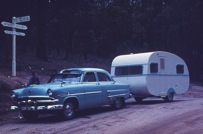
I do not remember the beginning of my life with caravans but a photograph of my brother, Graeme, and me indicates that those first experiences began before I was four years old. The first caravan was a home-made foldaway unit built onto a trailer by my father. Towed behind our 1928 Chrysler Royal motor car, it was the pre-cursor of today’s Camper Trailer. Its facilities were the most basic and our caravan park was but a clearing in the bush or a space among the dunes beside the sea. I know not how we fitted into the caravan or how we would have fared in the inclement weather which surely came our way from time to time. My memories of this early period are sparse, but they mark the beginning of a life time of holidays in which we took our home with us behind the car.

In the late 1940s, “after the war”, my father purchased the first of several caravans which would become the base of family holidays over many years. Each one of plywood construction, each slightly larger and having a little more comfort and convenience than the previous one, they enabled us to travel further afield. The cars changed, too. The Chrysler was replaced by a 1934 Plymouth Fluid Drive, which I later purchased as my first car and re-named ‘Esmerelda’. Then in 1953 came Dad’s first new car, the Ford Customline. Our holidays took us to many parts of Victoria—along the coast east and west of Melbourne, to inland cities and towns and along the Murray River. Interstate and around Australia caravanning was still in the future for most people. For us, Victoria had much to offer and we returned often to the beaches and surf and the forest country along The Great Ocean Road.

Caravan1The second phase of the caravan experience is easy to identify. It began on 25 February 1961 when Ruth and I set off on our honeymoon, driving the Customline and towing the streamlined ‘Don’ caravan. It began dramatically when a shattered windscreen on our second day prevented us reaching our intended destination. The only parking available was at the local football ground, and the only facilities were the open-to-the-skies change rooms and their cold showers. Although this was not Ruth’s introduction to the caravan, as she had accompanied our family on several occasions, it surely was a cool introduction to marriage.

That journey took us along the unsealed Princes Highway through Gippsland and the NSW south coast to Sydney and Palm Beach where we spent an idyllic week near the Barrenjoey Lighthouse with views to both Pittwater and the Pacific Ocean. Our return was via Canberra where we spent several days exploring the still young National Capital, little knowing that fourteen years later it would become the home for our family during a very significant period of our lives. Coincidentally, exploring the centre of Canberra known as Civic, we happened on a Canberra Day event—the commissioning of the new Ethos Fountain in Civic Square.

For several years, family holidays followed a familiar pattern. Travelling from Tasmania (King Island or Longford) to the mainland, we would borrow car and caravan and head for such places as Echuca or Mildura, Philip Island or Western Victoria. Thus another generation of McDonalds was being introduced to the caravan experience.

Eventually, it was time for phase three. In 1970, whilst at Longford, we purchased from a Launceston caravan hire business, which had fallen on hard times, our own caravan, a heavy 16 feet long, 8 feet wide Millard with high flat roof. With caravan in tow behind our HR Holden station-wagon, canvas annexe and stretcher beds for the children, many accessories stowed away, and three children in the back seat, we visited much of Tasmania and enjoyed many summer holidays near the sand dunes and beaches of St Helens.  They were happy days.

There was one near disaster with that caravan. On 5 January 1975, we left our Launceston home for the last time, to travel to Devonport where the ferry, Empress of Australia, would take us to Melbourne for some holiday time before travelling on to Canberra and the Reid Methodist Church. A tyre on the heavily-laden caravan blew out just a short distance from Launceston and without a replacement tyre we could not continue. It was Sunday afternoon and shops and garages in Tasmania were not open for business. Eventually we found the owner of a small garage who was able to open his workshop and fit a replacement tyre for us. Resuming our journey, the caravan was wandering a bit behind the car. A policeman stopped us, commented on the erratic driving, warned us to take care and allowed us to continue. We arrived at Devonport just in time to be the last vehicle to join the ferry, but too late to enjoy the picnic with the many friends who had travelled to Devonport to farewell us. One of those friends noticed that the replacement tyre did not match its partner.

Sadly, a real disaster occurred that night, just a few hours into our Bass Strait crossing. News travelled through the ferry that the bulk ore ship Lake Illawarra, had collided with the Tasman Bridge, linking western and eastern shores of the Derwent River at Hobart, sinking immediately and causing a major portion of the bridge to fall. Many lives were lost and the life of the City of Hobart and its citizens was affected for long time. That date is deeply etched in our memory.

Now mainland residents, our family holidays and occasional travels took us further afield. The summer family holiday was always at the coast—Pambula Beach, Bateau Bay, and Nambucca Heads. After ten years, it was time to replace the Millard which, though very spacious, had felt somewhat like a brick wall being towed behind the car. We replaced it with a lower-profile Viscount pop-top. Later again, the Viscount gave way to a Golf pop-top. With these lighter vans we not only continued our summer holiday bookings, but travelled throughout NSW, learning much of the history and geography, and building a photographic record that now fills many albums. These caravans were frequently our home as occasionally we crossed borders into Queensland or South Australia, or travelled by various routes to Melbourne to visit family and friends.

Caravan2In 2004, it was farewell to the Golf and welcome to our first ‘new’ caravan, a Jayco Heritage pop-top. The government’s pension bonus and an extraordinarily generous trade-in on the Golf enabled us to up-grade just one more time. (The story of that purchase is itself remarkable and may become the subject of some later writing.) No longer was there need of space for family members, though the beachside holiday tradition continued at Shoal Bay on Port Stephens; and visitors were always welcomed. There were dreams of travelling further afield, including particularly the Flinders Ranges and other parts of South Australia, but some health issues for both Ruth and me, and other circumstances caused the postponement, and eventually, the setting aside of those dreams.

In recent years, the caravan travelled less, but in fact was used more. It was the occasional extra bedroom if the number of visitors stretched beyond the resources of our small home at Valley Heights. It was a private space where Norman would meet and talk with colleagues or people who sought his counsel. It was the prayer room for many years where Ruth met regularly and prayed with several women in our community.

The realization that we would not use the caravan again for holiday or travelling was hard to accept and our initial attempts to sell were unsuccessful; so the caravan came with us to our new home. The night and day after our arrival here, the area experienced a ‘one in one hundred year’ storm with much local damage. The caravan suffered serious water damage, via a broken seal in the roof. Repair work has taken many months, covered by insurance, and now the caravan has passed to a new owner.

For the writer, the caravan experience era has spanned a lifetime; for Ruth it has been a part of our life together. For me, it is an experience I have embraced with joy and enthusiasm; for Ruth, probably less so as the caravan still carries with it many of the familiar duties of domestic life. It just puts them in a more confined space. But the caravans have enabled us and our families to enjoy holidays that would not otherwise have been possible, to tour and visit parts of our country we would not otherwise have seen and to enjoy a freedom that is different from that of many holiday environments.

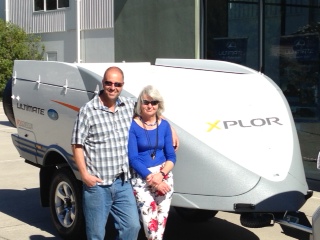
photoPerhaps for Ruth and me it is the end of an era. Family holidays have found different expressions in the next generation. Heather and her family enjoy the Canadian cottage by the lake. Stephen and his family enjoy erecting their tents in remote places. The caravan experience lives on as David and Fiona and their family have continued to enjoy the sand and surf of the coast, as well as exploring the vast outback of Australia on their several safaris. Their Ultimate Xplor Camper is more directly a descendent of the home-built fold-away caravan with which I was introduced to the caravan experience. Perhaps the era of the McDonald caravan experience has not ended, after all.

Serious hope for Adam

hope-beyond-cure

A review of Hope Beyond Cure by Adam Scott, first posted by Dave Miers

“It’s actually very serious.”

That was the last thing I wanted to hear from the doctors treating me.

An MRI had apparently revealed a large arterial tear in my neck and the consensus was that I’d probably had a stroke.  It all started feeling very serious.  I was 28 years old, laying in a hospital bed, surrounded by pensioners who were apparently healthier than I was – go figure!

It was the first time in my life that someone spoke candidly and clinically with me about the reality of dying and it was terrifying. I’d always expected dying to be a future, far-off, unfortunate but inevitable reality, but someone with more authority on the subject was telling me that perhaps my presumptions were wrong.

That’s probably why I’ve appreciated reading Hope Beyond Cure by David McDonald as much as I have. It’s a book written by a pastor who was humble enough to admit that facing death can be terrifying and perhaps our presumptions are wrong.

The opening chapters recount the events leading up to his cancer diagnosis and the emotional turmoil that followed. He talks openly about how the insidious nature of his illness filled him with fear, doubt and hopelessness. It’s a gutting and incredibly humble way to start a book about hope: in the context of a terminal illness.

Given how raw and real the book begins, you’re left with the impression that the kind of hope it’s going to dish up is going to have to be robust enough to withstand a daunting prognosis and remain relevant in the face of death. That’s not an easy task given that hope has become synonymous with wishful thinking in our culture.

For example, Ben Folds sings a song called Picture Window that talks about hope that’s cruel and inappropriate in the context of a terminal illness. He sings:

“you know what hope is,
hope is a bastard,
hope is a liar, a cheat and tease,
hope comes near you, kick it’s backside,
got no place in days like these”

Hope Beyond Cure engages with the kind of false hope that Ben Folds sings about and exposes a few of our favourite places to find it. Whether it’s in medicine, positive thinking or relationships, David gently points out that they all leave us exposed and each can be the very thing that Ben Folds describes: a liar, a cheat and a tease. They’re false hopes because none of them can promise to endure in the face of death.

Off the back of that David argues that we need something solid to anchor hope in. Because death is a serious business, we need a equally serious hope – not wishful thinking or clutching at straws. We need a serious hope that aims even higher than a cure for the illnesses that will ultimately take us, a hope that will flavour life and endure in the face of death. That’s the kind of hope that David ends up introducing when he talks about Jesus.

Hope in Jesus isn’t cruelly inappropriate wishful thinking. It’s all the things false hope isn’t: true, trustworthy and reliable. It doesn’t become inappropriate or irrelevant when we’re facing death, and because of that, hope in Jesus is worth having.

Towards the end of the book David writes this:

“I have no idea how many days, weeks or months I have before me – few of us do. Our times are in God’s hands and he alone knows when they will come to an end. But we don’t need to fear that day. In the resurrection of Jesus, God has taken away the sting of death. As Paul reminds us:

“When the perishable has been clothed with the imperishable, and the mortal with immortality, then the saying that is written will come true:
“Death has been swallowed up in victory.
Where, O death, is your victory?
Where, O death, is your sting?”

In the years that followed my injury, I’ve had countless scans. Apparently, there’s no longer any evidence of that terrifying time. I’m really glad about that, but the truth is one day something else is going to break and the wheels will fall off. That’s why I’m so thankful that real, authentic, robust hope is what I have – it’s what we need to endure in the face of death and to flavour life in the here and now.

Hope Beyond Cure says that hope is found in Jesus and I couldn’t agree more.